Prepare for the 2026 GCSE Mathematics exam with this Practice Paper 3 for the Higher Tier. This paper includes a variety of questions designed to test your understanding of key mathematical concepts, including algebra, geometry, and statistics. Ideal for students aiming to improve their calculator skills, the paper features real exam-style questions and provides a comprehensive review of the topics covered in the curriculum. Use this resource to practice and refine your problem-solving abilities ahead of the exam.
Key Points
Includes a range of GCSE Mathematics questions for Higher Tier students.
Focuses on calculator skills essential for the 2026 exam.
Covers topics such as algebra, geometry, and statistics.
Provides an opportunity for students to practice real exam-style questions.
This link leads to an external site. We do not know or endorse its content, and are not responsible for its safety. Click the link to proceed only if you trust this site.
Grade 11 Life Orientation June 2025 Exam PaperPast Paper
PDFPast Paper
Grade 11 Life Orientation Term 2 Exam Paper May 2025Past Paper
PDFPast Paper
Chemistry Unit 4A Question PaperPast Paper
PDFPast Paper
Physics Unit 5 Question PaperPast Paper
PDFPast Paper
Chemistry Unit 4 Question Paper – Edexcel International A LevelPast Paper
PDFPast Paper
January 2019 IAL Mark Scheme Paper 5 Edexcel Chemistry A LevelPast Paper
PDFPast Paper
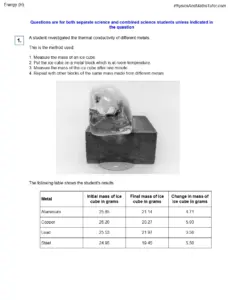
Energy (H) Question PaperPast Paper
PDFPast Paper
Cambridge O Level Biology 5090/12 Past Paper May/June 2025Past Paper
PDFPast Paper
Cambridge O Level Biology 5090/42 Paper 4 Alternative to Practical October/November 2025Past Paper
PDFPast Paper
Cambridge O Level Biology 5090/12 Paper 1 Multiple Choice October/November 2025Past Paper
PDFPast Paper
Chemistry Questions Paper – Class 12Past Paper
PDFPast Paper
English First Additional Language Paper 2 – May June 2023Past Paper
FAQs
What is the method to find the value of a car in 2025 based on depreciation?
To find the value of a car in 2025 after a 15% depreciation that reduces its value by £1,800, you can set up an equation. The depreciation amount (£1,800) represents 15% of the car's value in 2025. Therefore, if 'x' is the value of the car in 2025, the equation can be expressed as 0.15x = 1800. Solving for 'x' gives you the value of the car in 2025.
How do you calculate the density of liquid Z from liquids X and Y?
To calculate the density of liquid Z, mix 50 cm³ of liquid X with 70 cm³ of liquid Y. Liquid X has a density of 2.4 g/cm³, and liquid Y has a density of 0.9 g/cm³. The total mass of the mixture is calculated by adding the mass of each liquid: (50 cm³ * 2.4 g/cm³) + (70 cm³ * 0.9 g/cm³). The density of liquid Z is then found by dividing the total mass by the total volume (120 cm³).
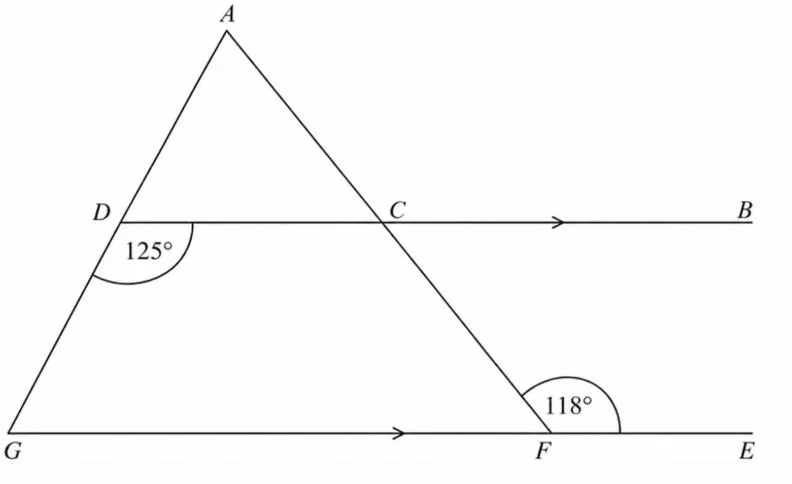
What is the process to find angle CAD in the given triangle?
To find the size of angle CAD in the triangle where ACF and ADG are straight lines and BCD and EFG are parallel, you can apply the properties of angles. Given that angle D is 125° and angle G is 118°, you can use the fact that alternate angles are equal and the sum of angles in a triangle is 180°. By calculating the remaining angles, you can derive the measure of angle CAD.
What is the formula for the nth term of the quadratic sequence provided?
The first five terms of the quadratic sequence are 4, 11, 22, 37, and 56. To find the nth term, you can observe the differences between the terms. The second difference is constant, indicating a quadratic relationship. By using the method of finite differences or deriving a general formula through pattern recognition, you can express the nth term in terms of 'n'.
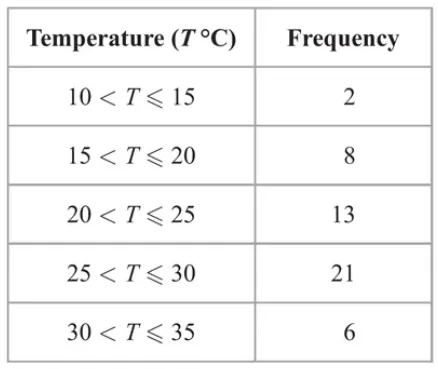
How do you estimate the mean temperature from the given data?
To estimate the mean temperature from the given data for 50 cities, you multiply the midpoints of the temperature ranges by their respective frequencies. The calculations involve adding these products together and then dividing by the total number of cities. The student’s method, however, contains an error in the final division step, leading to an incorrect mean temperature estimate.