Cambridge O Level Physics 5054/12 past paper for May/June 2024 provides a comprehensive assessment of key physics concepts. This examination paper includes multiple-choice questions covering topics such as mechanics, thermodynamics, and electricity. Designed for O Level students, it serves as an essential resource for exam preparation and practice. Each question is structured to test understanding and application of physics principles, making it ideal for students aiming to excel in their exams.

Key Points

  • Includes 40 multiple-choice questions on various physics topics.
  • Covers essential concepts such as mechanics, thermodynamics, and electricity.
  • Designed for Cambridge O Level Physics students preparing for exams.
  • Provides a comprehensive assessment format to enhance exam readiness.
Huzaifa Zeeshan
16 pages
Language:English
Type:Past Paper
Huzaifa Zeeshan
16 pages
Language:English
Type:Past Paper
276
/ 16
This document has 16 pages. Any blank pages are indicated.
IB24 06_5054_12/4RP
© UCLES 2024
[Turn ove
r
*4111481595*
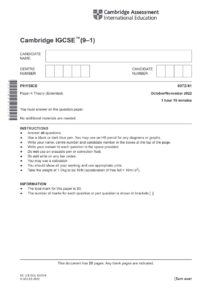
Cambridge O Level
PHYSICS 5054/12
Paper 1 Multiple Choice May/June 2024
1 hour
You must answer on the multiple choice answer sheet.
You will need: Multiple choice answer sheet
Soft clean eraser
Soft pencil (type B or HB is recommended)
INSTRUCTIONS
There are forty questions on this paper. Answer all questions.
For each question there are four possible answers A, B, C and D. Choose the one you consider correct
and record your choice in soft pencil on the multiple choice answer sheet.
Follow the instructions on the multiple choice answer sheet.
Write in soft pencil.
Write your name, centre number and candidate number on the multiple choice answer sheet in the
spaces provided unless this has been done for you.
Do not use correction fluid.
Do not write on any bar codes.
You may use a calculator.
Take the weight of 1.0
kg to be 9.8
N (acceleration of free fall = 9.8
m
/
s
2
).
INFORMATION
The total mark for this paper is 40.
Each correct answer will score one mark.
Any rough working should be done on this question paper.
2
© UCLES 2024 5054/12/M/J/24
1 What is measured using a micrometer?
A area
B current
C length
D mass
2 Two people pull on ropes to move a boat along a canal.
boatcanal
The boat moves at a constant velocity.
The vector diagram for the tension in the ropes is shown.
Which vector is the drag acting on the boat?
ABCD
3 The graph shows how the speed of a car travelling in a straight line changes with time.
Which section shows the largest acceleration?
0
0
time
speed
A
B
C
D
3
© UCLES 2024 5054/12/M/J/24 [Turn over
4 A man walks along a path from X to Y. The diagram shows the path from above.
X
Y
The man measures the distance he walks and the time taken.
Which quantity can be calculated using this data only?
A acceleration
B average speed
C average velocity
D power
5 Which property of an object determines its resistance to a change from its state of rest or motion?
A its mass
B its shape
C its surface area
D its volume
6 The diagram shows a moon buggy used by astronauts.
moon buggy
The mass of the moon buggy on the Earth is 210
kg. The gravitational field strength on the Moon
is
1
6
of that on the Earth.
What is the weight of the moon buggy on the Moon?
A zero B 35
N C 210
N D 340
N
/ 16
End of Document
276

FAQs

What is measured using a micrometer in physics?
A micrometer is used to measure length with high precision. It can accurately gauge small distances or thicknesses, making it essential in various physics experiments and engineering applications. The ability to measure minute dimensions is crucial in fields that require exact specifications.
How does the weight of a moon buggy on the Moon compare to its weight on Earth?
The weight of the moon buggy on the Moon is significantly less than its weight on Earth due to the lower gravitational field strength. The document states that the gravitational field strength on the Moon is 1/6 of that on Earth. Given that the moon buggy has a mass of 210 kg, its weight on the Moon would be approximately 35 N, compared to 210 N on Earth.
What is the relationship between speed, distance, and time in calculating average speed?
Average speed can be calculated by dividing the total distance traveled by the total time taken. In the context of the document, if a man walks from point X to point Y, measuring the distance and time, he can derive his average speed using this formula. This concept is fundamental in physics, as it helps understand motion and velocity.
What role does friction play in the motion of a box on a slope?
Friction is a force that opposes the motion of objects. In the document, when a box is moved up a rough slope, the force due to friction acts against the direction of movement. Identifying the force due to friction is essential for understanding the net forces acting on the box and predicting its motion.
How does the extension of threads relate to the load attached?
The document presents a graph showing the extension of four different threads in relation to the load applied. The relationship indicates that different materials exhibit varying degrees of elasticity and resistance to stretching. Understanding this relationship is crucial in physics, especially in material science and engineering applications.
What is the significance of Newton's third law in the context of gravitational forces?
Newton's third law states that for every action, there is an equal and opposite reaction. The document illustrates this with examples of gravitational forces acting between celestial bodies, such as the Earth and the Moon. Recognizing these forces helps in understanding the dynamics of orbits and the interactions between different masses in space.
What is the specific heat capacity of a liquid?
Specific heat capacity is defined as the energy required to heat 1 kg of a liquid through a temperature change of 1 °C. This concept is vital in thermodynamics and helps in understanding how different substances respond to heat. The document emphasizes the importance of specific heat capacity in various physical processes.