NITI Aayog, established in 2015, serves as India’s premier policy think tank, replacing the five-year planning system. This unit explores its structure, objectives, and key initiatives aimed at fostering cooperative federalism and economic growth. Topics include the Women Entrepreneurship Platform, Poshan Abhiyaan, and the Strategy for New India. Designed for students of commerce and economics, this unit provides insights into India’s evolving economic landscape and policy-making processes.

Key Points

  • Explains the structure and objectives of NITI Aayog, India’s policy think tank.
  • Covers key initiatives like the Women Entrepreneurship Platform and Poshan Abhiyaan.
  • Discusses the transition from five-year plans to NITI Aayog’s strategic framework.
  • Highlights the role of NITI Aayog in promoting cooperative federalism in India.
Sariq khan
22 pages
Language:English
Type:Textbook
Sariq khan
22 pages
Language:English
Type:Textbook
Sariq khan
22 pages
Language:English
Type:Textbook
201

Economic Environment in India – Unit 6: An Introduction to NITI Aayog pdf

/ 22
DCM1206: Economic Environment in India Manipal University Jaipur (MUJ)
Unit 6: An Introduction to NITI Aayog 1
BACHELOR OF COMMERCE
SEMESTER 2
DCM1206
ECONOMIC ENVIRONMENT IN INDIA
DCM1206: Economic Environment in India Manipal University Jaipur (MUJ)
Unit 6: An Introduction to NITI Aayog 2
Unit 6
An Introduction to NITI Aayog
SL
No
Topic
Fig No /
Table /
Graph
SAQ /
Activity
Page No
1
Introduction
-
-
3
1.1
Learning Objectives
-
-
2
Introduction of NITI Aayog
-
1
4 5
3
Structure of NITI Aayog
1
2
6 7
4
Activities under NITI Aayog
2
3
8 16
4.1
Women Entrepreneurship Platform
-
-
4.2
Poshan Abhiyaan
-
-
4.3
Strategy For New India
-
-
4.4
Methanol Economy
-
-
4.5
E-Amrit - electric mobility in India
-
-
4.6
Other Areas by NITI Aayog
-
-
5
Concept Map
3
-
17
6
Summary
-
-
18
7
Glossary
-
-
18
8
Terminal Questions
-
-
19
9
Answers
-
-
19 21
10
Suggested Books and E-References
-
-
22
Table of Contents
DCM1206: Economic Environment in India Manipal University Jaipur (MUJ)
Unit 6: An Introduction to NITI Aayog 3
In the previous unit, you learned about the economic reforms in India that helped India
reviving from the financial crisis. To help India further, the Government of India replaced the
five-year plans with the National Institution for Transforming India (NITI) Aayog in 2015.
NITI Aayog is the premier policy think tank of the Government of India, providing directional
and policy inputs. NITI Aayog designs long-term policies and programmes for the
Government of India and also provides relevant technical advice to the Centre, States, and
Union Territories.
NITI Aayog is chaired by Prime Minister and comprises Chief Ministers, legislatures and
Governors of all the States and Union Territories. Its aim is to bring the states to act together
in national interest, and thereby fosters cooperative federalism. Some of the areas in which
NITI Aayog works are Women Entrepreneurship Platform, Poshan Abhiyaan, Strategy for
New India, and Methanol Economy.
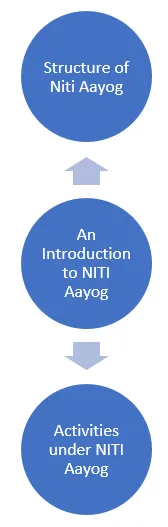
In this unit, you will learn about NITI Aayog’s structure in detail. This unit elaborates on the
activities under NITI Aayog.
1.1 Learning Objectives
After studying this unit, you should be able to:
Describe the introduction of NITI Aayog
Explain the Structure of Niti Aayog
Elaborate on the Activities under NITI Aayog
1. INTRODUCTION
/ 22
End of Document
201

FAQs

What is NITI Aayog and its main objectives?
NITI Aayog, established on January 1, 2015, is the National Institution for Transforming India. It aims to encourage involvement in the economic policy-making process. Its main objectives include providing strategic and technical advice to central and state governments, developing Centre-State coordination, and planning a vision towards national developmental priorities. NITI Aayog also focuses on strengthening cooperative federalism through structured support initiatives.
What are the key areas NITI Aayog works on?
NITI Aayog works in various key areas, including the Women Entrepreneurship Platform, Poshan Abhiyaan, Strategy for New India, and the Methanol Economy. These initiatives aim to foster entrepreneurship among women, improve nutritional outcomes for mothers and children, accelerate economic growth, and reduce oil imports and greenhouse gas emissions through methanol production.
How is the structure of NITI Aayog organized?
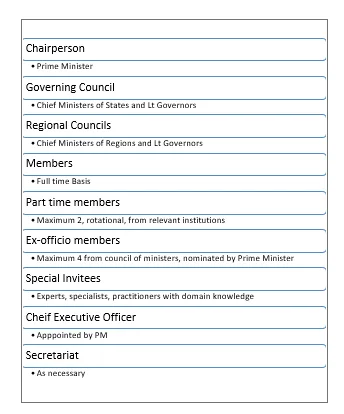
The structure of NITI Aayog includes the Prime Minister as the chairperson, with a governing council consisting of Chief Ministers of all States and Union Territories. It comprises a Vice Chairperson, four full-time members, two part-time members, and four Union Cabinet Ministers as ex-officio members. Additionally, a Chief Executive Officer appointed by the Prime Minister serves as the Member-Secretary, supported by a Secretariat.
What is the Women Entrepreneurship Platform (WEP)?
The Women Entrepreneurship Platform (WEP) is a unified access portal aimed at bringing together women from different parts of India to support their entrepreneurial aspirations. It operates on three pillars: Iccha Shakti (motivation), Gyaan Shakti (knowledge), and Karma Shakti (support). WEP provides services such as free credit ratings, mentorship, and funding support to women entrepreneurs, fostering a nurturing environment for their business endeavors.
What is the significance of the Poshan Abhiyaan?
The Poshan Abhiyaan is a holistic mission launched to improve nutritional outcomes for children and mothers. Initiated by NITI Aayog in September 2017, it aims to address malnutrition through a comprehensive strategy. Regular implementation reports are submitted to the Prime Minister’s Office, supported by a Technical Support Unit that provides research and policy assistance. This initiative underscores the government's commitment to enhancing health and nutrition across the country.
What does the Strategy for New India aim to achieve?
Released on December 19, 2018, the Strategy for New India aims to accelerate economic growth to 9-10% and transform India into a $4 trillion economy by 2022-23. It identifies constraints and suggests pathways to achieve these objectives, emphasizing the need for a conducive policy environment for private investment. The strategy document incorporates inputs from various stakeholders, including businesspersons and academics, to ensure comprehensive development.
How does NITI Aayog plan to implement the Methanol Economy?
The Methanol Economy initiative aims to reduce India's oil import bill and greenhouse gas emissions by producing methanol from high ash coal, agricultural residues, and municipal solid waste. NITI Aayog's roadmap includes large-scale production at a competitive cost, utilizing methanol as a domestic cooking fuel and in transportation. This initiative is expected to create jobs and promote environmental sustainability by providing a cleaner alternative to traditional fuels.