Agriculture in India plays a crucial role in the economy, contributing significantly to GDP and employing over 61% of the population. This unit explores the importance of agricultural production and productivity, recent trends, and government policies aimed at enhancing the agricultural sector. Topics include the impact of agriculture on national income, capital formation, and the supply of raw materials to industries. The unit also discusses modern agricultural practices and the challenges faced by farmers. Ideal for students studying the economic environment in India.

Key Points

  • Examines the role of agriculture in India’s GDP and employment statistics.
  • Discusses government policies aimed at improving agricultural productivity.
  • Analyzes recent trends in agricultural practices and technology.
  • Explores the impact of agriculture on national income and capital formation.
Sariq khan
20 pages
Language:English
Type:Textbook
Sariq khan
20 pages
Language:English
Type:Textbook
Sariq khan
20 pages
Language:English
Type:Textbook
184

Economic Environment in India – Unit 10: Agriculture in India pdf

/ 20
DCM1206: Economic Environment in India Manipal University Jaipur (MUJ)
Unit 10 : Agriculture in India 1
BACHELOR OF COMMERCE
SEMESTER 2
DCM1206
ECONOMIC ENVIRONMENT IN INDIA
DCM1206: Economic Environment in India Manipal University Jaipur (MUJ)
Unit 10 : Agriculture in India 2
Unit 10
Agriculture in India
SL
No
Topic
Fig No / Table /
Graph
SAQ /
Activity
Page No
1
Introduction
-
-
3 - 4
1.1
Learning Objectives
-
-
2
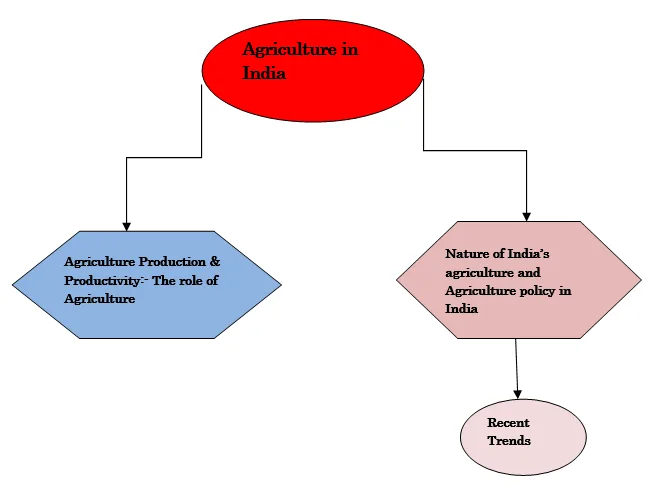
Agriculture Production & Productivity: The
Role of Agriculture
-
1
5 - 8
3
Nature of India’s Agriculture and Agriculture
Policy In India
-
2
9 - 14
3.1
Recent Trends
-
-
4
Concept Map
1
-
14
5
Summary
-
-
15 16
6
Glossary
-
-
16
7
Terminal Questions
-
-
17
8
Answers
-
-
17 20
9
Suggested Books and E-References
-
-
20
Table of Contents
DCM1206: Economic Environment in India Manipal University Jaipur (MUJ)
Unit 10 : Agriculture in India 3
Agriculture has a significant role to play in the Indian economy and the majority of the
population in the country is dependent on agriculture. The contribution of agriculture to the
total GDP of the country is at 18% and it holds an important place as the primary sector of
the Indian economy.
Indian agriculture has shown impressive growth over the last few years and it is a mode of
employment for more than 61% of India’s population. More than 44% of the geographical
area of India is used for agriculture which has resulted in a major increase in the production
of grains from 52 million tonnes to over 300 million tonnes since Independence.
Agriculture has helped the Indian economy with:
Contributing to the share in National Income
Largest sector for employment
A major contribution to resources for capital formation
Helped with providing raw material to the industries
They created a market for industrial products
The economic development of the country is dependent on agriculture and it is concerned
with the utilisation of resources, distribution, and allocation of resources needed for farming
and agriculture. Agriculture helps with providing surplus that is converted to funds that
helps with buying types of equipment needed for the economic development of the country
for the welfare of the people.
The funds are used for building roads, infrastructure, and providing for other kinds of public
services. In recent years, India has made a lot of progress and advances in the production of
agriculture with the introduction of high-yielding seeds. India has also initiated the proper
use of fertilizers and improved methods of water management systems like water
harvesting.
Agriculture has also helped with the expansion of the industrial sector since the time of
industrial revolution with the supply of raw materials. Agriculture has also contributed to
the supply and earning of foreign currency because it has contributed with its surplus in

1. INTRODUCTION
/ 20
End of Document
184

FAQs

What is the role of agriculture in India's economy?
Agriculture plays a significant role in the Indian economy, contributing approximately 18% to the total GDP. It employs more than 61% of the population, making it a crucial sector for employment. Furthermore, agriculture is essential for capital formation, providing raw materials for industries and creating markets for industrial products. It also helps generate surplus that is converted into funds for economic development, infrastructure, and public services.
How has agricultural productivity changed in India since independence?
Since independence, agricultural production in India has increased dramatically, with grain production rising from 52 million tonnes to over 300 million tonnes. This growth can be attributed to the introduction of high-yielding seeds, improved fertilizer usage, and better water management techniques. The focus on increasing agricultural productivity is vital for sustaining the growing population and meeting the rising demand for food.
What are the main objectives of India's agricultural policies?
The main objectives of India's agricultural policies include increasing productivity through better quality seeds, fertilizers, and irrigation projects. Policies aim to protect the interests of marginal and poor farmers, ensuring their income and living conditions improve. Additionally, the government focuses on modernizing agriculture through the introduction of new technologies and practices, while also addressing environmental concerns and enhancing agricultural research and training.
What recent trends have emerged in Indian agriculture?
Recent trends in Indian agriculture include the application of digital innovations to streamline processes and enhance productivity. The government has initiated strategies to mitigate climate risks, such as implementing early warning systems for flooding and droughts. Additionally, there has been a significant increase in agricultural exports, driven by favorable climatic conditions and government support, which has helped diversify agricultural operations and generate more employment.
How does agriculture contribute to India's national income?
Agriculture has been a major contributor to India's national income, accounting for over 60% of the gross domestic product (GDP). It provides livelihoods for more than two-thirds of the population, emphasizing its significance in the economy. The sector also plays a vital role in capital formation and is a primary source of raw materials for various industries, thus supporting overall economic growth.
What initiatives has the Indian government taken to support agriculture?
The Indian government has launched several initiatives to support agriculture, including schemes for providing improved seeds, fertilizers, and irrigation facilities. Programs like the Pradhan Mantri Krishi Sinchayee Yojana aim to enhance irrigation efficiency, while the Pradhan Mantri Fasal Bima Yojana offers insurance coverage for crops affected by natural calamities. These initiatives are designed to improve productivity and the standard of living for farmers.
What is the significance of agriculture in capital formation in India?
Agriculture plays a crucial role in capital formation in India, as it is one of the largest sectors in the economy. It contributes significantly to the rate of capital formation by generating surplus that can be reinvested in various sectors. Government policies are aimed at extracting surplus from agriculture to boost capital formation, which in turn supports economic development and infrastructure projects.