Two-Pass Assembler: Understanding Assembly Language Translation
Two-Pass Assembler focuses on the process of converting assembly language into machine code through two distinct scans of the source program. The first pass defines symbols and literals, while the second generates object code, resolving any forward references. This method is essential for programmers and computer science students who need to understand low-level programming and machine language. The document explains the differences between single-pass and two-pass assemblers, detailing their functionalities and advantages. Ideal for those studying computer architecture or assembly language programming.
Key Points
Explains the two-pass assembler process for converting assembly language to machine code.
Details the roles of Pass 1 and Pass 2 in symbol definition and object code generation.
Compares single-pass and two-pass assemblers, highlighting their functionalities.
Discusses the advantages of using a two-pass assembler in programming.
This link leads to an external site. We do not know or endorse its content, and are not responsible for its safety. Click the link to proceed only if you trust this site.
Understanding Spread, Pips, and Leverage in TradingPresentation
PDFPresentation
Introduction to Deriv Synthetic Indices – Understanding Synthetic MarketsPresentation
PDFStudy Guide
Passive Voice: Understanding and UsageStudy Guide
PDFPresentation
Présenter Un Projet De VoyagePresentation
PDFPresentation
History of Ethiopia and the Horn – Lecture Notes Chapters 1 and 2Presentation
PDFPresentation
Infrared Spectroscopy (IR) – Unit 5Presentation
PDFPresentation
Universal Gravitation – Physics Concepts and ApplicationsPresentation
PDFPresentation
Business Proposal Presentation: Blue Modern DesignPresentation
PDFPresentation
Blue Modern Business Proposal Presentation 20260104 211018Presentation
PDFPresentation
Ethical Principles and Their ApplicationsPresentation
FAQs
What is the role of an assembler in programming?
An assembler is a program that converts instructions written in low-level assembly code into relocatable machine code. It is essential for translating user-written programs into machine code, which is a lower-level language that the computer can execute. This translation process allows for the generation of information necessary for the loader, facilitating the execution of the program.
What are the two types of assemblers mentioned?
The document identifies two types of assemblers: Single-Pass Assembler and Multiple or Two-Pass Assembler. A Single-Pass Assembler generates object code directly in memory after scanning the source code just once. In contrast, a Two-Pass Assembler processes the source program in two sequential scans, resolving forward references in the first pass and generating object code in the second.
How does a Two-Pass Assembler resolve forward references?
A Two-Pass Assembler resolves forward references by dedicating the first pass to identifying and defining all data symbols and labels. During this pass, it keeps track of the location counter and processes pseudo-operations. The second pass then generates the object code without the complications of unresolved references, allowing for a more accurate translation of the assembly language into machine code.
What tasks are performed in Pass-1 of a Two-Pass Assembler?
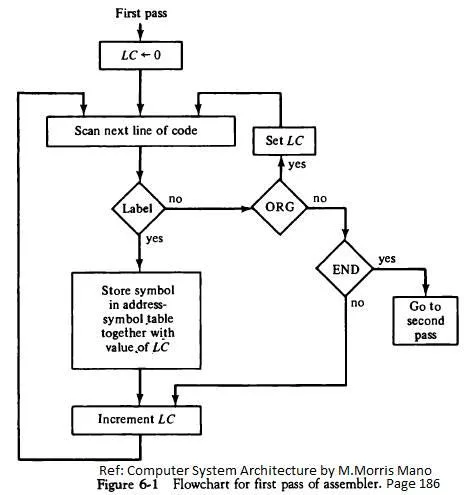
In Pass-1 of a Two-Pass Assembler, several key tasks are performed. It defines symbols and literals, storing them in the symbol table and literal table, respectively. The assembler also tracks the location counter, processes pseudo-operations, and assigns memory addresses to variables. This foundational work is crucial for the subsequent generation of machine code in Pass-2.
What are the advantages of using a Two-Pass Assembler?
One of the main advantages of a Two-Pass Assembler is its ability to generate an output file during the first pass, which can then be utilized in the second pass. This approach allows the first pass to record each line of input along with the next position of lexemes and parsing results. Consequently, the use of intermediate files can reduce unnecessary computations, although it may increase the input-output burden on the system.
What is the difference between a One-Pass and a Two-Pass Assembler?
The primary difference between a One-Pass and a Two-Pass Assembler lies in the number of scans over the source file. A One-Pass Assembler scans the file only once and handles forward references by using placeholders, while a Two-Pass Assembler performs two scans, resolving all forward references in the first pass. This results in a more accurate and complete code generation in the Two-Pass Assembler, albeit at the cost of speed.
What does Pass-2 of a Two-Pass Assembler accomplish?
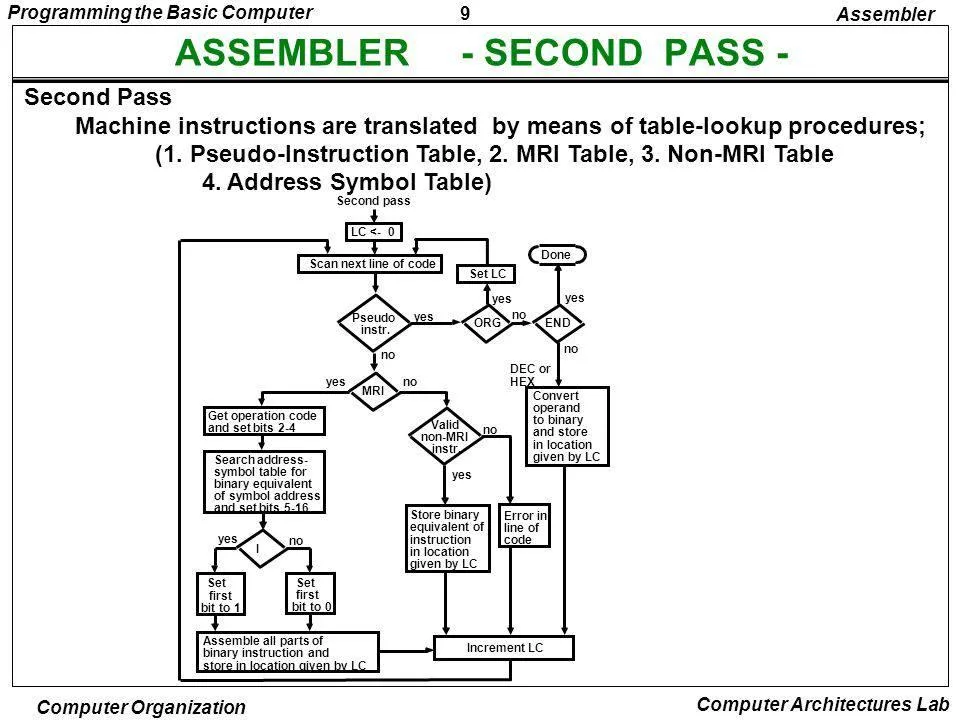
In Pass-2 of a Two-Pass Assembler, the focus shifts to generating the object code. This involves converting symbolic op-codes into their respective numeric op-codes and generating data for literals while looking up the values of symbols. Essentially, Pass-2 reads the source code again, utilizing the information gathered in Pass-1 to translate the assembly code into executable object code.