Control and coordination in plants and humans explores how organisms respond to stimuli through various mechanisms. It details the role of plant hormones like auxins, gibberellins, and cytokinins in growth and movement. The document also covers human nervous and endocrine systems, explaining how neurons transmit impulses and how hormones regulate bodily functions. Ideal for biology students, this resource provides insights into plant movements such as tropisms and nastic responses, as well as reflex actions in humans. It serves as a comprehensive guide for understanding biological coordination and response mechanisms.

Key Points

  • Explains plant hormones and their roles in growth and response to stimuli.
  • Describes types of plant movements, including tropic and nastic movements.
  • Covers the structure and function of the human nervous system.
  • Details the endocrine system and the role of hormones in regulating bodily functions.
  • Includes experiments demonstrating plant responses to environmental stimuli.
ARTI KANNAUJIYA
11 pages
Language:English
Type:Textbook
ARTI KANNAUJIYA
11 pages
Language:English
Type:Textbook
75
/ 11
CHAPTER 7
CONTROL AND COORDINATION
Stimuli: - The change in the surrounding through which organism react or respond is
called stimuli.
Response The reaction of the organism to the stimuli is called response.
Control and coordination in plants
The plants coordinate their behavior against stimuli by producing hormones. There are
mainly four types of plant hormones called phytohormones involved in the control and
coordination of plants are:-
1. Auxins (Growth Hormone)
(i) They promote cell differentiation and cell enlargement in plants.
(ii) They promote the growth of the fruits.
2. Gibberellins
1. They promote cell enlargement and cell differentiation in the presence of Auxin.
2. They help in breaking the dormancy in seeds and buds.
3. They also promote growth of the fruits.
3. Cytokinins
(i) They promote cell division in plants.
(ii) They delay ageing of leaves.
(iii) They promote the opening of stomata.
4. Abscisic acid(ABA)
(i) They promote the dormancy in seeds and buds.
(ii) They promote the closing of stomata.
(iii) They promote the wilting and falling of leaves.
Q. How auxin promotes the growth of stem:-
(a) Around the support
(b) Towards the light
Ans : Auxin is present on the tip of the stem:-
a) When stem touches a support auxin shifts to another side so that part grows more
and promotes the growth of the stem around the support.
b) When stem get light from one side so auxin shift to shady side and shady side grows
more and promote the growth of stem towards light.
Plant movement
Plant cannot move from one place to another they can only move their parts or organs
in response to light,gravity,water etc. Generally, these movements are growth movements.
Plant movements are of two types:-
(a) Tropic movement
(b) Nastic movement
A. Tropic movement
A growth movement in which plant part response to the stimulus and direction of
response is determined by the direction of stimulus is called tropic movement.
If the growth movement is towards the stimuli is called positive tropism.
If growth movement is away from the stimuli is called negative tropism.
Tropic movements are of five types:
(i) Phototropism
The movement of plant parts in response of light is called phototropism.
Eg:- Movement of stem towards the light is positive phototropism and movement of
root away from light is called negative phototropism.
(ii) Geotropism
The movement of plant part in response to gravity.
Eg: Growth of roots towards gravity is positive geotropism and growth of stem
away from gravity is negative geotropism.
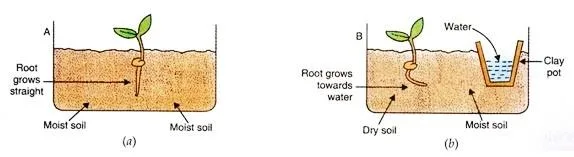
(iii) Hydrotropism
The movement of the plant in response to water is called hydrotropism.
Eg: Roots always move towards water.
(iv) Chemotropism
The movement of the plant parts in response to chemicals is called chemotropism.
Eg: Growth of pollen tube towards ovule during fertilization.
(v) Thigmotropism
The movement of the plants parts in response to touch is called thigmotropism.
Eg: Movement of tendril around a support.
B. Nastic movement
The movement of a plant part in response to stimuli in which direction of response is
not determined by the direction of stimuli is called nastic movement.
Eg:-
(i) The folding of the leaves of the sensitive plants (Memosa pudica or touch me not) on
touching.
(ii) Opening of the petals of the dandelion flower in morning light and closing in the
evening.
Q How movement occurs in the leaves of the sensitive plant?
Ans: Sensitive plants has pad like swelling called pulvini at the base of the each leaves which
contains lots of water. When we touch the leaves the water is lost from the pulvini. So, they lose
their firmness and fold.
Q Design an experiment to show hydrotropism?
Ans: Apparatus required
Two glass trough, two sapling, clay pot, water, soil
Procedure
We take two glass trough A and B fill both of them two third with soil .we plant one
sapling in both of them and place one clay pot in trough B .Water the soil in trough A but not in
trough B .We fill clay pot with water. We place this arrangement for some days. After few days
we dig up the sapling carefully without damaging their roots. The roots of sapling A are straight
but the roots of sapling B are bent.
Reason
The roots of sapling in trough A get water from all the sides. So they develop straight
towards gravity. In trough B water comes out of the clay pot and moist soil around it. The roots
in the trough are in dry soil. So, in search of water they bent towards the clay pot.
/ 11
End of Document
75

FAQs

What are the main types of plant hormones involved in control and coordination?
The main types of plant hormones, or phytohormones, involved in control and coordination are Auxins, Gibberellins, Cytokinins, and Abscisic acid (ABA). Auxins promote cell differentiation and enlargement, and aid in fruit growth. Gibberellins also promote cell enlargement and help break dormancy in seeds and buds. Cytokinins encourage cell division and delay leaf aging, while Abscisic acid promotes seed dormancy and the closing of stomata.
How do plants exhibit phototropism?
Phototropism is the movement of plant parts in response to light. In positive phototropism, the stem grows towards the light, while the roots exhibit negative phototropism by growing away from the light. This movement is facilitated by the action of Auxins, which redistribute to the shaded side of the plant, causing that side to grow more and thus bend towards the light.
What is the role of the nervous system in humans?
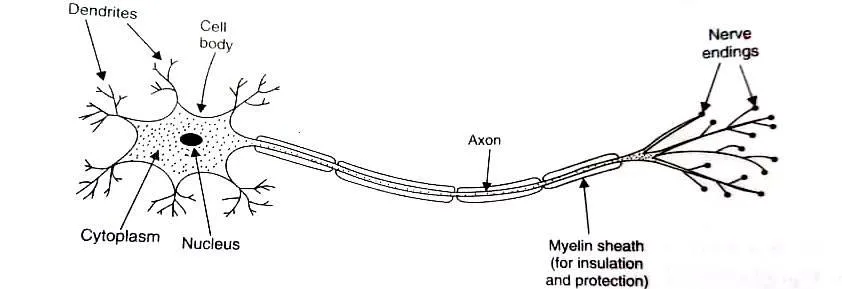
The nervous system in humans is responsible for control and coordination, comprising the Central Nervous System (CNS) and Peripheral Nervous System (PNS). The CNS includes the brain and spinal cord, which process information and coordinate responses. Neurons, the functional units of the nervous system, transmit impulses. Sensory neurons carry signals from receptors to the CNS, while motor neurons transmit impulses from the CNS to effectors, facilitating actions.
What are the differences between the nervous and endocrine systems?
The nervous system is made up of nerve fibers, transmitting messages as electric impulses quickly. In contrast, the endocrine system consists of glands that secrete hormones directly into the blood, which travel more slowly. While the nervous system transmits messages via nerve fibers, the endocrine system relies on chemical signals. This fundamental difference affects how each system regulates bodily functions and responses.
What is the function of the pituitary gland?
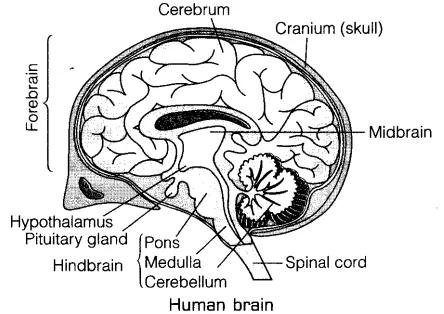
The pituitary gland, located just below the midbrain, produces the growth hormone, which controls growth by developing muscles and bones. Its deficiency can lead to dwarfism, while an excess can result in gigantism. This gland plays a crucial role in regulating various bodily functions through its hormone secretion.
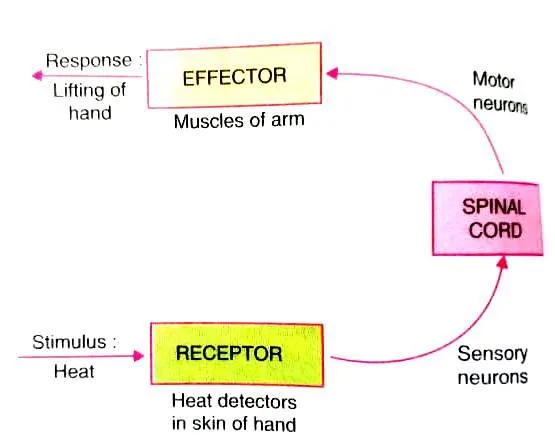
How do reflex actions occur in the human body?
Reflex actions are performed suddenly and automatically without conscious thought. They follow a pathway called the reflex arc, which includes sensory neurons that transmit impulses from receptors to the spinal cord, and motor neurons that carry impulses from the spinal cord to effectors. This rapid response mechanism allows for quick reactions to stimuli, ensuring safety and survival.
What is hydrotropism in plants?
Hydrotropism is the movement of plant roots in response to water. Roots typically grow towards moisture, ensuring that the plant receives adequate water for its survival. This movement is crucial for the plant's ability to thrive in varying soil conditions, as it helps them locate and utilize available water resources.