IRS 121: Rise of Nation-State explores the foundational concepts of nation, state, and nation-state. It delves into the distinctions between these terms, emphasizing the sociological and political dimensions. The document discusses the Treaty of Westphalia and its impact on modern state sovereignty and non-intervention principles. Ideal for students of international relations and peace studies, it provides insights into the complexities of statehood and cultural identity. Key examples include Nigeria's multi-ethnic composition and Japan's homogeneity as a nation-state.

Key Points

  • Defines the concepts of nation, state, and nation-state with relevant examples.
  • Explains the significance of the Treaty of Westphalia in shaping modern state systems.
  • Discusses the principles of state sovereignty and non-intervention in international relations.
  • Analyzes the implications of cultural identity on statehood, particularly in Nigeria and Japan.
Anthony Lilian
4 pages
Language:English
Type:Lecture Notes
Anthony Lilian
4 pages
Language:English
Type:Lecture Notes
238
/ 4
1
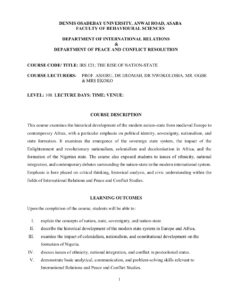
DENNIS OSADEBAY UNIVERSITY, ANWAI ROAD, ASABA
FACULTY OF BAHVIOURAL SCIENCES
DEPARTMENT OF INTERNATIONAL RELATIONS
&
DEPARTMENT OF PEACE AND CONFLICT RESOLUTION
COURSE CODE TITLE: IRS 121: RISE OF NATION - STATE
OUTLINE ONE: CONCEPTUAL CLARIFICATION: NATION, STATE, AND NATION
STATE
Nation
A nation is a group of people who share common elements of culture, language, history, or ethnicity
and possess a collective identity. Nations often have shared myths of origin, symbols, and a sense of
unity or common destiny. Importantly, a nation is a sociological and cultural construct; it may or may
not have political sovereignty (Smith, 1999; Coakley, 2017).
Example: The Igbo, Yoruba, and Hausa-Fulani ethnic groups in Nigeria are cultural nations, though
they do not possess statehood status.
State
A state is a sovereign political entity with defined territorial boundaries, a permanent population, a
functional government, and the capacity to enter into relations with other states (Weber, 1919/1946).
It holds the monopoly of legitimate use of force within its defined territory.
Example: Nigeria is a state; it has a government, institutions, international recognition, and defined
borders.
Nation-State
A nation-state occurs when the boundaries of a nation and a state overlap. It is a sovereign state
whose citizens are relatively homogeneous/identical in factors such as language or descent.
Example: Japan is often cited as a nation-state due to its ethnic and linguistic homogeneity. Nigeria,
by contrast, is a multi-ethnic state rather than a nation-state.
2
Difference between Nation and State
A nation is distinct from a state in that a nation's defining feature is a shared culture, language, history,
or ethnicity, and it possesses a collective identity. A state has sovereignty, international recognition,
and the capacity to enter into relations with other states. Importantly, many nations can exist within
a state. Therefore, a state is broader in scope and responsibility than a nation.
Basic Features of Modern States
As discussed earlier under the meaning of state, the basic features of a state include a defined
population and territory, as well as government and sovereignty. However, modern conceptualisation
considers the above four features essential, though not exclusively. Others include a recognised
entity, with existing rule of law, permanent institution, an organised economy with a taxable system,
and international relations.
OUTLINE TWO: THE TREATY OF WESTPHALIA AND THE ORIGIN OF THE
MODERN STATE SYSTEM
The Peace of Westphalia concluded in 1648, marking the end of the Thirty Years’ War in Europe.
Beyond resolving a devastating religious and political conflict, the treaties (Munster and Osnabruck)
introduced enduring principles foundational to the modern international state system; particularly the
notion of state sovereignty and the principle of non-intervention.
Westphalia’s legacy is not just historical; it continues to influence how international law, global
order, and diplomatic relations are conceived today. For African countries like Nigeria, emerging
into sovereignty post-colonialism, the Westphalian ideas became both guiding principles and, at
times, points of contention in a globalised world.
3
Origins and Provisions of the 1648 Treaty
A. Historical Background
The Thirty Years’ War (1618–1648) devastated much of Central Europe, primarily the Holy Roman
Empire. What began as a religious conflict between Protestants and Catholics evolved into a broader
power struggle involving France, Spain, Sweden, and others. The Peace of Westphalia ended these
conflicts and introduced diplomatic norms.
B. Major Provisions
The Peace of Westphalia (1648) reinforced the principle of sovereign territorial authority, building
upon the earlier doctrine of cuius regio, eius religio established under the Peace of Augsburg (1555),
whereby rulers could determine the religion of their territories
Non-Intervention: External powers were prohibited from interfering in the domestic affairs of other
states.
Territorial Integrity: States’ borders were to be respected and recognised.
Secularisation of Diplomacy: Politics began to take precedence over religious allegiances.
C. Institutional Legacy
Westphalia set a precedent for international legal equality and laid the groundwork for developing
international organisations and law (Redalyc, 2019).
Sovereignty and the Principle of Non-Intervention
A. Concept of Sovereignty
Sovereignty, as articulated in Westphalia, is the absolute authority of the state within its borders
without external interference. This principle aligns with what we now term internal sovereignty;
control over domestic matters; and external sovereignty; freedom from external domination.
B. Non-Intervention Principle
A principle that follows from sovereignty is non-intervention, meaning that no state has the right to
intervene in another state's internal affairs, whether militarily or otherwise (Richmond, 2002).
/ 4
End of Document
238

FAQs

What is the definition of a nation according to the document?
A nation is defined as a group of people who share common elements of culture, language, history, or ethnicity and possess a collective identity. Nations often have shared myths of origin, symbols, and a sense of unity or common destiny. Importantly, a nation is a sociological and cultural construct and may or may not have political sovereignty.
How does the document differentiate between a nation and a state?
The document highlights that a nation is distinct from a state in that a nation's defining feature is a shared culture, language, history, or ethnicity, and it possesses a collective identity. In contrast, a state is a sovereign political entity with defined territorial boundaries, a permanent population, and a functional government, holding the monopoly of legitimate use of force within its territory.
What is the significance of the Treaty of Westphalia in the modern state system?
The Treaty of Westphalia, concluded in 1648, is significant as it introduced enduring principles foundational to the modern international state system, particularly state sovereignty and the principle of non-intervention. It marked the end of the Thirty Years' War and established norms for diplomatic relations, influencing how international law and global order are conceived today.
What are the major provisions of the Peace of Westphalia?
The major provisions of the Peace of Westphalia reinforced the principle of sovereign territorial authority, established non-intervention by external powers in domestic affairs, and emphasized the respect for states' borders. It also marked a shift towards secular diplomacy, where politics began to take precedence over religious allegiances.
What is the concept of sovereignty as discussed in the document?
Sovereignty, as articulated in the document, refers to the absolute authority of the state within its borders without external interference. This includes internal sovereignty, which is control over domestic matters, and external sovereignty, which signifies freedom from external domination. The principle of sovereignty is crucial for understanding the framework of international relations.
What exceptions to the principle of non-intervention are mentioned?
The document notes that there are exceptions to the principle of non-intervention, particularly in cases of humanitarian interventions. For instance, the United Nations may override state sovereignty under the 'Responsibility to Protect' (R2P) principle when mass atrocities occur. Additionally, the African Union Charter allows for intervention in grave cases such as war crimes or genocide.