It is about media relations

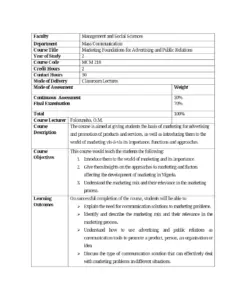
Faculty
Management and Social Sciences
Department
Mass Communication
Course Title
Fundamentals of Media Relations
Year of Study
2
Course Code
MCM 216
Credit Hours
2
Contact Hours
30
Mode of Delivery
Classroom Lectures
Mode of Assessment
Weight
Continuous Assessment
Final Examination
30%
70%
Total
100%
Course Lecturer
Folorunsho, O.M.
Course
Description
The course is designed to inform students about some of the aspects of the
media’s development which affect its operation today, as well as offering
some practical guidelines on how to work with the media successfully.
Course
Objectives
This course would teach the students the following:
1. Educate them on how to effectively use media relations to enhance the
reputation of their clients or employers.
2. Give them insights on the strategies needed in establishing good
working relationships with journalists who will in turn serve them
well in the future.
3. Widen their knowledge about the tactics and techniques of writing for
the press, using some of the media relations’ tools.
Learning
Outcomes
On successful completion of the course, students will be able to:
➢ Understand and discuss media relations, its evolution, objectives,
functions and responsibilities.
➢ Identify and describe the various tools of media relations.
➢ Explain how to consistently establish, maintain and sustain good
relationship with media men.
➢ Organise press conferences, receptions and press interviews.

➢ Monitor and evaluate media relation activities/efforts.
➢ Prepare a media relations budget.
Teaching and
Learning
The class will meet for two hours every week for a combination of both the
lecture hours and tutorials.
Detailed Course
Content
This course focused on the analysis of ways and means of establishing and
maintaining rapport and credibility with media gatekeepers. The course further
presents the importance of media relations, evolution, objectives, functions and
responsibilities; analyses the various tools employed in media relations;
explain how to consistently project positive image through the media; outline
how to nurture and sustain appropriate liaison/relationship with the news media
at all times; organise a mock press conference effectively simulate press
interview session; monitor and evaluate the effectiveness of media exposures:
media audit and analysis; and prepare a media relations budget.
Course Content Sequencing
Weeks
Detailed Course Outline
Allocated Time
Week 1
Introduction
▪ Definitions of Media Relations
▪ Similarities and Differences between Media
Relations and Public Relations
▪ Forms of Media Relations
Week 2
The Media Context
▪ Brief Media History in Nigeria
▪ Ownership of the Media
▪ Trends in Media Ownership (Cross-media
ownership)
Week 3,4
Dealing with the Press
▪ Media Laws (Contempt of court, Libel &
slander, Official secret act)
▪ Ethics and Privacy
Week 5
Handling the Broadcast Media
▪ The Importance of Broadcast Coverage

▪ Preparation and Briefing
▪ Winning the Interview
▪ Handling different Interviews
Continuous Assessment I
Week 6
Relating with Newspapers and Periodicals
▪ Press Relations
▪ Writing for the Press (press releases, PR
features, Photos, e.t.c)
▪ Talking to the Press (press interviews, press
conferences, receptions)
Week 7, 8
Media Evaluation
▪ Method of evaluation – research, media content
analysis, coverage vs. content
▪ Media Audit
▪ Budgeting for Media Relations (Nature and
factors to consider)
Weeks 9, 10, 11
Tools of Media Relations
▪ Newsletter, House Journal, News Release,
Facility Visits, Magazine, Bulletin, Blog,
Website, Rejoinder, Letter to the Editor,
Feature Article and Fact Sheet
Week 12
Revision
Week 13, 14
Examinations
Recommended Reading Material
Bland, M., Thaker, A., & Wragg, D. (2005). Effective media relations: How to get results.
London: Kogan Page Limited.
NOTE: 75% attendance to class is a MUST to qualify to sit for examination in Fundamentals of
Media Relations