IRS 121 explores the historical development of the modern nation-state, focusing on political identity, sovereignty, and nationalism. The course covers key events from medieval Europe to contemporary Africa, including the impact of colonialism and the formation of the Nigerian state. Students will engage with concepts such as ethnicity and national integration, fostering critical thinking and historical analysis. This course is essential for students in International Relations and Peace and Conflict Studies, providing a comprehensive understanding of contemporary debates surrounding the nation-state.

Key Points

  • Examines the emergence of the sovereign state system in Europe and Africa.
  • Discusses the impact of colonialism on the formation of Nigeria.
  • Explores Enlightenment thought and its influence on modern governance.
  • Analyzes nationalism and state formation in Europe, particularly in Germany and Italy.
  • Addresses postcolonial challenges of ethnicity and national unity in Nigeria.

Anthony Lilian
4 pages
Language:English
Type:Syllabus
Anthony Lilian
4 pages
Language:English
Type:Syllabus
257
/ 4
1
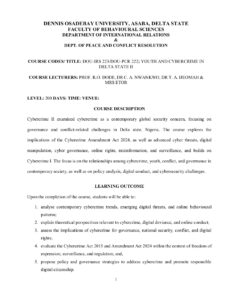
DENNIS OSADEBAY UNIVERSITY, ANWAI ROAD, ASABA
FACULTY OF BEHAVIOURAL SCIENCES
DEPARTMENT OF INTERNATIONAL RELATIONS
&
DEPARTMENT OF PEACE AND CONFLICT RESOLUTION
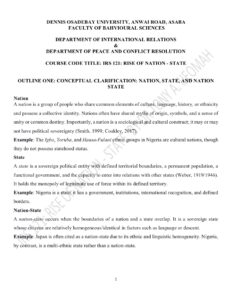
COURSE CODE/ TITLE: IRS 121; THE RISE OF NATION-STATE
COURSE LECTURERS: PROF. ASHIRU, DR IJEOMAH, DR NWOKOLOBIA. MR. OGBE
& MRS EKOKO
LEVEL: 100. LECTURE DAYS: TIME: VENUE:
COURSE DESCRIPTION
This course examines the historical development of the modern nation-state from medieval Europe to
contemporary Africa, with a particular emphasis on political identity, sovereignty, nationalism, and
state formation. It examines the emergence of the sovereign state system, the impact of the
Enlightenment and revolutionary nationalism, colonialism and decolonisation in Africa, and the
formation of the Nigerian state. The course also exposed students to issues of ethnicity, national
integration, and contemporary debates surrounding the nation-state in the modern international system.
Emphasis is here placed on critical thinking, historical analysis, and civic understanding within the
fields of International Relations and Peace and Conflict Studies.
LEARNING OUTCOMES
Upon the completion of the course, students will be able to:
I. explain the concepts of nation, state, sovereignty, and nation-state.
II. describe the historical development of the modern state system in Europe and Africa.
III. examine the impact of colonialism, nationalism, and constitutional development on the
formation of Nigeria.
IV. discuss issues of ethnicity, national integration, and conflict in postcolonial states.
V. demonstrate basic analytical, communication, and problem-solving skills relevant to
International Relations and Peace and Conflict Studies.
ii
COURSE SCHEDULE
WEEK
DATE
TOPICS TO COVER
1
Mon. 4 Fri. 8 May, 2026
Conceptual Clarification: Nation, State, and Nation-
State
(Tutor-Led)
- Meaning of Nation
- Meaning of State
- Meaning of Nation-State
- Differences Between Nation and State
- Basic Features of Modern States
Task: Distinguish between a nation and a state using
examples from Africa.
2
Mon. 11 Fri. 15 May, 2026
The Treaty of Westphalia and the Origin of the
Modern State System
(Student-Centred Learning)
- Background to the Treaty of Westphalia
- Emergence of Sovereign States
- Territorial Authority and Borders
- Principle of Non-Intervention
Task: Why is the Treaty of Westphalia important in
International Relations?
3
Mon. 18 Fri. 22 May, 2026
The Modern State System
(Tutor-Led)
- Characteristics of Modern States
- Sovereignty and Political Authority
- Citizenship and National Identity
- State Institutions and Governance
Analytical Question: What makes a state “modern?
4
Mon. 25 Fri. 29 May, 2026
Enlightenment Thought and Political Ideas
(Student-Centred Learning)
- Meaning of Enlightenment
- Liberty and Political Authority
- Social Contract Idea
- Contributions of John Locke, Montesquieu, Voltaire,
Jean-Jacques Rousseau, and Immanuel Kant
Task: How did Enlightenment thinkers influence
modern government?
5
Mon. 1 Fri. 5 Jun., 2026
The French Revolution and Nationalism
(Student-Centred Learning)
- Causes of the French Revolution
- Liberty, Equality, and Fraternity
- Growth of Nationalism
iii
- Citizenship and Political Participation
Task: Explain how the French Revolution contributed
to nationalism.
6
Mon. 8 Fri. 12 Jun., 2026
Nationalism and State Formation in Europe
(Student-Centred Learning)
- Nationalism in Germany
- Nationalism in Italy
- Role of Culture and Language
- Leadership and State Unification
Task: Compare the unification of Germany and Italy.
7
Mon. 15 Fri. 19 Jun., 2026
Pre-Colonial Political Systems in Africa
(Tutor-Led)
- Traditional Governance in Africa
- Hausa-Fulani Political System
- Yoruba Kingdoms
- Igbo Political Organisation
Task: What similarities and differences existed among
pre-colonial African political systems?
8
Mon. 22 Fri. 26 Jun., 2026
Colonialism and the Formation of Nigeria
(Student-Centred Learning)
- European Colonial Expansion in Africa
- British Colonial Rule in Nigeria
- Amalgamation of 1914
- Indirect Rule System
Task: How did colonialism shape the Nigerian state?
9
Mon. 29 Jun. Fri. 3 Jul.,
2026
Constitutional Development in Nigeria
(Tutor-Led)
- Clifford Constitution
- Richards Constitution
- Macpherson Constitution
- Lyttleton Constitution
Task: Which colonial constitution contributed most to
Nigerian political development?
10
Mon. 6 Fri. 10 Jul., 2026
Nationalism and Independence in Africa
(Student-Centred Learning)
- Meaning of African Nationalism
- Pan-Africanism
- Anti-Colonial Movements
- Struggles for Independence
Task: Discuss the role of nationalism in Africa’s
independence movements.
/ 4
End of Document
257

FAQs

What are the key concepts covered in IRS 121: The Rise of Nation-State?
The course covers several key concepts including the definitions of nation, state, and nation-state, as well as the differences between these terms. It emphasizes the historical development of the modern state system, particularly from medieval Europe to contemporary Africa. Additionally, the course addresses issues of sovereignty, nationalism, and state formation, alongside contemporary debates surrounding the nation-state in the international system.
How does the course address the impact of colonialism on Nigeria?
The syllabus outlines a dedicated week to explore colonialism and its effects on Nigeria. It discusses European colonial expansion in Africa, British colonial rule in Nigeria, and the significant events such as the Amalgamation of 1914 and the Indirect Rule system. This section aims to analyze how colonialism shaped the political landscape and state formation in Nigeria.
What learning outcomes are expected from IRS 121?
Upon completing the course, students are expected to explain the concepts of nation, state, sovereignty, and nation-state. They should be able to describe the historical development of the modern state system in Europe and Africa, examine the impact of colonialism and nationalism on Nigeria, and discuss issues of ethnicity and national integration in postcolonial states. Additionally, students will develop basic analytical, communication, and problem-solving skills relevant to International Relations and Peace and Conflict Studies.
What topics are included in the course schedule for IRS 121?
The course schedule includes a variety of topics such as the Treaty of Westphalia, Enlightenment thought, the French Revolution, nationalism in Europe, pre-colonial political systems in Africa, and Nigeria's constitutional development. Each week focuses on different aspects of the rise of the nation-state, with tasks designed to engage students in critical thinking and analysis of these historical events and concepts.
What is the significance of the Treaty of Westphalia in the course?
The Treaty of Westphalia is highlighted as a pivotal moment in the emergence of the modern state system. The course discusses its background, the establishment of sovereign states, territorial authority, and the principle of non-intervention. Students are tasked with understanding why this treaty is important in the context of International Relations, making it a crucial topic in the syllabus.
How does the course explore the theme of nationalism?
Nationalism is a central theme in IRS 121, with specific weeks dedicated to its exploration. The syllabus addresses the causes of the French Revolution and its contributions to nationalism, as well as nationalism and state formation in Europe, particularly in Germany and Italy. The course also examines African nationalism and its role in independence movements, providing a comprehensive view of nationalism's impact on state formation.
What challenges faced Nigeria after independence according to the course?
The course outlines several major challenges that Nigeria faced after gaining independence, including issues related to federalism, ethnicity, and national unity. It covers the Nigerian Civil War and the ongoing challenges of nation-building, emphasizing the complexities of maintaining unity in a diverse nation. This analysis helps students understand the historical context and contemporary implications of these challenges.