The Directed Reading Thinking Activity (DRTA) strategy significantly enhances students’ reading comprehension skills by fostering critical thinking and engagement. This study explores the implementation of DRTA in an educational setting, focusing on eighth-grade students at Bimbel Aksara. Through qualitative research methods, including observations and interviews, the study reveals positive student perceptions and increased motivation towards reading. The findings suggest that integrating digital tools and collaborative activities can further enrich the learning experience.

Key Points

  • Explores the effectiveness of the Directed Reading Thinking Activity (DRTA) strategy
  • Focuses on enhancing reading comprehension for eighth-grade students
  • Utilizes qualitative research methods including observations and interviews
  • Highlights positive student perceptions and increased motivation towards reading
Ephin Aluni
Author:Nelfia, Izzati Gemi Seinsiani
21 pages
Language:English
Type:Research Paper
Ephin Aluni
Author:Nelfia, Izzati Gemi Seinsiani
21 pages
Language:English
Type:Research Paper
370
/ 21
Book Chapter English Language Teaching, Literature, and
Translation Vol. 1
209
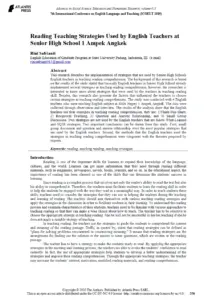
The Use of the Directed Reading Thinking Activity
(DRTA) Strategy in Enhancing Students’ Reading
Comprehension
Nelfia, Izzati Gemi Seinsiani
Universitas Negeri Semarang
DOI: https://doi.org/10.15294/eltlt.v1i1.386
QRCBN 62-6861-2530-756
ABSTRACT
This study aims to investigate the implementation of the
Directed Reading Thinking Activity (DRTA) strategy in
enhancing students’ reading comprehension. The research
employed a qualitative descriptive approach to explore how
the DRTA strategy was implemented and to find out the
students’ perceptions of using DRTA to enhance their reading
comprehension skills. The data were collected through
observations, interviews, and questionnaires. The findings
revealed that the Directed Reading Thinking Activity (DRTA)
Strategy can enhance students’ reading comprehension and
foster critical thinking. Moreover, students perceive the DRTA
strategy positively, significantly increasing their motivation
and interest in reading skills. Additionally, this study suggests
that the DRTA strategy should be implemented by combining
digital tools and group-based activities to enhance the
learning experience and make it more engaging and
collaborative.
Keywords: Directed Reading Thinking Activity; Reading
Comprehension; Implementation; Perceptions
INTRODUCTION
English is regarded as a compulsory subject that should
be taught at school. Regarding that, English as a foreign
language has been taught at all levels of education in Indonesia,
210
Book Chapter English Language Teaching, Literature, and
Translation Vol. 1
from elementary school to university. Teaching English as a
foreign language in Indonesia aims to equip students to
communicate in written and spoken English (Arisetyawati,
2017). To achieve comprehensive communication, students
must learn four fundamental language skills: listening,
speaking, reading, and writing (Brown, 2000).
In teaching English as a foreign language, reading is one
of the four language skills students should master (Akmal,
2018). It is important because it can increase students' insight,
knowledge, and vocabulary. According to Welson (2020),
Reading is a vital skill through which people acquire
knowledge, gain experience, and develop a deeper
understanding of the world. Reading is a necessary skill that
must be complemented by the ability to comprehend its
content, enabling understanding of the information included in
various texts (Sunarti & Fatma Mernawati, 2022). According to
Nunan, as cited in Hasan (2017), reading requires obtaining
meaning and making sense of the printed word.
Furthermore, as cited in William (1984), reading is a
process whereby one examines and comprehends what has
been written. It means that reading is a competence that
students must use to gather information from written texts,
such as drawing conclusions and identifying main ideas. To
understand the information in the text, the learners need to
comprehend what they read.
Reading consists of two main components: word
recognition and comprehension. The two components are
interrelated. Word recognition skills help readers to
understand the structure of the text. Meanwhile,
comprehension enables readers to understand the text's
content more deeply and with a richer, more nuanced meaning.
The better the word recognition skills, the better the reading
comprehension skills. The main objective of reading is
comprehension. Comprehension is simply the ability to
understand specific information accurately and effectively.
Learners must comprehend what they read to understand the
meaning of the text. According to Wolley (2011), as cited in
Hayu Novendiana et al. (2016), reading comprehension is the
process of making meaning from the text. Reading
comprehension can be defined as the process of making

Book Chapter English Language Teaching, Literature, and
Translation Vol. 1
211
meaning from a particular type of text Arisetyawati (2017).
However, many students have difficulty with reading
comprehension. They fail to determine the topic, main idea,
inference, reference, and generic structure of reading English
texts. When students read English text, they focus on the
translation, even though gaining a lot of information and
knowledge after reading is the most important thing.
Based on the writer’s observations and interviews with
some eighth-grade students at Bimbel Aksara, some problems
contribute to students’ struggles in reading comprehension.
The lack of vocabulary significantly affects the students’
struggle with reading comprehension. A restricted vocabulary
can impede students’ ability to comprehend the nuances of
complex vocabulary and diverse terminology encountered in
reading material. In a second language, vocabulary is the core
of all language skills. Improving listening skills involves
hearing sentences composed of various vocabulary words, and
an abundance of vocabulary can be acquired by increasing
reading frequency. Mastery of a vast vocabulary can support
reading skills, making it easier for students to understand the
sentences they read. Furthermore, enriching vocabulary can
help students develop a more effective writing style and choose
appropriate diction.
Additionally, some students feel that teachers' learning
methods are less attractive. Then, they become quite bored
with learning activities due to the frequent use of conventional
techniques, such as asking students to read and re-enact
dialogues or texts available in front of the class. Arini and
Wahyudin (2022) suggest that utilizing more engaging
learning methods is an alternative approach for teachers to
encourage students to become more active and enthusiastic
about learning, thereby enhancing their English skills.
Teaching strategy is one of the key elements that attracts
and helps students improve their reading comprehension
skills. The teacher should apply an effective strategy to interest
students in reading activities. Various strategies, methods, and
approaches can be employed in teaching reading
comprehension, including top-down, bottom-up, interactive,
Know What Learn (KWL), Directed Reading Thinking Activity
(DRTA), and Guided Reading (Yazdani & Mohammadi, 2015).
/ 21
End of Document
370

FAQs

what is the Directed Reading Thinking Activity (DRTA) strategy

The Directed Reading Thinking Activity (DRTA) strategy is a teaching method designed to enhance students' reading comprehension skills.

  • It involves generating questions and making predictions about the text.
  • Students read in segments, pausing to confirm or revise their predictions.
  • The strategy encourages active participation and critical thinking.

how does the DRTA strategy improve reading comprehension

The DRTA strategy significantly improves reading comprehension by engaging students in a structured reading process.

  • It fosters critical thinking through prediction and verification.
  • Students learn to analyze texts more deeply.
  • It enhances vocabulary and understanding of complex texts.

what are the findings of the DRTA strategy research

Research on the Directed Reading Thinking Activity (DRTA) strategy reveals positive outcomes for students' reading skills.

  • Students reported increased motivation and interest in reading.
  • There was a notable improvement in their comprehension abilities.
  • The strategy effectively supports collaborative learning environments.

how is the DRTA strategy implemented in classrooms

The implementation of the DRTA strategy in classrooms involves several key steps.

  • Selecting appropriate reading materials that match students' levels.
  • Preparing prediction questions to activate prior knowledge.
  • Facilitating discussions during and after reading to reflect on predictions.

what are the benefits of using the DRTA strategy

Using the Directed Reading Thinking Activity (DRTA) strategy offers multiple benefits for students.

  • It enhances engagement and focus during reading sessions.
  • Students develop critical thinking and analytical skills.
  • The strategy makes reading more enjoyable and less monotonous.

what challenges are associated with the DRTA strategy

While the DRTA strategy is effective, it presents some challenges for students.

  • Students may struggle with making accurate predictions due to unfamiliar vocabulary.
  • The strategy can be time-consuming, potentially leading to fatigue.
  • Some students find it cognitively demanding to engage deeply with the text.

how does DRTA foster critical thinking in students

The Directed Reading Thinking Activity (DRTA) fosters critical thinking by requiring students to engage actively with the text.

  • Students make predictions and verify them, promoting deeper analysis.
  • Reflective discussions encourage them to consider multiple perspectives.
  • This process develops their ability to think critically about what they read.

what types of texts are suitable for the DRTA strategy

Suitable texts for the Directed Reading Thinking Activity (DRTA) strategy include narrative and descriptive materials.

  • Texts should be engaging and relevant to students' experiences.
  • The complexity of the text should match students' reading levels.
  • Examples include short stories, articles, and age-appropriate literature.

what role do teachers play in the DRTA strategy

Teachers play a crucial role in implementing the Directed Reading Thinking Activity (DRTA) strategy effectively.

  • They select appropriate texts and prepare guiding questions.
  • Teachers facilitate discussions and encourage student participation.
  • They help students reflect on their predictions and understanding of the text.