Materials 2022, 15, 4047 2 of 11
can significantly improve the overall stability and horizontal deformation control of the
subgrade structure [
14
–
16
]. According to the different types of weaving, geogrids are
divided into uniaxial, biaxial, and multiaxial [
17
,
18
]. Liu et al. [
19
] laid a geogrid inside the
fill to form a load-bearing composite, which effectively restrained the lateral deformation
and improved the overall stress state of the soil. Sweta et al. [
11
] found that the utilization
of geogrids directly enhanced the shear strength of ballast and reduced the percentage of
breakage by 9.24%. Esmaeili et al. [
20
] reported that the number of geogrid layers is one
of the important factors affecting the lateral resistance of a single sleeper/track panel. In
another study, Gao et al. [
21
] performed model tests based on transparent soil technology
and digital image technology to comprehensively study the effect of the layers and types of
geogrids on the reinforcement effect of foundation soil. In addition, due to the excellent
tensile properties of the geogrid, it can also be used as the wrapping material of the gravel
pile to limit the lateral deformation of the gravel pile. In addition, due to the excellent
tensile properties of the geogrid, it can be used as the wrapping material of the gravel pile
to limit its lateral deformation [
22
–
24
]. However, the widely used geosynthetic material
is a chemical product made of a high molecular polymer as a raw material, which is a
non-renewable resource. Additionally, its production process will produce a large amount
of sulfide, nitrogen oxides and carbon dioxide, and other gases, which will pollute the
environment [
25
]. At present, the construction industry advocates green and low-carbon
development and searches for sustainable reinforcement materials similar to geogrids,
which have important theoretical and environmental significance in the field of soil–rock
mixture reinforcement.
Bamboo is a natural biomaterial with high strength, high toughness, and renewable,
and is easily accessible in Asia. It is also widely distributed in mountain areas where
highway construction is carried out. In China, the growing area of bamboo has reached
7.2 million hectares. Bamboo can be used in civil engineering simply by optimizing
its anti-corrosion ability of bamboo. Generally, bamboos are mostly used for auxiliary
structures and members, but some are also used as a part of load-bearing structures. Several
studies have confirmed the ability of bamboo as a reinforcement material in composite
panels, concrete elements, and shear connectors, and put forward the idea of large-scale
application [
26
–
30
]. In addition, the biggest advantage of bamboo is its high tensile
properties. It is estimated that the tensile strength and elastic modulus of bamboo grids
are about 20 times and 30 times that of geogrids, respectively, while the elongation is only
1/6 of those of geogrids. Therefore, the bamboo grid woven with bamboo reinforcements
instead of geogrids has broad application prospects in geotechnical engineering [
31
–
33
].
Hegde et al. [
34
] performed model tests and found that the combination of geocells and
geogrids increased the bearing capacity of the clay bed by six times, and the settlement and
deformation of the foundation were effectively controlled. Ahirwar et al. [
35
] found that
parameters such as laying position, grid size, number of reinforcement layers, and grid
shape all affect the bearing capacity of the foundation reinforced with the bamboo grid.
All the above studies report the applicability of bamboo as an alternative material for
geogrid/rebar. Moreover, the research on the reinforcement of the foundation by bamboo
grids is basically carried out on the soft clay/sand layer system with few coarse particles and
well graded. However, there are few experimental studies on the improvement of special
soil–rock mixture subgrades with the bamboo grid. In order to promote the application of
bamboo grids in the reinforcement of soil–rock mixture, this study mainly investigated the
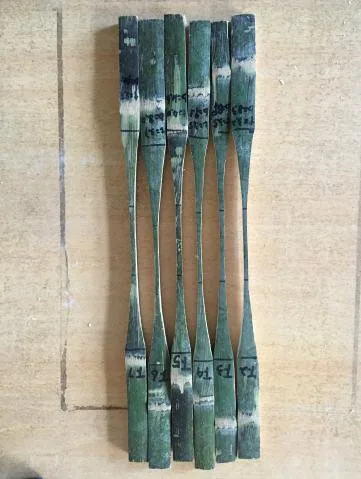
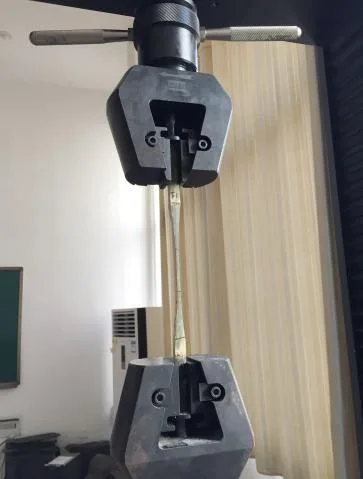
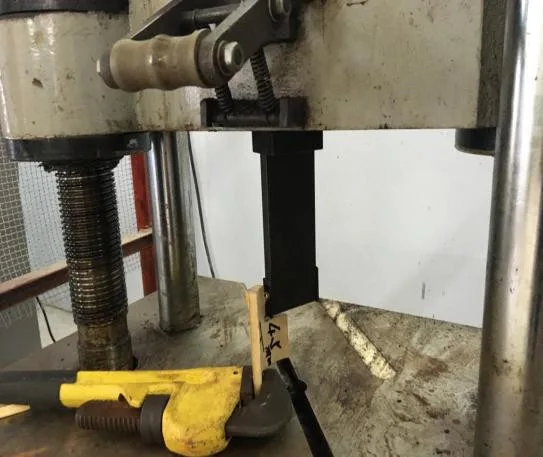
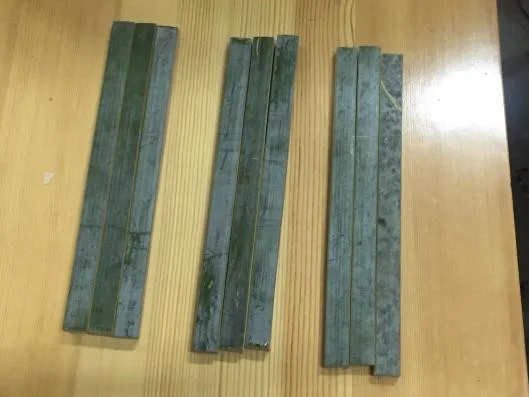
tensile, shear, and flexural properties of bamboo reinforcement. Further, a field pull-out
test was performed to study the interfacial friction properties of uniaxial/biaxial bamboo
grid reinforced soil–rock mixtures under different vertical loads.
2. Mechanical Properties Test of Bamboo Reinforcement
The premise of using bamboo reinforcement as a subgrade reinforcement material is
to ensure that its strength meets the performance requirements required by actual working
conditions. Previous studies have shown that the mechanical properties of bamboo are