cohesive soil increases due to the effect of placing woven
bamboo as a reinforcement method. This can be seen from
the smaller decrease when the amount of woven bamboo
is added. Research conducted [9] concluded that bamboo
tarpaulins and grids used as alternative peat soil
reinforcement materials can increase the ultimate bearing
capacity and BCR (Bearing California Ratio) value.
Variations in the width of the reinforcement always
showed an increase in the bearing capacity of the soil.
From research [19][20], the maximum CBR value
obtained was 5.42% in the variation of 3 layers with 5
layers of compaction 56 blows. From this research, it is
also concluded that the CBR value of soil with woven
bamboo reinforcement is higher than that of bamboo grid
reinforcement.
As is known, soft clay soil is one of the problematic
soils due to its low bearing capacity and excessive
settlement in terms of its specifications. Therefore, there
is a need for parameters to overcome this. The research
parameter carried out is testing the bearing capacity of the
soil against the maximum load and settlement on a footing
as a load pressure area that was placed on top of the soft
clay layer media with the addition of geotextile and
woven bamboo composite materials. The objective is the
value of the bearing capacity of soft clay soil with
reinforcement will be much greater when compared to
soft clay soil without reinforcement and the settlement
that occurs will be smaller. This research will test the
physical properties of soil including water content,
specific gravity, Atterberg limits, soil grain size analysis,
classification of soil, settlement value, and maximum
load. The soil samples used came from Purwosuman
Village, Sidoharjo District, Sragen Regency, Central Java
with a conditioning water content plan of 60.00% and
saturated. This research uses geotextile reinforcement and
woven bamboo with depth variations from the footing
width ratio (B) of 100 mm, namely variations of 0.5B, 1B,
1.5B, and 2B which are accompanied by the width of
reinforcement at each depth variation based on the theory
of pressure distribution in the soil 2 Vertical: 1 Horizontal
with loading method using loading frame. The variation
of depth and width of reinforcement will be searched for
the effective value that can withstand maximum load and
the settlement with various factors behind it.
2 Material and Methodology
The soft clay soil used came from Purwosuman Village,
Sidoharjo District, Sragen Regency, Central Java. The soil
was collected at a depth of ± 40 cm from the original soil
surface. The soil to be used is also in an air-dried
condition and passes sieve No.4 (4.750 mm). The physical
and mechanical tests were conducted in the Soil
Mechanics Laboratory at Universitas Muhammadiyah
Surakarta.
The physical properties of soft clay soil were
conducted which includes testing moisture content,
specific gravity, Atterberg limits, soil grain size analysis,
and soil classification. after obtaining the air-dried
moisture content from the physical test results of 10.67%,
water was added until the soft clay soil reached the design
moisture content of 60% and saturated for 96 hours. Then
put the soil into a 60 cm diameter drum and compact it
into 5 layers. Each layer was compacted by 200 blows
using a hammer’s proctor. Footing made from steel in the
thickness of 2 cm was placed on top of the soft clay soil
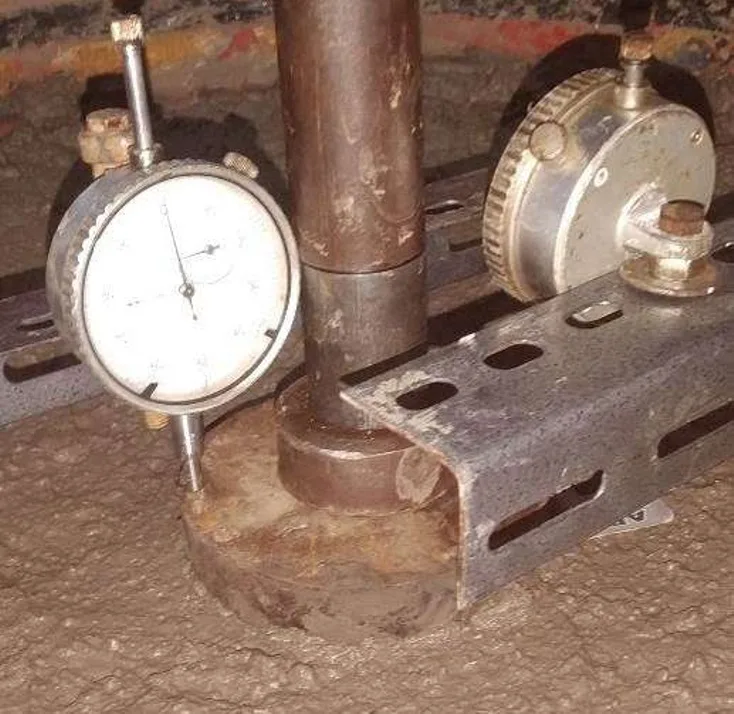
and tried to be in the middle of the drum. 1 dial was set
above the footing to determine the amount of vertical
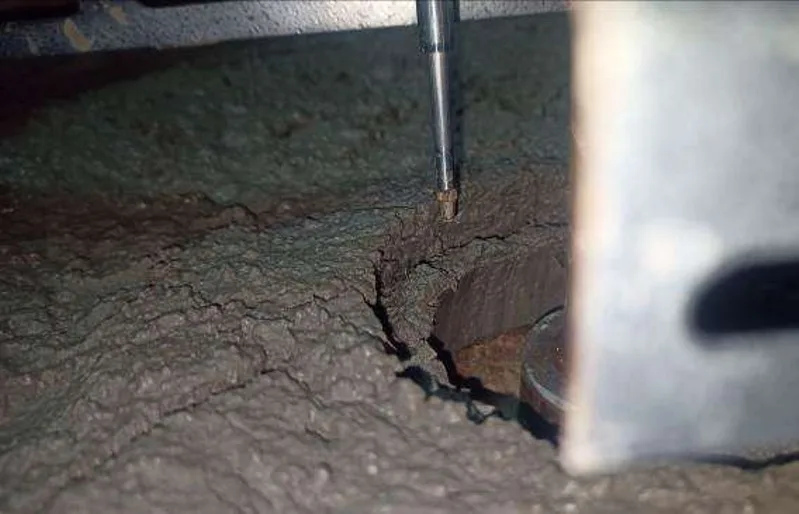
settlement and 1 dial gauge above the ground to determine
the amount of waving that occurred. Tests were carried
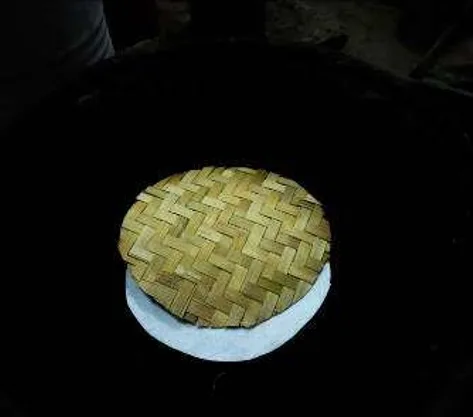
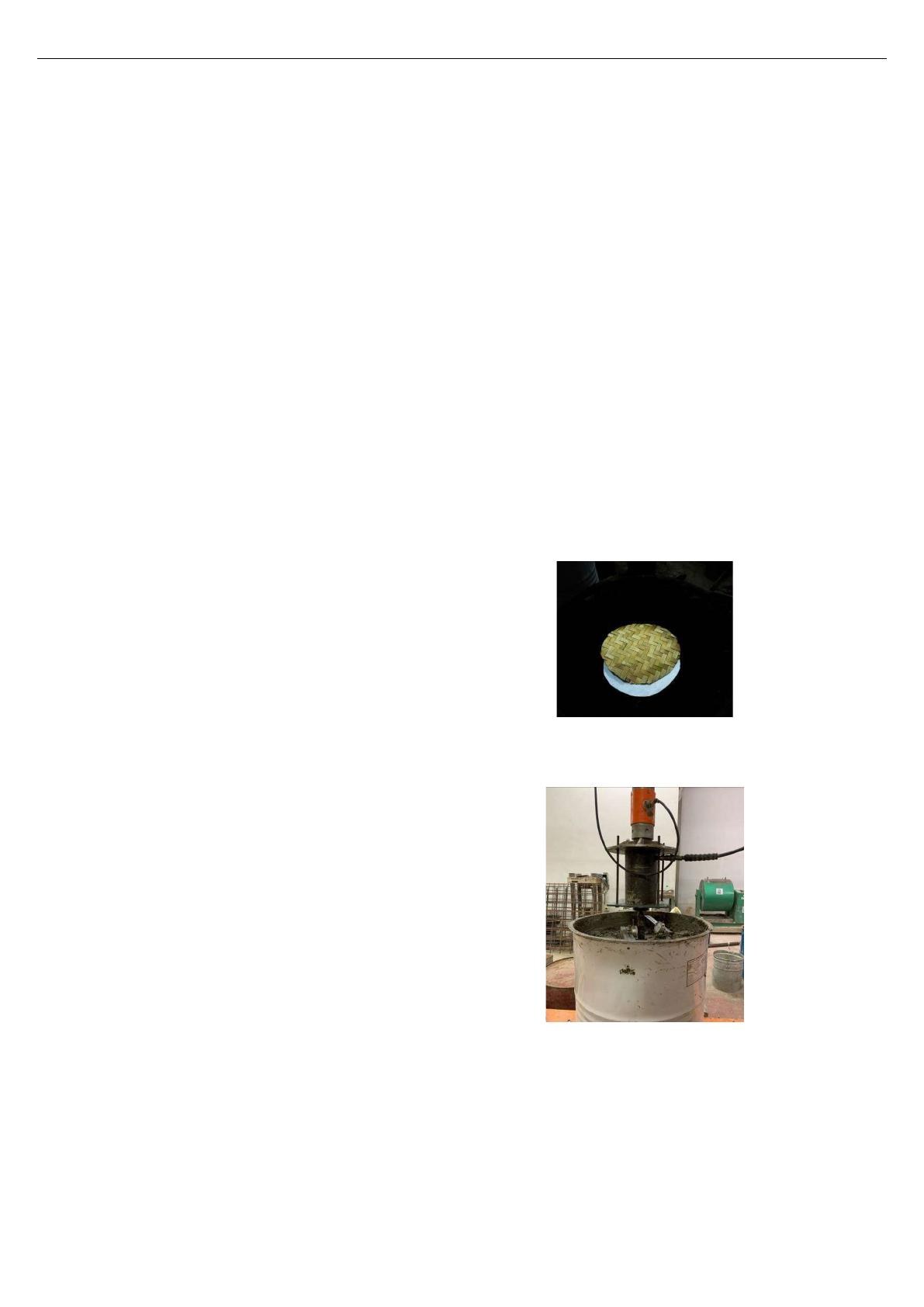
out both on soft clay soil media using geotextile
reinforcement and woven bamboo with predetermined
variations as shown in Fig. 1 and soft clay soil media
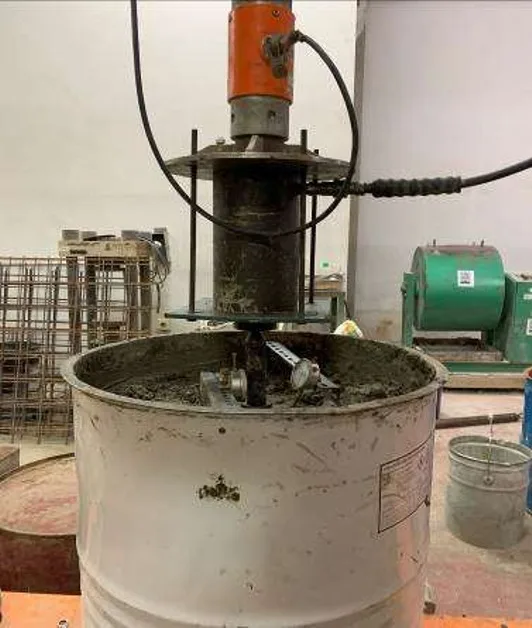
without reinforcement. Vertical loading tests were carried
out using a loading frame as shown in Fig. 2.
Observations are conducted on the load readings from the
strain meter display and 2 dial gauges then the results.
Based on the tests from several stages above, the results
of physical tests and loading tests are obtained and then
analyzed to make conclusions and suggestions on the
research that has been carried out.
Fig. 1. Geotextile and Woven Bamboo as Reinforcement on
Soft Clay Soil
Fig. 2. Testing design
3 Result and Discussion
3.1. Physical properties of soil
Testing the physical properties of clay soil consisted of
water content, specific gravity, Atterberg limits, grain size
Analysis, and soil classification. Water content testing is
conditioned until the soft clay soil water content reaches
the planned water content of 60.00%. The results of the
ICETIA 2023
, 1
2004
(2024)
E3S Web of Conferences
https://doi.org/10.1051/e3sconf/202451712004
517
2