3
e
iϕ
sin(
φ
2
)|V i, with φ ∈ {0,
π
4
,
π
2
,
3π
4
, π} and a variety of
phases ϕ ∈ {0, 2π}, where the locally available informa-
tion φ and ϕ is used to prepare ρ
ctc
. In standard (linear)
quantum mechanics no unitary evolution can introduce
additional distinguishability between quantum states. To
illustrate the non-linearity in the system we employ two
different distinguishability measures: the trace-distance
D(ρ
1
, ρ
2
)=
1
2
Tr[|ρ
1
− ρ
2
|], where |ρ|=
p
ρ
†
ρ and a single
projective measurement with outcomes “+” and “−”:
L(ρ
1
, ρ
2
) = h+|ρ
1
|+ih−|ρ
2
|−i + h−|ρ
1
|−ih+|ρ
2
|+i. (4)
While the metric D is a commonly used distance mea-
sure it does not have an operational interpretation and
requires full quantum state tomography in order to be
calculated experimentally. The measure L in contrast is
easily understood as the probability of obtaining differ-
ent outcomes in minimum-error discrimination of the two
states using a single projective measurement on each sys-
tem. The operational interpretation and significance of L
is discussed in more detail in the Supplemental Material.
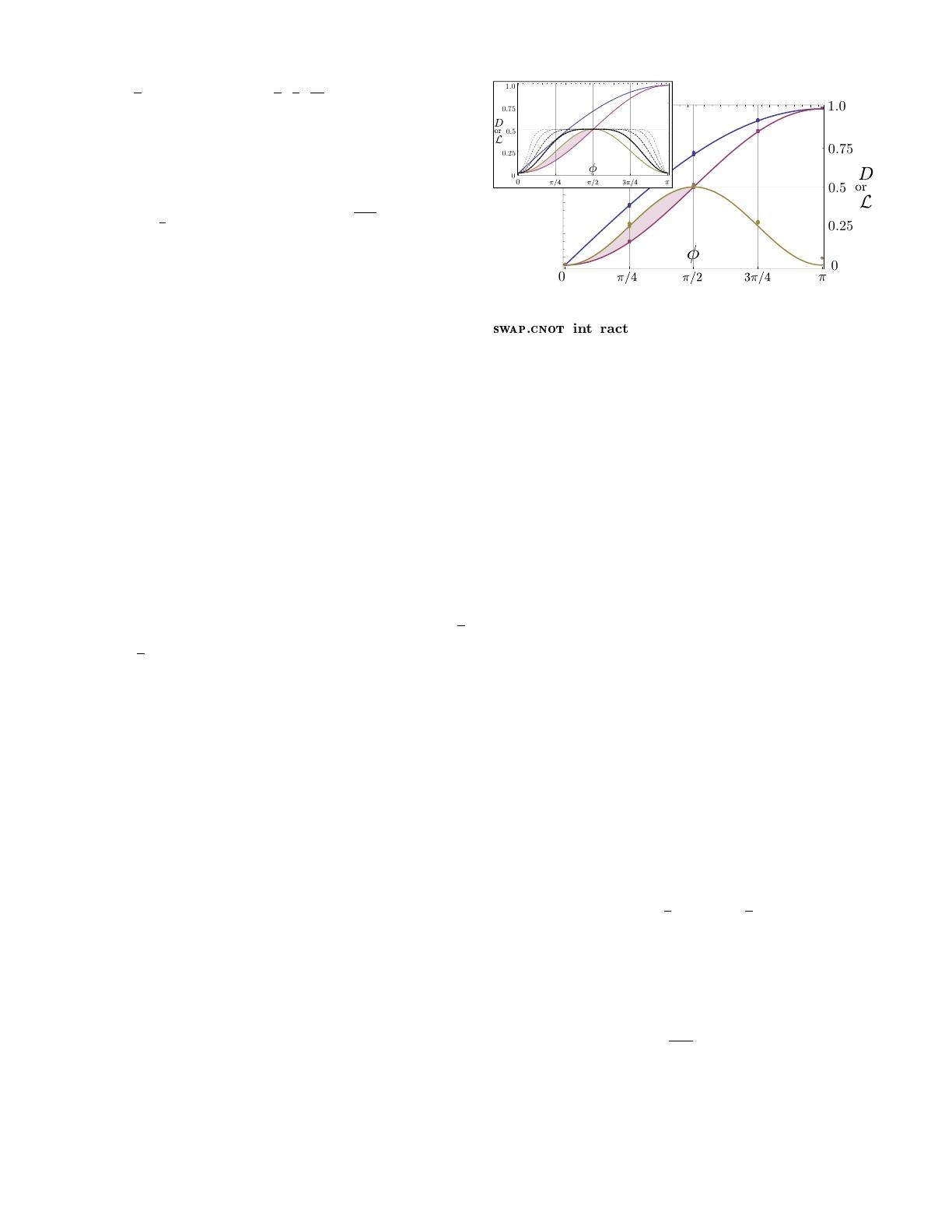
Both D and L are calculated between the state |ψi and
the fixed reference state |Hi after being evolved through
the circuit shown in Fig. 2b)(i). The results are plotted
and compared to standard quantum mechanics in Fig. 3.
If the state |ψi is not known then, based only on the
knowledge of the reference state |Hi and the evolution
in Eq. (2) it is natural and optimal to use the measure L
with a σ
z
-measurement.
We observe enhanced distinguishability for all states
with an initial trace-distance to |Hi smaller than 1/
√
2
(i.e. φ≤
π
2
), as clearly demonstrated by the σ
z
-based mea-
sure, see Fig. 3. Note, however, that this advantage over
standard quantum mechanics is not captured by the met-
ric D(ρ
1
, ρ
2
) unless the non-linearity is amplified by iter-
ating the circuit on the respective output at least 3 times,
see inset of Fig. 3. This shows that the non-linearity is
not directly related to the distance between two quan-
tum states. By testing states with various polar angles
for each azimuthal angle on the Bloch sphere, we confirm
that any phase information is erased during the evolution
and that the evolved state ρ
out
is indeed independent of
ϕ, up to experimental error. We further confirm, with an
average quantum state fidelity of F = 0.998(2) between
the input and output state of ρ
ctc
in Eq. (3), that the
consistency relation (1) is satisfied for all tested scenar-
ios.
Non-orthogonal state discrimination. While it is
the crucial feature, non-linear state evolution is not
unique to the swap.cnot interaction, but rather a cen-
tral property of all non-trivial CTC interactions. Simi-
lar circuits have been found to allow for perfect distin-
guishability of non-orthogonal quantum states [9], lead-
ing to discomforting possibilities such as breaking of
quantum cryptography [9], perfect cloning of quantum
states [10, 11], and violation of Heisenberg’s uncertainty
FIG. 3: Non-linear evolution in a Deutsch CTC with
swap
.
cnot
interaction. Both the trace distance D, and
the σ
z
-based distinguishability measure L (equal to within
experimental error in this case) of the evolved states ρ
out
after the interaction with the CTC are shown as yellow di-
amonds. The blue circles (red squares) represent the measure
D (L) between the input states |ψi and |Hi in the case of
standard quantum mechanics. Note that due to the phase-
independence of the evolution in Eq. (2) states that only differ
by a phase collapse to a single data point. Crucially, the met-
ric D does not capture the effect of the non-linearity, while L
does, indicated by the red shaded region. Error bars obtained
from a Monte Carlo routine simulating the Poissonian count-
ing statistics are too small to be visible on the scale of this
plot. Inset: The dashed black lines with decreasing thickness
represent theoretical expectations for D and L from 2, 3, 4 and
5 iterations of the circuit.
principle [12]. In particular it has been shown that a
set {|ψ
j
i}
N−1
j=0
of N distinct quantum states in a space
of dimension N can be perfectly distinguished using an
N-dimensional CTC-system. The algorithm proposed by
Brun et al. [9] relies on an initial swap operation between
the input and the CTC-system, followed by a series of
N controlled unitary operations, transforming the input
states to an orthogonal set, which can then be distin-
guished.
In our simulation of this effect we consider the qubit
case N=2, which consequently would require two con-
trolled unitary operations between the input state and
the CTC system. We note, however, that without loss
of generality the set of states to be discriminated can be
rotated to the xz-plane of the Bloch sphere, such that
|ψ
0
i=|Hi and |ψ
1
i= cos(
φ
2
)|Hi+ sin(
φ
2
)|V i for some an-
gle φ. In this case, the first controlled unitary is the
identity operation I, while the second performs a con-
trolled rotation of |ψ
1
i to |V i as illustrated in Fig. 4a).
In detail, the gate CU
xz
applies a π rotation to the target
qubit conditional on the state of the control qubit, about
an axis in the xz-plane defined by the angle θ
xz
. For
the optimal choice θ
xz
=
φ−π
2
the gate rotates the state
|ψ
1
i to |V i, orthogonal to |ψ
0
i, enabling perfect distin-
guishability by means of a projective σ
z
measurement,
see Fig. 4a).
In practice the gate CU
xz
is decomposed into a