Partitioning Line Segments Notes for Geometry Students
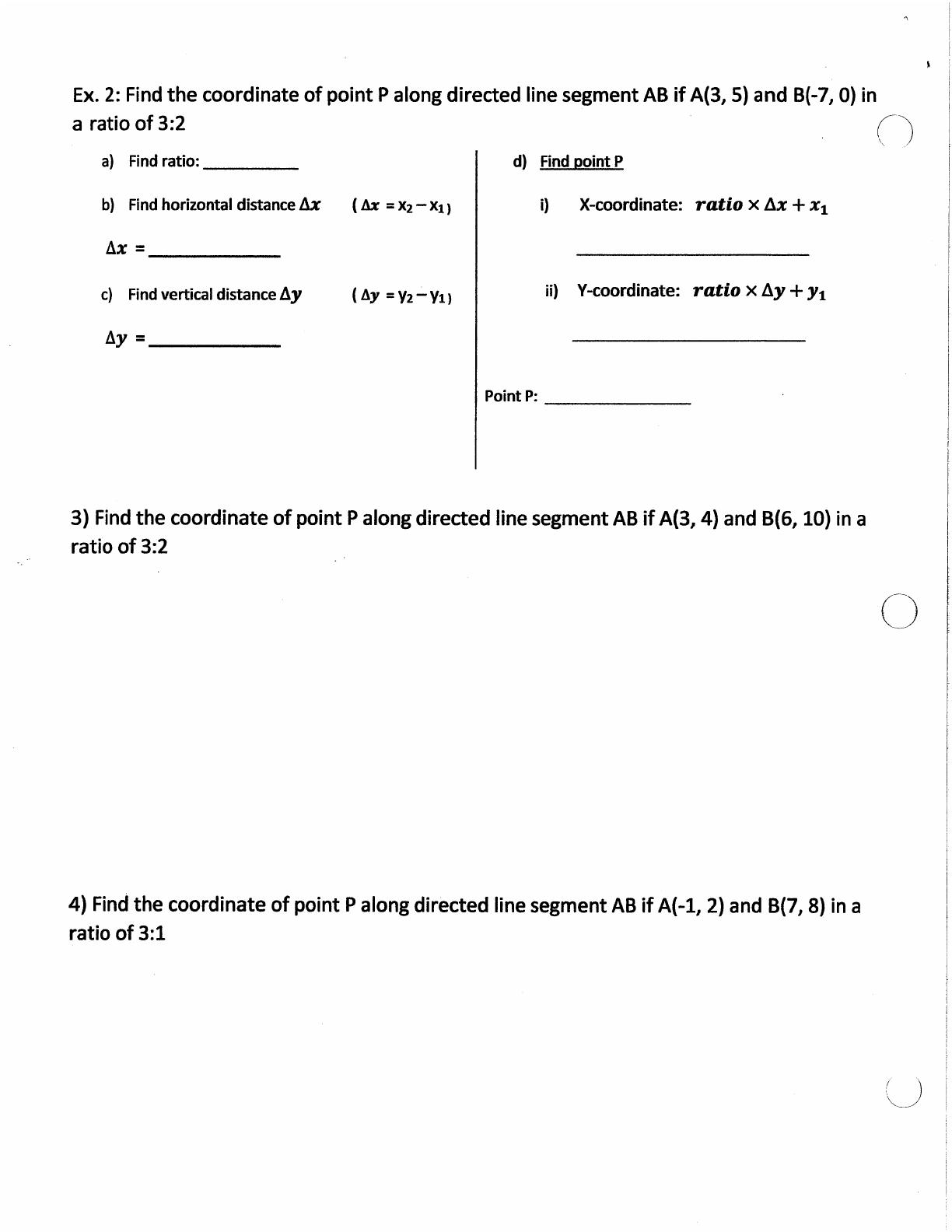
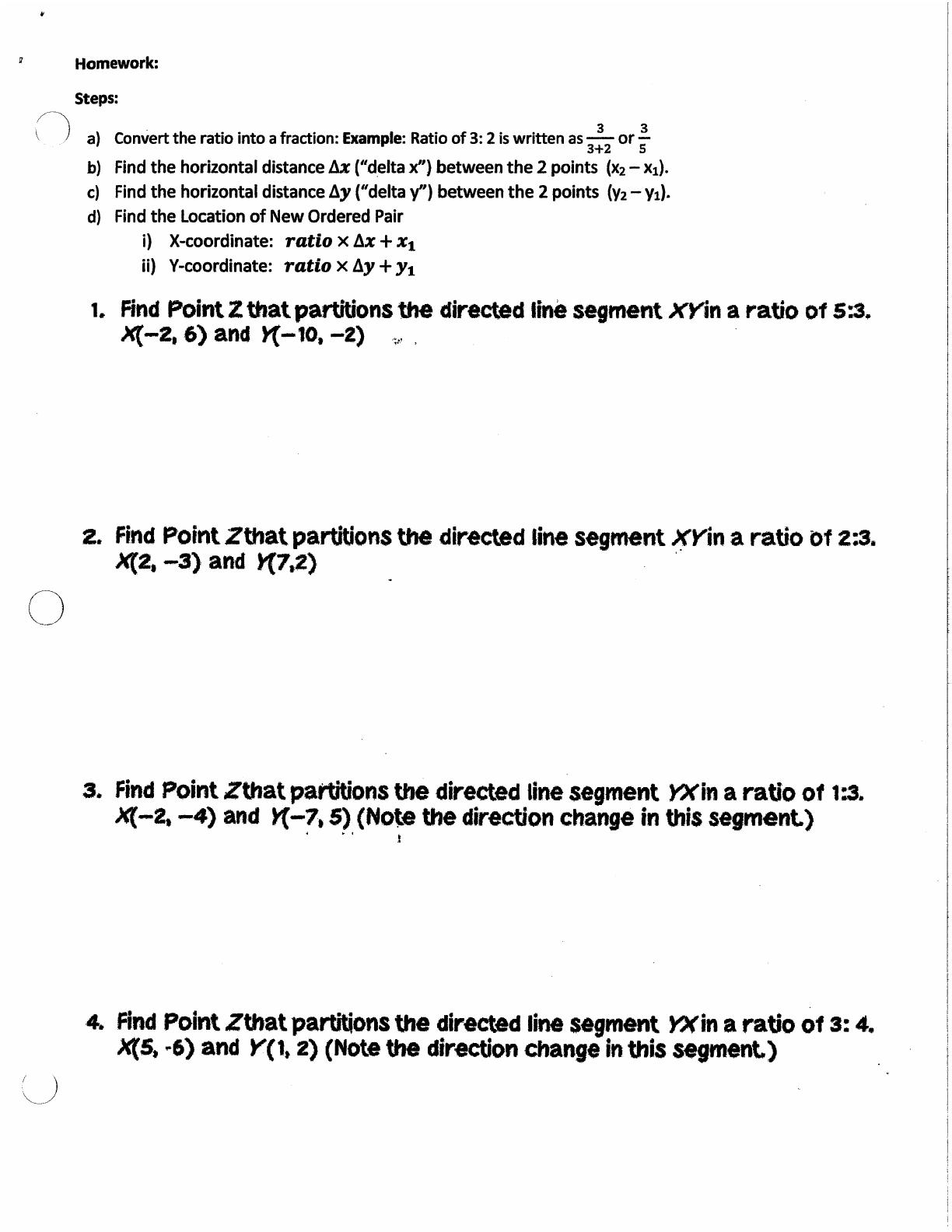
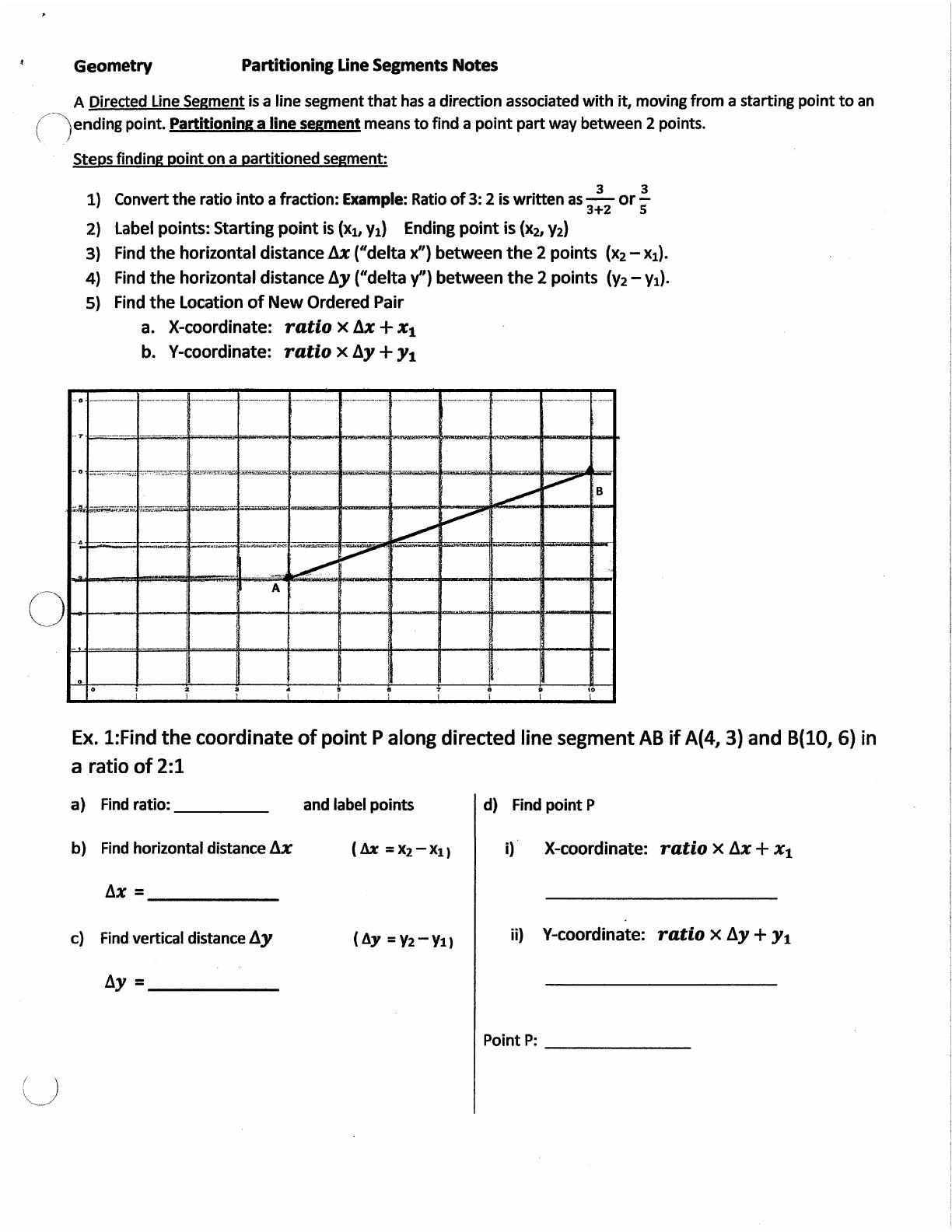
Partitioning line segments is a key concept in geometry, focusing on finding points along a directed line segment between two endpoints. This resource provides detailed examples and exercises for students learning how to calculate coordinates using ratios. It includes step-by-step instructions for determining horizontal and vertical distances, as well as finding the location of new ordered pairs. Ideal for high school geometry students, this material supports understanding of proportional reasoning and coordinate geometry. Practice problems reinforce skills necessary for solving real-world geometric applications.
Key Points
Explains how to find coordinates along a directed line segment using ratios.
Includes examples of calculating horizontal and vertical distances.
Provides step-by-step instructions for determining new ordered pairs.
Features practice problems that reinforce key concepts in geometry.
This link leads to an external site. We do not know or endorse its content, and are not responsible for its safety. Click the link to proceed only if you trust this site.
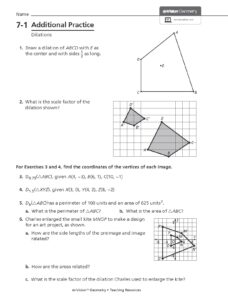
Geometry Dilations Practice Exercises for Students
PDF
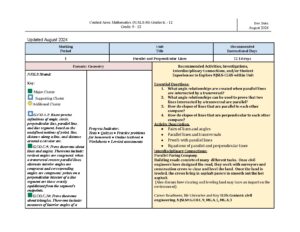
Geometry Unit 3 – Parallel and Perpendicular Lines
PDF
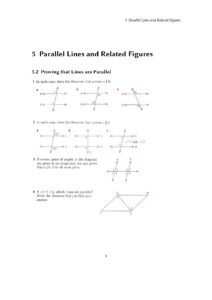
Geometry for Enjoyment and Challenge Chapter 5 Section 2 Proving That Lines Are Parallel
PDFResource
DAAD EPOS Deadlines 2026-2027 for Scholarships and ProgramsResource
PDFStudy Guide
Consumer Rights Project for Class 10 StudentsStudy Guide
PDFReport
Career Counselling Workshop Report for Class 12 StudentsReport
PDFNotes
Database Management System Lecture Notes by Swagatika DalaiNotes
PDFGuide
Off Campus Housing Guide for StudentsGuide
PDFStudy Guide
Youth Mental Health in the Digital Age: Online Gaming AddictionStudy Guide
PDFStudy Guide
Acceleration of a Trolley on an Inclined Plane ExperimentStudy Guide
PDFStudy Guide
NEET Chemistry Study Guide for Aspiring Medical StudentsStudy Guide
FAQs
How do you calculate the coordinates of a point along a line segment?
To calculate the coordinates of a point along a line segment, you first identify the endpoints of the segment and the ratio in which the segment is divided. Use the formula for the x-coordinate, which is the starting x-coordinate plus the ratio multiplied by the difference in x-coordinates. Similarly, calculate the y-coordinate using the same method. This approach allows you to find the precise location of the point within the specified ratio.
What is the significance of partitioning line segments in geometry?
Partitioning line segments is significant in geometry as it helps students understand proportional relationships and coordinate systems. This concept is foundational for more advanced topics, such as vector analysis and transformations. By mastering this skill, students can apply it to various geometric problems, including those involving triangles, polygons, and real-world applications like navigation and design.
What types of problems are included in the partitioning line segments notes?
The partitioning line segments notes include a variety of problems that require students to find coordinates based on given ratios. These problems range from simple calculations to more complex scenarios involving multiple segments. Each problem is designed to enhance understanding of the underlying principles of geometry and to provide practice in applying these concepts to solve real-world problems.
What steps are involved in finding the location of a new ordered pair?
Finding the location of a new ordered pair involves several steps. First, determine the horizontal and vertical distances between the endpoints of the line segment. Next, apply the given ratio to these distances to find the proportions of the segment. Finally, add these calculated distances to the coordinates of the starting point to arrive at the new ordered pair. This systematic approach ensures accuracy in geometric calculations.
How can partitioning line segments be applied in real life?
Partitioning line segments can be applied in various real-life situations, such as in architecture, engineering, and computer graphics. For instance, architects may use these principles to design buildings with precise measurements and proportions. In computer graphics, partitioning helps in rendering images and animations accurately by determining the positions of pixels and objects within a given space. Understanding this concept is crucial for professionals in fields that require spatial reasoning.
Related
PDFStudy Guide
Cornell Notes System for Effective Note TakingStudy Guide
PDFStudy Guide
Corporate Analysis and Valuation Unit 2 Study NotesStudy Guide
PDFStudy Guide
Corporate Analysis and Valuation Study Notes Semester 4Study Guide
PDFStudy Guide
Periodic Properties Study Notes for NEETStudy Guide
PDFStudy Guide
Personal Banking Notes for International RelationsStudy Guide