The analysis of an oligopolistic market focuses on the airline industry, examining key players like Ryanair, Lufthansa, and American Airlines. It discusses market dynamics, pricing strategies, and the impact of competition on profitability. The document highlights challenges such as rising fuel costs and regulatory pressures, while also exploring innovations in sustainability and technology. This comprehensive overview is valuable for students and professionals interested in economics, business strategy, and market analysis.

Key Points

  • Explores the competitive landscape of the airline industry, focusing on major players like Ryanair and Lufthansa.
  • Analyzes pricing strategies and the impact of low-cost carriers on traditional airlines.
  • Discusses challenges faced by airlines, including rising fuel costs and regulatory pressures.
  • Highlights innovations in sustainability and technology within the airline market.
Qwertyu iop
7 pages
Language:English
Type:Report
Qwertyu iop
7 pages
Language:English
Type:Report
40
/ 7
ANALYSIS OF AN OLIGOPOLISTIC MARKET AND A SPECIFIC COMPANY
IN THAT MARKET
PART 1: ANALYSIS OF THE AIRLINE MARKET
1.Introduction
Airline industry consists of companies that operate flights to transport passengers and cargo,
often cooperating through codeshare agreements. It is a highly competitive and costly industry,
with major expenses such as fuel and labor, low profit margins, and strong seasonality. Its
performance is also heavily influenced by economic conditions, fuel prices, and strict
regulations.
The market operates as an oligopoly, dominated by a few large airlines like American Airlines,
Lufthansa, and Ryanair. Although many airlines exist, only a few typically compete on the
same routes, limiting customer choice. Global alliances such as Star Alliance further
concentrate the market by allowing airlines to coordinate routes and schedules.
Competition is especially intense on price, largely due to low-cost carriers, which have forced
traditional airlines to reduce fares and sometimes engage in price wars. Airlines also compete
through service quality, comfort, and loyalty programs, but differentiation is limited, making
profitability difficult.
Finally, entering the market is very challenging due to high barriers. Starting an airline requires
significant investment in aircraft, staff, and operations, along with compliance with strict safety
regulations. Limited airport slots and the advantages of established airlinessuch as
economies of scale and strong brand loyaltymake it difficult for new entrants to succeed.
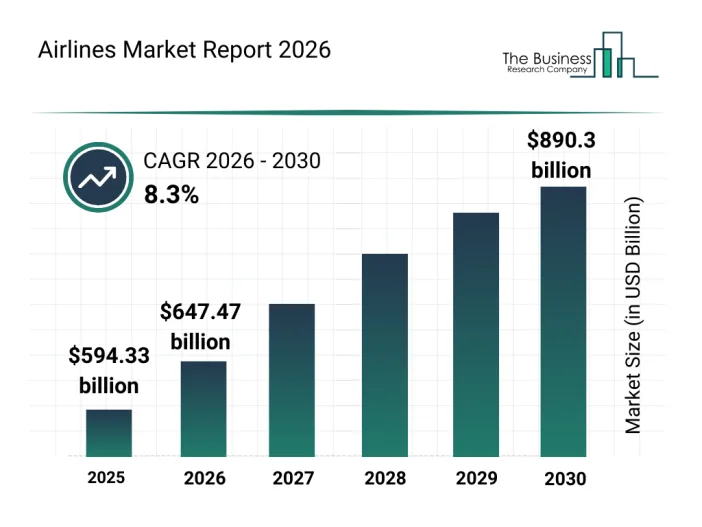
The airline market is expected to grow
significantly, reaching $890.3 billion by
2030 with a CAGR of 8.3%. This growth
is mainly driven by demand for more
sustainable aviation, the adoption of
digital platforms to personalize customer
experience, expansion of premium
services, improved efficiency through
advanced technologies, and the
development of new long-haul routes
using next-generation aircraft.
2. Market analysis
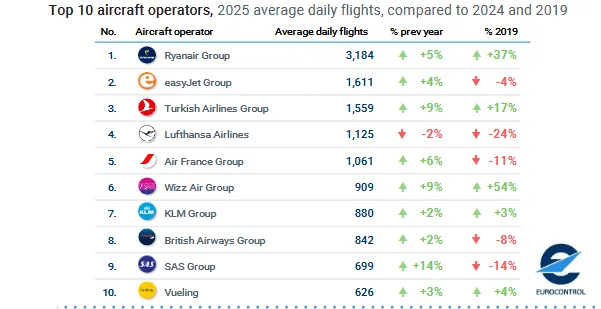
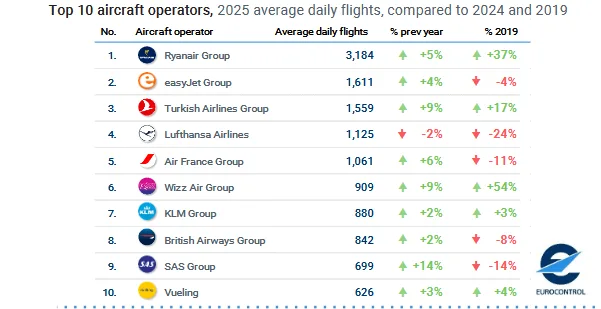
The European airline market is quite concentrated,
but still competitive. Ryanair clearly stands out as
the market leader, accounting for roughly 1820% of
total traffic, which puts it well ahead of any other
airline.
Behind it, Lufthansa Group holds around 1012%, followed by International Airlines Group with
about 910%. Air France-KLM has a slightly smaller share, at around 89%, while low-cost
airlines like easyJet and Wizz Air account for approximately 78% and 45% respectively. The
remaining 30% or so is made up of many smaller airlines, which shows that although one
company dominates, the market is still shared among several important competitors. Overall,
this creates a balance between concentration and competition in the European airline industry.
3. Pricing strategies
Airlines compete primarily on price, with ticket costs varying depending on factors such as
travel dates, routes, booking timing, and service class. In the Airline industry, pricing is highly
dynamic and largely driven by competition rather than coordination. Airlines frequently engage
in fare wars, where one carrier reduces prices and others quickly follow. These situations can
lead to significant price dropsaround 32% on average, and in extreme cases up to 79%
especially when competition intensifies on specific routes or demand is uncertain.
Although most competition is legal and market-driven, there have been notable exceptions. A
key example is the Air cargo cartel case, where more than 20 airlines colluded on fuel
surcharges, leading to fines of nearly €800 million by the European Commission. Despite this,
airlines do not usually divide markets formally. Instead, segmentation occurs naturally, as
competition tends to be route-based, with airlines focusing on specific origindestination pairs.
Customer behavior also plays an important role. Loyalty programs and switching costs
encourage passengers to stay with certain airlines, while differences between business and
leisure travelers lead to varied pricing strategies. In addition, airlines operate across multiple
routes and markets at the same time, which influences how aggressively they compete.
Overall, pricing in the airline industry is complex, competitive, and constantly evolving.
4. Agreements and concentrations
The Airline industry has several characteristics that can facilitate collusion and therefore
require antitrust monitoring. Factors such as multi-market contact between airlines, the role of
International Air Transport Association (IATA), and the use of advanced pricing platforms like
ATPco or OAG increase transparency and make it easier for airlines to coordinate, even
informally. In practice, this has led not only to explicit cartelssuch as the Air cargo cartel
casebut also to more subtle forms of coordination, like signaling pricing strategies or limiting
capacity to keep fares high.
Mergers and acquisitions have further increased market concentration. Evidence shows that
after mergers, flight frequency can fall by around 8.7% to 12.2%, reflecting reduced
competition, especially on routes where the airlines previously competed directly. However, the
impact varies: it is stronger on competitive routes and weaker where one airline already
dominated. In some cases, mergers can also improve efficiency when airlines operate
complementary networks.
At the same time, airlines benefit from strong economies of scale due to their high fixed costs.
Large carriers like American Airlines or Lufthansa spread costs over more passengers, use
fuel-efficient aircraft such as the Boeing 787 or Airbus A350, and gain advantages from bulk
purchasing. Productivity is also improved through high aircraft utilization, quick turnaround

times, and the use of digital tools like dynamic pricing and route optimization, as seen in
airlines such as Ryanair.
5. Differentiations and innovations
Airlines differentiate their economy class mainly through service, pricing, and route networks.
On short-haul flights, differentiation is limited, as passengers focus mostly on price, punctuality,
and reliability.
However, on long-haul flights, small details matter more. Factors like the quality of meals, in-
flight entertainment, and attentive service can significantly improve the experience. Even if
seats are similar, these extras help airlines stand out and create a more memorable journey for
passengers.
Innovation is becoming increasingly important in the airline industry, especially in sustainability
and technology. It can be divided into two main types: product innovation (new or improved
services or technologies) and process innovation (improvements in how operations are
managed).
For example, sustainable aviation fuel (SAF) is a key product innovation, capable of reducing
lifecycle emissions by up to 80% compared to traditional fuel. Airlines, including groups like
IAG, are expanding its use, although it still represents less than 1% of global consumption.
Other product innovations include research into electric and hydrogen aircraft for the future.
Process innovation focuses on improving efficiency through tools like AI and data analytics to
optimize routes, scheduling, and fuel consumption. Together, these innovations are essential
for reducing emissions, improving efficiency, and achieving goals such as net-zero emissions
by 2050.
6. Interdependencies between providers
The Airline industry is highly interdependent because it operates as an oligopoly, meaning that
the actions of one airline quickly affect others. When a company changes prices, launches
promotions, or adjusts services, competitors tend to respond rapidly to protect their market
share. This often leads to price cuts, service improvements, or increased marketing efforts
across the industry.
A clear example was during the COVID-19 pandemic, when some airlines received
government support and could continue operating or offer incentives, putting others at a
disadvantage. Similarly, when low-cost carriers like Ryanair lower prices or expand routes,
traditional airlines are forced to react by adjusting fares or improving services. This constant
reaction between competitors makes the market highly dynamic and competitive.
Furthermore, actions such as mergers, strategic alliances, or route expansions by one airline
can alter entry barriers and bargaining power with suppliers and customers, affecting the entire
value chain.
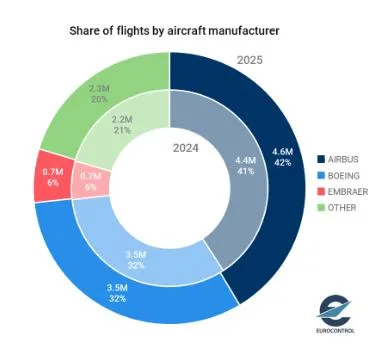
The global aircraft market is dominated by a duopoly: Airbus and Boeing, which supply
over 90% of commercial airplanes. This dominance gives airlines limited bargaining power,
/ 7
End of Document
40

FAQs

what is an oligopolistic market in the airline industry

An oligopolistic market in the airline industry is characterized by a few large airlines dominating the market, significantly influencing pricing and service offerings.

  • The market includes major players like American Airlines, Lufthansa, and Ryanair.
  • Competition is intense, particularly on price, due to the presence of low-cost carriers.
  • High barriers to entry exist, making it difficult for new airlines to enter the market.

how does competition work in the airline industry

Competition in the airline industry operates primarily through pricing, service quality, and route availability.

  • Airlines often engage in fare wars, leading to significant price reductions.
  • Service differentiation is limited, especially in economy class.
  • Customer loyalty programs play a crucial role in retaining passengers.

what are the key challenges in the airline industry

The airline industry faces several key challenges that impact profitability and growth.

  • Rising fuel prices significantly affect operational costs.
  • Supply chain disruptions delay aircraft deliveries, limiting fleet expansion.
  • Stricter environmental regulations increase operational costs and require investment in sustainable practices.

how do airlines differentiate their services

Airlines differentiate their services mainly through pricing strategies, service quality, and route networks.

  • On short-haul flights, differentiation is primarily based on price.
  • Long-haul flights focus more on in-flight services like meals and entertainment.
  • Customer loyalty programs also help in creating a competitive edge.

what is Ryanair's business model

Ryanair's business model is based on being an ultra-low-cost carrier, focusing on cost reduction and efficiency.

  • It employs an 'à la carte' pricing strategy, charging separately for additional services.
  • Ryanair maximizes aircraft usage and operates from secondary airports to keep costs low.
  • Digital tools enhance operational efficiency and customer experience.

how do mergers affect the airline market

Mergers in the airline market can lead to increased concentration and reduced competition.

  • Post-merger, flight frequency may drop by 8.7% to 12.2% on overlapping routes.
  • Mergers can also improve efficiency by combining complementary networks.
  • However, they may lead to higher fares due to reduced competition.

what role do low-cost carriers play in the airline industry

Low-cost carriers play a significant role in the airline industry by driving down prices and increasing competition.

  • They force traditional airlines to lower fares and improve services.
  • Low-cost carriers primarily target price-sensitive travelers.
  • They have expanded rapidly, capturing significant market share.

how does the airline industry handle price wars

The airline industry handles price wars through rapid fare adjustments and promotional strategies.

  • When one airline lowers fares, competitors often follow suit to maintain market share.
  • This can lead to average price drops of around 32%, and in extreme cases, up to 79%.
  • Airlines also engage in strategic marketing to attract customers during price wars.

what innovations are emerging in the airline industry

Emerging innovations in the airline industry focus on sustainability and operational efficiency.

  • New technologies include sustainable aviation fuels (SAF) that reduce emissions.
  • Airlines are researching electric and hydrogen aircraft for future use.
  • Process innovations involve using AI and data analytics to optimize operations.

what is the impact of COVID-19 on the airline industry

The COVID-19 pandemic had a profound impact on the airline industry, leading to a drastic reduction in air travel.

  • Passenger numbers fell by around 60% globally, with European airlines experiencing a 73% drop.
  • Airlines lost over $120 billion during this period.
  • The pandemic highlighted the industry's vulnerability to external shocks.