When heritable alterations occur in a very small segment of DNA molecule, i.e., a single
nucleotide or nucleotide pair, then this type of mutations are called “point mutations”. The
point mutations may occur due to following types of subnucleotide change in the DNA and
RNA.
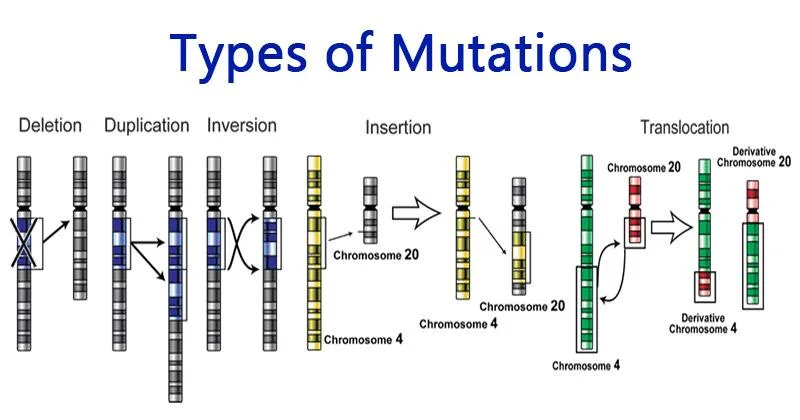
– Deletion mutations. The point mutation which is caused due to loss or deletion of some
portion (single nucleotide pair) in a triplet codon of a cistron or gene is called deletion
mutation.
– Insertion or addition mutation. The point mutations which occur due to addition of one or
more extra nucleotides to a gene or cistron are called insertion mutations.
The mutations which arise from the insertion or deletion of individual nucleotides and cause
the rest of the message downstream of the mutation to be read out of phase, are
called frameshift mutations.
– Substitution mutation. A point mutation in which a nucleotide of a triplet is replaced by
another nucleotide, is called substitution mutation.
2. Multiple mutations or gross mutations.
When changes involving more than one nucleotide pair, or entire gene, then such mutations
are called gross mutations. The gross mutations occur due to rearrangements of genes within
the genome. It may be:
1. The rearrangement of genes may occur within a gene. Two mutations within the same
functional gene can produce different effects depending on gene whether they occur
in the cis or trans position.
2. The rearrangement of gene may occur in number of genes per chromosome. If the
numbers of gene replicas are non-equivalent on the homologous chromosomes, they
may cause different types of phenotypic effects over the organisms.
3. Due to movement of a gene locus new type of phenotypes may be created, especially
when the gene is relocated near heterochromatin. The movement of gene loci may
take place due to following method:
(i) Translocation. Movement of a gene may take place to a non-homologous chromosome
and this is known as translocation.
(ii) Inversion. The movement of a gene within the same chromosome is called inversion.
E. Phenotypic Effects
1. Morphological mutations are mutations that affect the outwardly visible properties
of an organism (i.e. curly ears in cats)