This assignment focuses on key concepts in thermodynamics, chemical kinetics, and chemical equilibrium. It includes calculations for spontaneity of reactions, entropy changes, and the analysis of experimental data. Designed for students studying physical chemistry, it covers essential topics such as heat capacity, vaporization, and reaction order. The assignment is ideal for those preparing for exams in chemistry or related fields.

Key Points

  • Analyzes the spontaneity of the reaction H2 + I2 ⇌ 2 HI at different temperatures.
  • Calculates entropy change for heating 1 mol of gas at constant volume.
  • Determines the entropy change when converting ice to water vapor.
  • Utilizes experimental data to assess the order of a chemical reaction.
Sihle Usisa mpongwana
Edition:2024 Edition
2 pages
Language:English
Type:Assignment
Sihle Usisa mpongwana
Edition:2024 Edition
2 pages
Language:English
Type:Assignment
323
/ 2
Assignment 2
Entropy, Gibbs, Chemical Kinetics, Chemical Equilibrium
1. Determine whether the following reaction is spontaneous at 298 K & 500 K.
Use the Table at the back of textbook (Elements of Physical Chemistry) for
standard value: H
2
(g) + I
2
(g)  2 HI (g)
2. If the heat capacity at constant volume varies with temperature according to
the expression,
Cv = 15 – 1.5 T (where T is the temperature in K)
Determine the change in entropy, ΔS, for reversibly heating 1 mol from 277 K
to 356 K at constant volume. Show all the calculation steps.
3. Calculate the change in entropy of the system when 5 g of ice at −10.0 °C is
converted to water vapour at 110.0 °C at a constant pressure of 1 bar. The
molar constant-pressure heat capacities are:
C
p
,m
(H
2
O(s)) = 37.6 J K
−1
mol
−1
;
C
p
,m
(H
2
O(l)) = 75.3 J K
−1
mol
−1
; and
C
p
,m
(H
2
O(g)) = 33.6 J K
−1
mol
−1
. The
standard enthalpy of vaporization of H
2
O(l) is 40.7 kJ mol
−1
, and the standard
enthalpy of fusion of H
2
O(l) is 6.01 kJ mol
−1
, both at the relevant transition
temperatures.
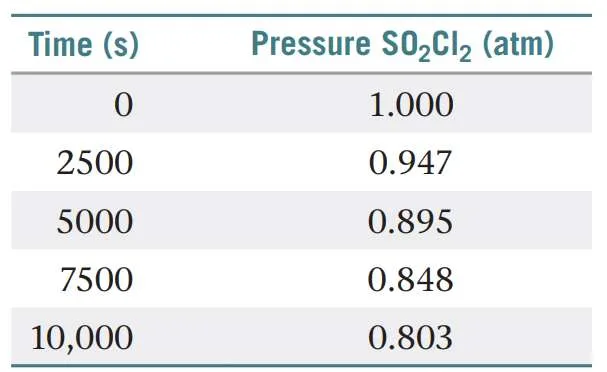
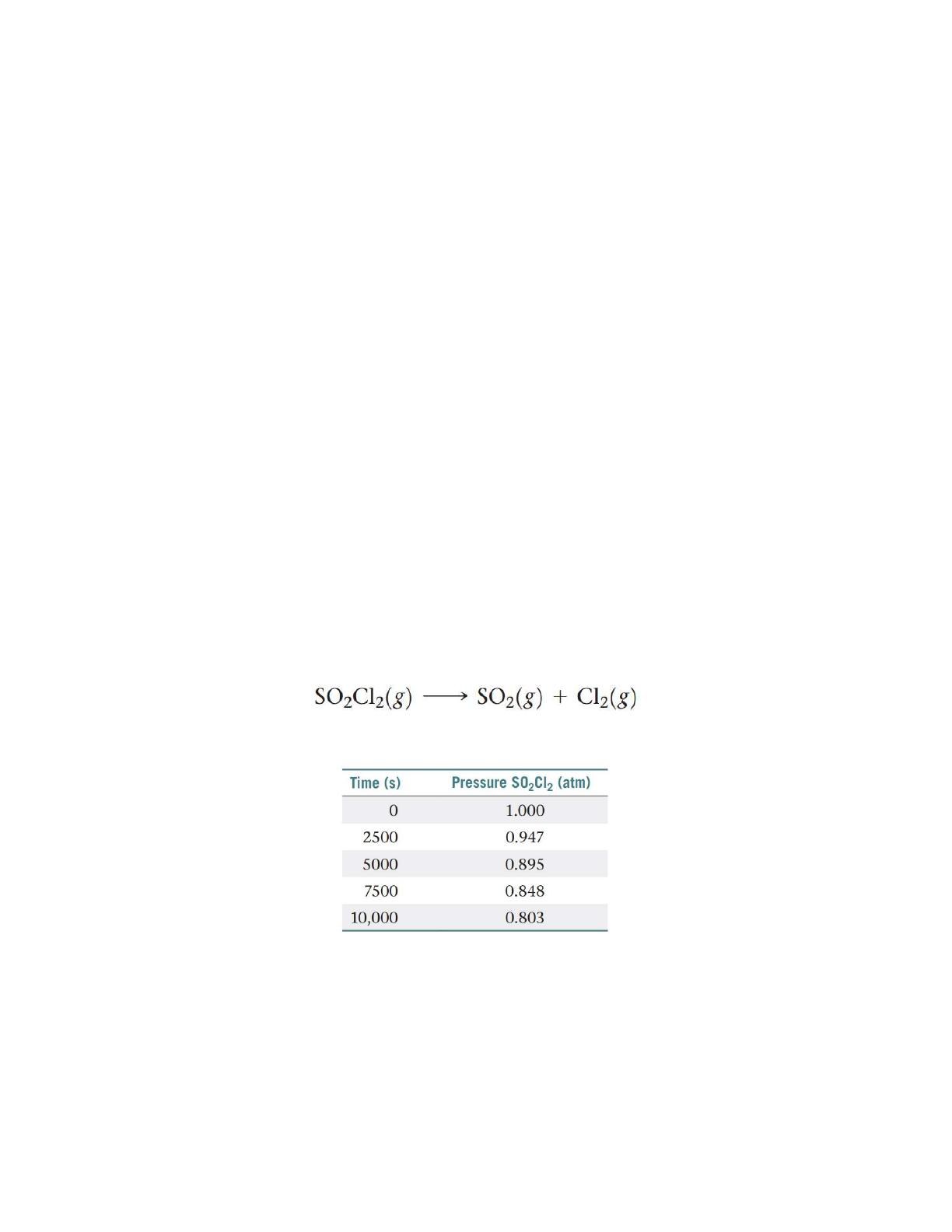
4. Use a graph to determine the order of the following reaction:
Given experimental data:
5.
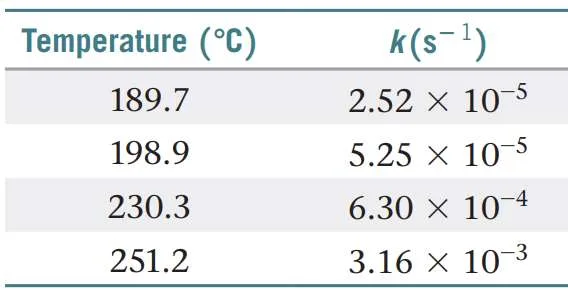
Use the table that shows the rate constants for the rearrangement of methyl
isonitrile at various temperatures:
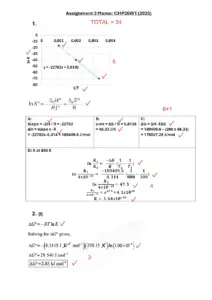
a. Plot a graph in excel and calculate the activation energy.
b. What is the value of the rate constant at 430.0 K
6.
7.
iv. Calculate K
p
at 25 and 150 °C. [3]
/ 2
End of Document
323

FAQs

what is the Entropy and Chemical Kinetics Assignment 2 about

The Entropy and Chemical Kinetics Assignment 2 focuses on key concepts in thermodynamics and reaction kinetics.

  • It includes calculations related to spontaneity of reactions at different temperatures.
  • Students are required to determine changes in entropy for various processes.
  • The assignment also involves analyzing reaction orders using experimental data.

how to calculate entropy in the Entropy and Chemical Kinetics Assignment 2

Calculating entropy in the Entropy and Chemical Kinetics Assignment 2 involves using specific formulas based on the heat capacities and temperature changes.

  • For constant volume, use the formula: ΔS = ∫(C_v/T) dT.
  • Apply the given heat capacity equation to find the change in entropy between specified temperatures.
  • Ensure to account for phase changes and their associated enthalpies when necessary.

what are the key topics in the Entropy and Chemical Kinetics Assignment 2

The key topics covered in the Entropy and Chemical Kinetics Assignment 2 include thermodynamic principles and reaction kinetics.

  • Spontaneity of chemical reactions and Gibbs free energy.
  • Calculating changes in entropy for heating and phase transitions.
  • Understanding reaction mechanisms and determining the order of reactions from experimental data.

how to determine spontaneity in the Entropy and Chemical Kinetics Assignment 2

To determine spontaneity in the Entropy and Chemical Kinetics Assignment 2, you need to analyze the Gibbs free energy change (ΔG).

  • If ΔG is negative, the reaction is spontaneous.
  • Use standard enthalpy and entropy values at given temperatures to calculate ΔG.
  • Consider the temperature's effect on spontaneity by evaluating ΔG at different temperatures.

what formulas are used in the Entropy and Chemical Kinetics Assignment 2

The Entropy and Chemical Kinetics Assignment 2 employs several key formulas for calculations.

  • ΔG = ΔH - TΔS for spontaneity analysis.
  • Entropy change: ΔS = ∫(C/T) dT for constant volume processes.
  • Rate laws and Arrhenius equation for reaction kinetics.

how to analyze reaction order in the Entropy and Chemical Kinetics Assignment 2

Analyzing reaction order in the Entropy and Chemical Kinetics Assignment 2 involves using experimental data to create concentration vs. time plots.

  • Determine the slope of the plot to identify zero, first, or second-order kinetics.
  • Use the integrated rate laws for each order to fit the data.
  • Graphical methods such as plotting ln[A] vs. time or 1/[A] vs. time can help clarify the reaction order.

what is the significance of Gibbs free energy in the Entropy and Chemical Kinetics Assignment 2

The significance of Gibbs free energy in the Entropy and Chemical Kinetics Assignment 2 lies in its ability to predict the spontaneity of reactions.

  • Gibbs free energy combines enthalpy and entropy to determine if a reaction will occur under specific conditions.
  • A negative ΔG indicates that the reaction can proceed spontaneously.
  • Understanding this concept is crucial for predicting reaction behavior in various chemical processes.

what are the heat capacities used in the Entropy and Chemical Kinetics Assignment 2

The heat capacities used in the Entropy and Chemical Kinetics Assignment 2 are essential for calculating entropy changes.

  • Cp,m(H2O(s)) = 37.6 J K−1 mol−1 for solid water.
  • Cp,m(H2O(l)) = 75.3 J K−1 mol−1 for liquid water.
  • Cp,m(H2O(g)) = 33.6 J K−1 mol−1 for water vapor.

how to calculate activation energy in the Entropy and Chemical Kinetics Assignment 2

Calculating activation energy in the Entropy and Chemical Kinetics Assignment 2 can be done using the Arrhenius equation.

  • Use the formula: k = Ae^(-Ea/RT), where k is the rate constant, A is the pre-exponential factor, Ea is the activation energy, R is the gas constant, and T is the temperature.
  • Plot ln(k) vs. 1/T to determine the slope, which is equal to -Ea/R.
  • This method allows for the determination of activation energy from experimental rate constants at various temperatures.

what is the role of phase changes in the Entropy and Chemical Kinetics Assignment 2

The role of phase changes in the Entropy and Chemical Kinetics Assignment 2 is crucial for understanding entropy calculations.

  • Phase changes, such as melting and vaporization, involve significant changes in entropy.
  • Standard enthalpies of fusion and vaporization must be included in entropy calculations.
  • These changes affect the overall spontaneity and thermodynamic behavior of reactions.