Fractals and Fractal Dimension explores the concept of fractals, introduced by B. Mandelbrot in the 1960s, and their applications across various fields. This document provides a comprehensive analysis of deterministic fractals, including the Cantor set, Koch curve, and Sierpiński carpet, detailing their formation algorithms and self-similarity properties. It also delves into the concept of fractal dimension, explaining how it differs from traditional dimensions and its significance in understanding complex structures. Ideal for students and researchers in mathematics and science, this resource offers insights into the mathematical modeling of fractals and their practical implications.

Key Points

  • Explains the concept of fractals and their historical context.
  • Details the formation algorithms of the Cantor set and Koch curve.
  • Discusses the significance of fractal dimension in mathematics.
  • Illustrates self-similarity properties of various fractals.
George Knitter
4 pages
Language:Ukrainian
Type:Lab Report
George Knitter
4 pages
Language:Ukrainian
Type:Lab Report
236
/ 4
Лабораторна робота. Фрактали та фрактальна розмірність
1.1. Поняття фрактала
Поняття фрактала введене у 60-х роках ХХ ст.
Б. Мальденбротом. Останніми десятиліттями це поняття широко використовують у різних галузях
знань. Пояснимо поняття фрактала на прикладі задачі знаходження довжини кола. Для цього
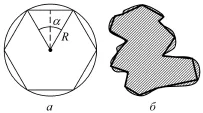
впишемо у коло багатокутник, внутрішній кут якого
2/n
.
Очевидно, що довжина кола приблизно дорівнює периметру багатокутника
(рис. 1.а):
2
2 sin 2 sin
2
l nR nR
nn


, або .
sin
2
l
n
Rn
Рис. 1. Визначення довжини кола (а) та площі фігури довільної форми (б)
Точне значення довжини отримаємо в разі граничного переходу:
lim sin 3,1415..
2
n
l
n
Rn


.
Якщо використати таку процедуру для знаходження довжини плоскої фігури довільної форми
(див. рис. 1, б), то її довжина зростатиме зі збільшенням n і в граничному випадку стане
нескінченно великою. Іншими словами, визначена таким способом довжина є “поганою”
характеристикою фігури з довільним контуром. Для знаходження “хорошої характеристики”
треба ввести ншу величину, якою і слугує фрактальна розмірність.
1.2. Детерміновані фрактали
Для вивчення фракталів широко використовують математичні моделі, які дають змогу
отримувати і досліджувати детерміновані фрактальні структури. Наведемо типові приклади
фракталів та алгоритми їхнього утворення.
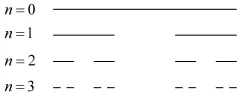
Найпростішим прикладом фрактала слугує, напевне, множина Кантора, для утворення якої
беруть відрізок одиничної довжини (рис. 2). На першому кроці цей відрізок ділять на три однакові
частини і викидають середню його частину. У підсумку утворюється
2N
відрізки з довжиною
1
1/3r
.
Рис. 2. Алгоритм утворення множини Кантора
На другогму кроці ці два відрізки знову ділять на три однакові частини і викидають середні
їхні частини. Унаслідок цього утвориться
2
42N 
відрізки з довжиною
2
2
1/9 1/3r 
.
На n-му кроці утворюється, очевидно,
відрізків з довжиною
1/3
n
n
r
. У разі
повторення цієї процедури багато разів виникає множина Кантора, яку схематично зображено на
рис. 2.
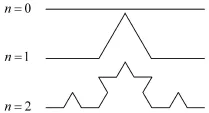
Для утворення кривої Кох вихідним також є одиничний відрізок, який ділять на три однакові
частини (рис. 3).
Надалі середній відрізок замінюють двома відрізками такої ж довжини, так що на першому
кроці крива вже має
4N
відрізки довжиною
1
1/3r
/ На наступному кроці середні частини
чотирьох відрізків заміняють двома, так що виникає
2
16 4N 
відрізків з довжиною
2
2
1/9 1/3r 
.
На n-му кроці існуватиме
відрізків з довжиною
1/3
n
n
r
(див. рис. 12.4).
Рис. 3. Алгоритм утворення кривої Кох
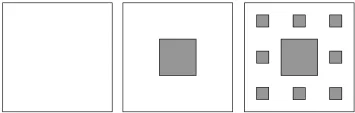
Килим Серпінського виникає в разі розділення квадрата з одиничною стороною на дев’ять
однакових квадратиків зі стороною
1
1/3r
і викиданням центрального (рис. 4).
Унаслідок цього на першому кроці буде
8N
квадратиків, а площа, яку викидають,
2
1
1/3S
.
Після повторення процедури на другому кроці отримаємо квадратиків зі стороною
2
2
1/3 ,r
а площа, яку викидають, буде
2
1
1/3S
.
На n-му кроці утворюється
8
n
N
квадратиків зі стороною
1/3
n
n
r
, а
2
1/3
n
n
S
.(див.
рис. 4).
Рис. 4. Алгоритм утворення килима Серпінського (заштриховані квадрати викидають)
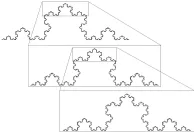
Найважливішою властивістю фракталів є їхня самоподібність. Для розкриття суті цієї
властивості виділимо деяку частину кривої Кох з характерною довжиною і розглянемо її в
іншому масштабі. У цьому разі спостерігатимемо фігуру, яка нічим не відрізняється від
початкової (рис. 5). Якщо виконувати таку саму дію з фігурою, отриманою після першої операції,
то одержимо такий самий результат. Іншими словами, незалежно від масштабу структура
фракталу є однаковою.
Рис. 5. Самоподібність кривих Кох
1.3. Фрактальна розмірність
Згідно з означенням, фракталом є масштабно-інваріантний (тобто самоподібний) об’єкт, який
має дробову (нецілу) розмірність D і “вкладений” в одно-, дво- чи тривимірний топологічний
простір.
Топологічна розмірність
T
d
є цілочисловою, і такою, що дорівнює, відповідно, 0,1, 2 та 3 для
точки, кривої, поверхні та об’ємного тіла.
Дробова розмірність або розмірність Хаусдорфа–Базековича
,
H
d
уведена 1918 р. Ф.
Хаусдорфом. Для обчислення розмірності Хаусдорфа
,
H
d
досліджувану множину “занурюють” у
простір
T
d
, а потім покривають її вимірними “кубиками” зі стороною
r
. Зрозуміло, що “об’єм”
кубика становитиме
,
H
d
r
а їхня кількість в одиничному об’ємі
1V
1
HH
dd
V
Nr
rr

(1)
З отриманого співвідношення можна розрахувати
:
H
d
ln
ln1/
H
Nr
d
r
(2)
Зазвичай фрактальну розмірність визначають повторенням описаної процедури з різними
значеннями сторони “кубика”, тоді
ln
lim
ln1/
n
H
n
n
Nr
d
r

(3)
Застосуємо співвідношення (3) для визначення фрактальної розмірності розглянутих
фракталів. З алгоритму утворення множини Кантора безпосередньо випливає, що
ln
ln2 ln 2
lim lim 0,63
ln1/ ln3 ln3
n
n
H
n
nn
n
Nr
d
r
 
(4)
Отже,
01
H
d
, з чого випливає, що множина Кантора вже не є лінією, для якої
1
H
d
, проте і не
є сукупністю точок, для яких
.
/ 4
End of Document
236

FAQs

what are fractals and fractal dimension

Fractals are complex geometric shapes that can be split into parts, each of which is a reduced-scale copy of the whole. This property is known as self-similarity.

Fractal dimension is a measure that describes how completely a fractal appears to fill space as you zoom in on it. Unlike traditional dimensions, which are integers (0, 1, 2, 3), fractal dimensions can be non-integer values, indicating the complexity of the fractal.

how to calculate fractal dimension

The fractal dimension can be calculated using various methods, one of the most common being the box-counting method. This involves covering the fractal with a grid of boxes and counting how many boxes contain part of the fractal.

  1. Choose a grid size (ε).
  2. Count the number of boxes (N(ε)) that contain a part of the fractal.
  3. Repeat with different grid sizes.

As the grid size approaches zero, the relationship between N(ε) and ε can be used to find the fractal dimension (D) using the formula: D = lim (ln(N(ε))/ln(1/ε)).

examples of fractals in nature

Fractals are prevalent in nature, showcasing the concept of self-similarity. Some notable examples include:

  • Snowflakes: Each snowflake exhibits intricate patterns that are self-similar at various scales.
  • Coastlines: The length of a coastline can vary dramatically based on the scale of measurement, demonstrating fractal properties.
  • Plants: The branching patterns of trees and the arrangement of leaves are often fractal in nature.

These examples illustrate how fractals can be found in various natural phenomena, reflecting complex structures and patterns.

what is the significance of fractal dimension

The fractal dimension is significant because it provides insight into the complexity and structure of various phenomena. It helps quantify how a fractal occupies space and can be applied in multiple fields.

  • In biology: Understanding the branching patterns of blood vessels.
  • In geography: Analyzing the shapes of coastlines and mountain ranges.
  • In art: Creating visually appealing designs that mimic natural patterns.

By studying fractal dimensions, researchers can better understand the underlying principles governing complex systems.

how are fractals used in computer graphics

Fractals are widely used in computer graphics to create realistic textures and landscapes. Their self-similar nature allows for the generation of intricate patterns without requiring extensive data.

  • Terrain generation: Fractals can simulate natural landscapes, such as mountains and valleys.
  • Textures: They can create complex textures for surfaces, like bark or clouds.
  • Animation: Fractals can be animated to produce dynamic and visually appealing effects.

This application of fractals enhances the realism and visual quality of computer-generated imagery.

what are deterministic fractals

Deterministic fractals are fractals generated by a specific, repeatable process. Unlike random fractals, their structures can be precisely defined and reproduced.

  • Examples include:
  • Cantor set: Created by repeatedly removing the middle third of a line segment.
  • Koch curve: Formed by recursively altering the sides of a triangle.
  • Sierpinski triangle: Generated by removing the central triangle from an equilateral triangle.

These fractals highlight the mathematical principles behind self-similarity and infinite complexity.

what is the relationship between fractals and chaos theory

The relationship between fractals and chaos theory lies in their shared characteristics of complexity and unpredictability. Fractals often emerge in systems that exhibit chaotic behavior.

  • Self-similarity: Both concepts involve patterns that repeat at different scales.
  • Non-linear dynamics: Systems described by chaos theory often produce fractal structures in their phase space.
  • Example: The logistic map is a classic example of a chaotic system that produces fractal patterns.

Understanding this relationship helps in analyzing complex systems in various scientific fields.

what are the applications of fractals in science

Fractals have numerous applications across various scientific disciplines due to their ability to model complex structures and processes.

  • Medicine: Analyzing the branching patterns of blood vessels and lung structures.
  • Geology: Studying the distribution of minerals and the formation of geological structures.
  • Physics: Understanding phenomena such as turbulence and wave patterns.

These applications demonstrate the versatility of fractals in representing and analyzing real-world phenomena.

how do fractals relate to art

Fractals have a significant relationship with art, as they inspire various artistic movements and techniques. Artists utilize fractal patterns to create visually striking and complex works.

  • Digital art: Many digital artists use algorithms to generate fractal images.
  • Architecture: Fractal geometry influences architectural designs that mimic natural forms.
  • Traditional art: Artists like M.C. Escher incorporated fractal-like patterns in their work.

This intersection of fractals and art highlights the beauty of mathematical concepts in creative expression.