Design Thinking and Innovation Suggestions provides a comprehensive overview of design thinking methodologies and their applications. This resource explores the phases of design thinking, including empathy, definition, ideation, prototyping, and testing. It also discusses brainstorming techniques, prioritization methods like the 2×2 matrix, and the 6-3-5 method for idea generation. Ideal for professionals and students seeking to enhance their problem-solving skills through innovative design approaches.

Key Points

  • Explains the phases of design thinking, including empathy and ideation.
  • Describes brainstorming techniques and the 2×2 matrix for prioritizing ideas.
  • Covers the 6-3-5 method for effective idea generation.
  • Discusses the importance of storytelling in design thinking.
112_KOUSHIK BADYAKAR_CSE
1 page
Language:English
Type:Lecture Notes
112_KOUSHIK BADYAKAR_CSE
1 page
Language:English
Type:Lecture Notes
395
/ 1
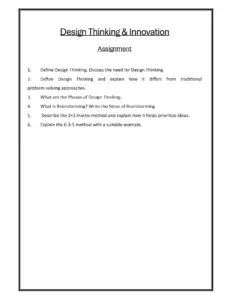
Design Thinking & Innovation
1. Define Design Thinking. Discuss the need for Design Thinking.
2. Define Design Thinking and explain how it differs from tradional
problem-solving approaches.
3. What are the Phases of Design Thinking.
4. What is Brainstorming? Write the Steps of Brainstorming.
5. Describe the 2 matrix method and explain how it helps priorize ideas.
6. Explain the 6-3-5 method with a suitable example.
7. What is Storytelling? Write the difference between Invenon and Innovaon.
8. What is 5W + H Quesons? Explain.
9. What is Feedback Capture Grid? Explain.
10. What is meant by a shared model in team-based design? Illustrate with an
example of how it improves collaboraon.
/ 1
End of Document
395

FAQs

what is design thinking and innovation

Design thinking is a human-centered approach to innovation that integrates the needs of people, the possibilities of technology, and the requirements for business success.

  • Empathy: Understanding the user’s needs and experiences.
  • Define: Clearly articulating the problem to be solved.
  • Ideate: Generating a wide range of ideas and solutions.
  • Prototype: Creating tangible representations for a subset of ideas.
  • Test: Seeking feedback and iterating on the solutions.

how does design thinking differ from traditional problem-solving

Design thinking differs from traditional problem-solving by emphasizing a user-centered approach and iterative processes.

  • Focus on Users: Design thinking prioritizes understanding user needs, while traditional methods often focus on data and analytics.
  • Iterative Process: It encourages prototyping and testing, allowing for adjustments based on feedback, unlike linear traditional methods.
  • Collaboration: Design thinking promotes teamwork across disciplines, fostering diverse perspectives.

what are the phases of design thinking

The phases of design thinking typically include five key stages: Empathize, Define, Ideate, Prototype, and Test.

  • Empathize: Engage with users to understand their needs.
  • Define: Clearly articulate the problem based on user insights.
  • Ideate: Brainstorm a wide range of ideas.
  • Prototype: Create simple models of potential solutions.
  • Test: Gather user feedback to refine the solutions.

what is brainstorming in design thinking

Brainstorming is a creative group activity aimed at generating a large number of ideas to solve a specific problem.

  • Encourages Free Thinking: Participants are encouraged to share any ideas without judgment.
  • Builds on Ideas: Ideas can be combined or improved upon by others in the group.
  • Steps of Brainstorming: Define the problem, encourage idea generation, record all ideas, and evaluate them later.

what is the 2x2 matrix method in design thinking

The 2x2 matrix method is a visual tool used to prioritize ideas based on two criteria.

  • Axes: Typically, one axis represents impact and the other represents effort.
  • Quadrants: Ideas are categorized into four quadrants: High Impact/Low Effort, High Impact/High Effort, Low Impact/Low Effort, and Low Impact/High Effort.
  • Prioritization: This helps teams focus on ideas that offer the best return on investment.

what is the 6-3-5 method in design thinking

The 6-3-5 method is a structured brainstorming technique designed to generate a large number of ideas in a short period.

  • Participants: Six participants each write down three ideas in five minutes.
  • Rotation: After five minutes, participants pass their ideas to the next person, who builds on them.
  • Outcome: This process continues until all ideas are exhausted, leading to a rich pool of concepts.

what is storytelling in design thinking

Storytelling in design thinking is a technique used to communicate ideas and solutions effectively.

  • Engagement: It helps engage stakeholders by illustrating user experiences.
  • Connection: Stories create emotional connections that can drive understanding and empathy.
  • Difference between Invention and Innovation: Invention is creating something new, while innovation is improving or applying existing ideas in new ways.

what are 5W + H questions in design thinking

The 5W + H questions are a framework used to explore a problem deeply by asking Who, What, Where, When, Why, and How.

  • Who: Identify the stakeholders involved.
  • What: Define the problem or challenge.
  • Where: Determine the context or environment.
  • When: Establish the timeline for the problem.
  • Why: Understand the reasons behind the issue.
  • How: Explore potential solutions and methods.

what is a feedback capture grid in design thinking

A feedback capture grid is a tool used to organize and analyze feedback from users during the design process.

  • Structure: It typically includes sections for positive feedback, negative feedback, suggestions, and questions.
  • Purpose: This helps teams identify patterns and prioritize changes based on user input.
  • Implementation: Teams can use this grid during testing phases to refine their prototypes.

what is a shared model in team-based design

A shared model in team-based design refers to a common understanding or framework that all team members use to collaborate effectively.

  • Collaboration: It fosters open communication and alignment among team members.
  • Example: A visual representation of the design process can serve as a shared model, helping everyone stay on the same page.
  • Benefits: This approach enhances teamwork, reduces misunderstandings, and improves project outcomes.