Mutation and Its Types explores the various forms of genetic mutations, including gene and chromosome mutations. It provides detailed classifications such as somatic and germinal mutations, as well as spontaneous and induced mutations. The document outlines the phenotypic effects of mutations, including morphological, lethal, and conditional mutations. Ideal for biology students, this unit serves as a comprehensive guide to understanding genetic variation and its implications in organisms. It covers essential concepts relevant for AP Biology and genetics courses.

Key Points

  • Explains gene mutations and chromosome mutations, detailing their classifications.
  • Covers somatic and germinal mutations, highlighting their transmission to progeny.
  • Describes spontaneous and induced mutations, including their origins and effects.
  • Discusses phenotypic effects such as morphological, lethal, and conditional mutations.
Mahi Goyal
7 pages
Language:English
Type:Lecture Notes
Mahi Goyal
7 pages
Language:English
Type:Lecture Notes
110
/ 7
Mutation and its types
Mutation is a process that produces a gene or chromosome that differs from
the wild type. The mutation may result due to changes either on the gene or the
chromosome itself.
Thus, broadly mutation maybe:
1. Gene mutation where the allele of a gene changes.
2. Chromosome mutation where segments of chromosomes, whole chromosomes, or
entire sets of chromosomes change.
Types of Mutations
There are various schemes for classification of different kind of mutations. Depending on:
A. The Type of Cell Involved
1. Somatic mutations
Mutations that are in the somatic tissues of the body.
Mutations are not transmitted to progeny.
The extent of the phenotypic effect depends upon whether the mutation is dominant or
recessive (dominant mutations generally have a greater effect).
The extent of the phenotypic effect depends upon whether it occurs early or late in
development (early arising mutations have a greater effect).
2. Germinal mutations
Mutations that are in the germ tissues of the body.
Mutations may be transmitted to progeny
Dominant mutations are seen in first generation after the mutation occurs
If a female gamete containing an X-linked mutation is fertilized, the males will show
the mutant phenotype
Recessive mutations will only be seen upon the chance mating with an individual
carrying the recessive allele too; thus, the recessive mutation may remain hidden for
many generations
B. Mode of Origin
(1) Spontaneous mutations
The spontaneous mutations occur suddenly in the nature and their origin is unknown. They
are also called “background mutation” and have been reported in many organisms such as,
Oenothera, maize, bread molds, microorganisms (bacteria and viruses), Drosophila, mice,
man, etc.
(2) Induced mutations
Besides naturally occurring spontaneous mutations, the mutations can be induced artificially
in the living organisms by exposing them to abnormal environment such as radiation, certain
physical conditions (i.e., temperature) and chemicals.
C. Direction of Mutation
According to their mode of direction following types of mutations have been recognised:
1. Forward mutations
In an organism when mutations create a change from wild type to abnormal phenotype, then
that type of mutations are known as forward mutations. Most mutations are forward type.
2. Reverse or back mutations
The forward mutations are often corrected by error correcting mechanism, so that an
abnormal phenotype changes into wild type phenotype.
D. Size and Quality
According to size following two types of mutations have been recognized:
1. Point mutation
When heritable alterations occur in a very small segment of DNA molecule, i.e., a single
nucleotide or nucleotide pair, then this type of mutations are called “point mutations”. The
point mutations may occur due to following types of subnucleotide change in the DNA and
RNA.
Deletion mutations. The point mutation which is caused due to loss or deletion of some
portion (single nucleotide pair) in a triplet codon of a cistron or gene is called deletion
mutation.
Insertion or addition mutation. The point mutations which occur due to addition of one or
more extra nucleotides to a gene or cistron are called insertion mutations.
The mutations which arise from the insertion or deletion of individual nucleotides and cause
the rest of the message downstream of the mutation to be read out of phase, are
called frameshift mutations.
Substitution mutation. A point mutation in which a nucleotide of a triplet is replaced by
another nucleotide, is called substitution mutation.
2. Multiple mutations or gross mutations.
When changes involving more than one nucleotide pair, or entire gene, then such mutations
are called gross mutations. The gross mutations occur due to rearrangements of genes within
the genome. It may be:
1. The rearrangement of genes may occur within a gene. Two mutations within the same
functional gene can produce different effects depending on gene whether they occur
in the cis or trans position.
2. The rearrangement of gene may occur in number of genes per chromosome. If the
numbers of gene replicas are non-equivalent on the homologous chromosomes, they
may cause different types of phenotypic effects over the organisms.
3. Due to movement of a gene locus new type of phenotypes may be created, especially
when the gene is relocated near heterochromatin. The movement of gene loci may
take place due to following method:
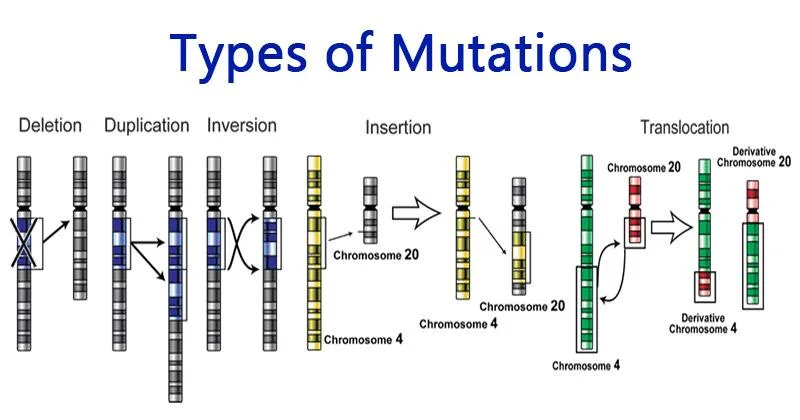
(i) Translocation. Movement of a gene may take place to a non-homologous chromosome
and this is known as translocation.
(ii) Inversion. The movement of a gene within the same chromosome is called inversion.
E. Phenotypic Effects
1. Morphological mutations are mutations that affect the outwardly visible properties
of an organism (i.e. curly ears in cats)

/ 7
End of Document
110

FAQs

What are the main types of mutations described in the document?
The document outlines two broad categories of mutations: gene mutations and chromosome mutations. Gene mutations involve changes in the allele of a gene, while chromosome mutations pertain to alterations in segments of chromosomes, whole chromosomes, or entire sets of chromosomes. Additionally, mutations are classified based on the type of cell involved, such as somatic and germinal mutations, and their mode of origin, which includes spontaneous and induced mutations.
What is the difference between somatic and germinal mutations?
Somatic mutations occur in the somatic tissues of the body and are not transmitted to progeny, while germinal mutations occur in germ tissues and can be passed to offspring. The phenotypic effects of somatic mutations depend on whether they are dominant or recessive and when they arise during development. In contrast, dominant germinal mutations can be observed in the first generation, whereas recessive mutations may remain hidden for generations until they are expressed through mating.
What are point mutations and their types?
Point mutations refer to heritable alterations occurring in a very small segment of DNA, specifically a single nucleotide or nucleotide pair. They can be categorized into three types: deletion mutations, which involve the loss of a nucleotide; insertion mutations, which add extra nucleotides; and substitution mutations, where one nucleotide is replaced by another. Frameshift mutations, caused by the insertion or deletion of nucleotides, can shift the reading frame of the genetic code, affecting downstream coding.
How do gain of function and loss of function mutations differ?
Gain of function mutations, also known as activating mutations, enhance the gene product's effect or introduce a new function, while loss of function mutations, or inactivating mutations, result in reduced or absent function of the gene product. The document explains that loss of function mutations can lead to complete inactivation of the gene, whereas gain of function mutations may lead to stronger or abnormal functions of the gene product.
What are the phenotypic effects of mutations mentioned in the document?
The document categorizes phenotypic effects of mutations into several types. Morphological mutations affect visible traits of an organism, such as curly ears in cats. Lethal mutations impact the organism's viability, while conditional mutations only manifest under specific environmental conditions. Biochemical mutations may not be visible but can significantly affect growth or proliferation, as seen in certain E. coli mutants that require external tryptophan for growth.
What is the significance of chromosomal mutations?
Chromosomal mutations involve changes in chromosome structure or number and are significant in applied biology, including agriculture and medicine. They can lead to structural changes, such as deletions or duplications of chromosome segments, and changes in the number of chromosomes, which can result in conditions like euploidy and aneuploidy. These mutations can have profound effects on the phenotype and are inherited once they occur.
What are the types of aneuploidy described in the document?
Aneuploidy involves the gain or loss of part of the chromosome set, resulting in an abnormal number of chromosomes. The document identifies three types of aneuploidy: nullisomy, which is the loss of both homologous chromosomes; monosomy, the loss of one chromosome from a homologous pair; and trisomy, the gain of an extra chromosome. Examples of trisomy include Klinefelter syndrome and Down syndrome.