The Deshi Nama System is an ancient accounting method that predates the double entry system. It utilizes books known as Wahi, written in regional languages, making it accessible and easy to understand. This system is characterized by its unique format, including specific pages for worship and the use of traditional ink. It is commonly maintained according to the Vikram Samvat calendar, aligning with financial year practices. Ideal for students and professionals interested in historical accounting methods, this overview covers key features and practices of the Deshi Nama System.
Key Points
Deshi Nama System is an ancient accounting method predating double entry accounting.
Books in Deshi Nama are known as Wahi and are often covered in red cloth.
The system is maintained according to the Vikram Samvat calendar and modern financial year.
Unique features include a puja page for worship and specific ink usage.
This link leads to an external site. We do not know or endorse its content, and are not responsible for its safety. Click the link to proceed only if you trust this site.
DLD QB – Comprehensive Overview and AnalysisLecture Notes
PDFLecture Notes
Device Management in Operating Systems – Lesson 6Lecture Notes
PDF
Overview of 14 Literary Genres and Their Characteristics
PDF
Nervous System Overview for Grade 6 Science
PDFLecture Notes
Evolution and Transformation of Cybercrime NetworksLecture Notes
PDFLecture Notes
IRS 121: Rise of Nation-State – Conceptual ClarificationsLecture Notes
PDFLecture Notes
Accounting Concepts – Chapter 6 Part 2Lecture Notes
PDFLecture Notes
Soil Compaction Part IILecture Notes
PDFLecture Notes
Units & Measurement Mind MapsLecture Notes
PDFLecture Notes
アニミズムの概念とその影響Lecture Notes
PDFLecture Notes
Thermodynamics Processes – PHY 103Lecture Notes
PDFLecture Notes
Racial Capitalism and Mining in South Africa LectureLecture Notes
FAQs
What are the two methods of writing accounts mentioned in the document?
The document identifies two prevalent methods of writing accounts: the Double Entry system and the Deshi Nama System. The Deshi Nama System is noted to be very old and predates the Double Entry system. It is also referred to as 'Wahl Khata paddhati' and is written in the regional language, making it easier to understand and use.
What are the characteristics of the Deshi Nama System?
The Deshi Nama System has several key characteristics. Firstly, the books used are typically covered with red cloth and hardbound, featuring a design made with thick string. Additionally, it is maintained for a Vikram Samvat year, starting from Kartak sud 1 to Aso vad 30, or according to income tax rules from April 1 to March 31. The first page often contains a prayer to God, and entries are made with the prefix 'Shri' to signify respect.
How is the credit and debit side organized in the Deshi Nama System?
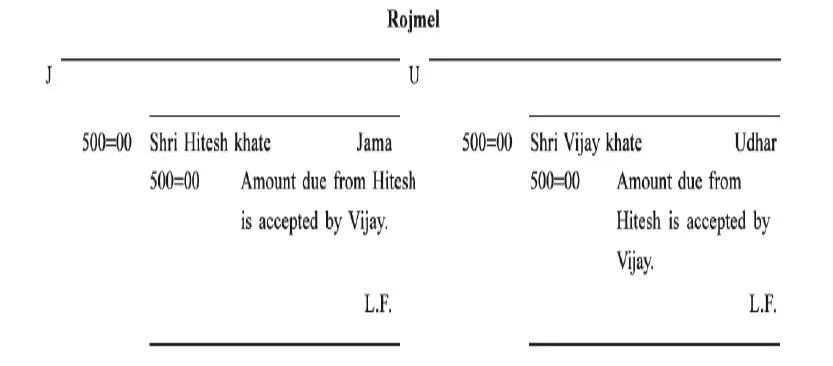
In the Deshi Nama System, the books are structured with a total of eight folds. The first four folds on the left-hand side are designated as the Jama (credit) side, while the remaining four folds on the right-hand side are known as the Udhar (debit) side. This organization helps in clearly distinguishing between credits and debits in financial transactions.
What is the significance of the 'puja page' in the Deshi Nama System?
The 'puja page' in the Deshi Nama System is significant as it is the first page of the Rojmal or Bethomel where the businessman writes a prayer to God, such as 'Shri Ganeshay Namah.' This page serves a ceremonial purpose, and importantly, no accounting entries are recorded on it, emphasizing the spiritual aspect of the accounting process.
What is the method of writing amounts in the Deshi Nama books?
When entering amounts in Deshi Nama books, a sign known as 'Holayo' or 'Olayo' is placed between the rupee and paise amounts. In contemporary practice, many businessmen use the equality sign (=) instead. For example, an amount may be written as 121 25 or 121=25, indicating one hundred twenty-one rupees and twenty-five paise.
What language is used in the Deshi Nama System?
The Deshi Nama System is characterized by the use of the regional language for writing accounts. For instance, in Gujarat, the Deshi Nama is written in Gujarati. This practice makes the accounting process more accessible and understandable for local businessmen.
Related
PDFStudy Guide
The Great Gatsby OverviewStudy Guide
PDFReport
Wekeza Family Financial Overview 2025-2026Report
PDFNotes
Information and Communication Technology (ICT) OverviewNotes
PDFNotes
Database Management System Lecture Notes by Swagatika DalaiNotes
PDFPDFPractice Test
Year 9 Global Systems Practice Test QuestionsPractice Test
PDFStudy Guide
Cornell Notes System for Effective Note TakingStudy Guide
PDFGuide
Product Strategy Overview and ImportanceGuide
PDFGuide
2024 Jiji Sales Training Day 1 OverviewGuide
PDFTextbook
RAD 381 The Female Reproductive SystemTextbook
PDFGuide
UML Use Case Diagram for ATM SystemsGuide
PDFStudy Guide
Software Testing Fundamentals OverviewStudy Guide
PDFResource
Entrepreneurship Development Process OverviewResource