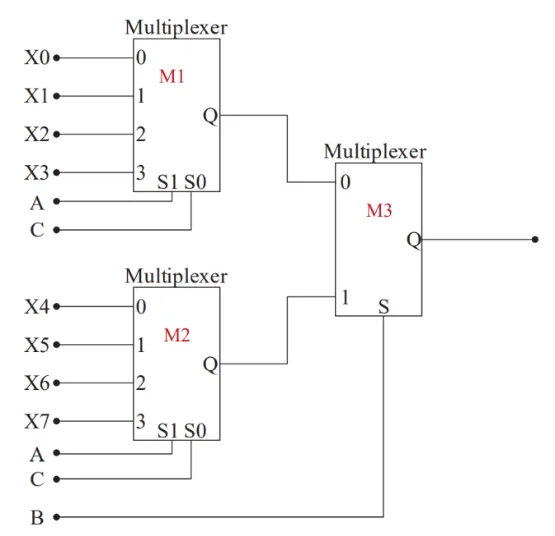
Q13. Implement the following logic circuit using a 3:8 line decoder.
F1 = minterms(1,2,7), F2 = minterms(2,3,4), F3 = minterms(0,4,6).
UNIT 3: Sequential Logic Circuits
Q14. Define sequential logic circuits. Differentiate between combinational and sequential
circuits.
Q15. Explain the working of SR, JK, D, and T flip-flops with truth tables. Why is JK flip-flop
preferred over SR flip-flop?
Q16. Convert a JK flip-flop into:
(a) D flip-flop. (b) T flip-flop.
Q17. Implement T to J-K and SR to J-K Flipflop.
Q18. Design a 2-bit asynchronous up counter using JK flip-flops. Draw timing diagrams.
Q19. Design a synchronous 3-bit up counter using D flip-flops.
Q20. Design a random sequence generator using JK flip-flops for the sequence:
001 → 011 → 101 → 111 → 001.
Q21. A Binary ripple counter is used to count upto (2047)10, How many FF’s will be required
for its designing.
Q22. For the communication system given below, what will be the output frequency?
Q23. Define the terms: a). Setup time, b). Hold time, c). Negative edge triggered circuit,
d). Propagation Delay, e). Flipflop, f). Max. clock Frequency.
UNIT 4: Counters
Q24. Design a 3 bit asynchronous up/down counter.
Q25. Design an asynchronous MOD-7 up counter using J-K FF. Show the reset logic clearly.
Q26. Design an asynchronous MOD-4 down counter using T FF. Show the reset logic clearly.
Q27. Design a 2-bit synchronous up/down counter using J-K FF.
Q28. Design a type T counter that goes through states 0, 3, 5, 6, 0, …, Is the counter self-
starting? If it’s not a self-starting, then modify the circuit.
Q29. Design a type D counter that goes through states 0, 1, 2, 4, 0, … The unused/ unwanted
states must go to zero(000) on next clock pulse.
Q30. Design a J-K counter that goes through states 3, 4, 6, 7 and 3… . Is the counter self-
starting? Modify the circuit such that if it goes to an invalid state it comes back to state 3.