The investigation explores the foaming capacity of various washing soaps and the impact of sodium carbonate on their effectiveness. It details the chemical properties of soaps, including their ability to emulsify oils and dirt, and describes the experimental procedure used to measure foam stability. This study is essential for understanding how different soap formulations perform in cleaning applications, particularly in hard versus soft water conditions. The findings are relevant for chemistry students and professionals interested in detergent formulation and effectiveness.

Key Points

  • Analyzes the foaming capacity of various washing soaps under controlled conditions.
  • Explains the chemical reactions involved in soap production and its cleaning mechanisms.
  • Details the experimental setup, including the use of sodium carbonate to enhance soap performance.
  • Compares the foaming stability of soaps in distilled versus tap water.
Bhumika Rajput
5 pages
Language:English
Type:Research Paper
Bhumika Rajput
5 pages
Language:English
Type:Research Paper
240
/ 5
© May 2020 | IJIRT | Volume 6 Issue 12 | ISSN: 2349-6002
IJIRT 149364 INTERNATIONAL JOURNAL OF INNOVATIVE RESEARCH IN TECHNOLOGY 67
Investigation of Foaming Capacity of Different Washing
Soap
Pradnya B. Bhatane
1
, Yogesh Harangule
2
, Nandkishor B. Bavage
3
, Vidyasagar Gali
4
, Shyamlila B.
Bavage
5
1
B.Pharmacy Final Year, Latur College of Pharmacy Hasegaon, Tq. Ausa, Dist. Latur-413512,
Maharashtra, India
2
Department of Organic Chemistry, Latur College of Pharmacy Hasegaon, Tq. Ausa, Dist.
Latur-413512, Maharashtra, India
3,4
Department of Pharmaceutical Analysis, Latur College of Pharmacy Hasegaon, Tq. Ausa, Dist.
Latur-413512, Maharashtra, India
5
Department of Pharmacognosy, Latur College of Pharmacy, Hasegaon, Tq. Ausa, Dist.
Latur-413512, Maharashtra, India
Abstract- Aim is to investigate foaming capacity of
different washing soap and effect of addition of sodium
carbonate on them. Soaps and detergents are cleaning
ingredients that are able to remove oil particles from
surfaces because of their unique chemical properties.
Soaps are created by the chemical reaction of a jetty
acid with on alkali metal hydroxide. In a chemical sense
soap is a salt made up of a corboxylix acid and an alkali
like sodium of potassium. The cleaning action of soap
and detergents is a result of thrill, ability to surround
oil particles on a surface and disperse it in water.
Index terms- Foam, Detergent, soap, chemicals
INTRODUCTION
Bar soap has been used for centuries and continues to
be an important product for batching and cleaning. It
is also a mild antiseptic and ingestible antidote for
certain poisons. SOAP is a common term for a
number of related compounds used as of washing
clothes or bathing. Soaps are sodium or potassium
salts of higher fatty acids such as stearic acid (C17
H35 COOH), politic acid (C15 H31 COOH) and
oleic acid (C17H35 COOH) they have the general
formula RCOONa and RCOONa. Soap is produced
by a saponification or basic hydrolysis reaction of a
fat or oil. Currently sodium carbonate or sodium
hydroxide is used to neutralize the fatty acid and
convert it to the salt.
MATERIAL REQURED
a. Apparatus Five 100ml conical flasks, five 20ml
test tubes, 100ml measuring cylinder, test tube
stand, weight box and stop watch.
b. Chemicals Five different samples of soap and
distilled water.
THEORY
There is no quantitative method for the determination
of foaming capacity of soap. The foaming capacity of
soap depends upon concentration of soap in the
sample. Solution of different soap is prepared by
dissolving their equal weights in equal volumes of
distilled water. These solutions are shaken vigorously
to produce foam and then they are allowed to stand.
Time taken for the disappearance of foam is
measured for different samples. Longer the time
taken for the disappearance of foam in a given
sample of soap, greater is its foaming capacity.
The foaming capacity of a soap sample depends upon
the nature of soap and its concentration. This can be
compared for various samples of soaps by taking the
same concentration of solution and shaking them.
The foam is formed and the time taken for
disappearances of foam in all cases is compared. The
lesser the time taken by a solution for the
disappearance of foam, the lower is its foaming
capacity.
When soap is shaken with water it becomes a soap
solution that is colloidal in nature. Agitating it tends
to concentrate the solution on the surface and causes
foaming. This helps the soap molecules make a
unimolecular film on the surface of water and to
© May 2020 | IJIRT | Volume 6 Issue 12 | ISSN: 2349-6002
IJIRT 149364 INTERNATIONAL JOURNAL OF INNOVATIVE RESEARCH IN TECHNOLOGY 68
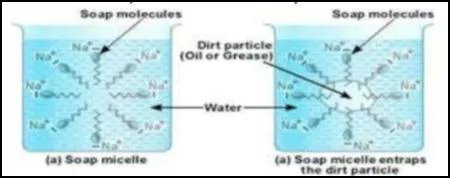
penetrate the fabric. The long non-polar end of a soap
molecule that are hydrophobic, gravitate towards and
surround the dirt (fat or oil with dust absorbed in
it).The short polar end containing the carboxylate ion,
face the water away from the dirt. A number of soap
molecules surround or encircle dirt and grease in
clustered structure called 'micelles', which encircles
such particles and emulsify them.
Procedure
Five conical flasks (100 ml each) are taken and
numbered 1 to 5. In each of these flasks equal
amounts (say 5 gm) of the given samples of soap
shavings or granules are taken and 50 ml of distilled
water is added. Each conical flask is heated few
minutes to dissolve all the soap completely. In a test-
tube stand, five big clean and dry test tubes are taken
and numbered 1 to 5 One ml of the five soap solution
is then poured in the test tubes of corresponding
number. 10 ml. of distilled water is then added to
each test tube. Test tube no 1 is then shaken
vigorously 5 times. The foam would be formed in the
empty space above the container. Stop watch is
started immediately and the time taken for the
disappearance of foam is noted. Similarly the other
test tubes are shaken vigorously for equal number of
times (i.e., 5 times) with approximately with the same
force and the time taken for the disappearance of
foam in each case is recorded. The lesser the time
taken for the disappearance of foam, the lower is the
foaming capacity.
TYPES OF SOAP
The type of fatty acid and length of the carbon chain
determines the unique properties of various soaps.
Tallow or animal fats give plimarily sodium stearate
(18 carbons) a very hard, insoluble soap. Fatty acids
with longer chains are even more insoluble. As a
matter of fact, 3inc stearate is used in talcum powders
because it is water repellent. Coconut oil is a source
of lauric acid (12 carbons) which can be made into
sodium lourate. This soap is very soluble and will
lather easily even in sea water. Fatty acids with only
10 or fewer carbons are not used in soaps because
they irritate the skin and have objectionable odors
Description
The type of fatty acid and length of the carbon chain
determines the unique properties of various soaps.
Tallow or animal fats give plimarily sodium stearate
(18 carbons) a very hard, insoluble soap. Fatty acids
with longer chains are even more insoluble. As a
matter of fact, 3inc stearate is used in talcum powders
because it is water repellent. Coconut oil is a source
of lauric acid (12 carbons) which can be made into
sodium lourate. This soap is very soluble and will
lather easily even in sea water. Fatty acids with only
10 or fewer carbons are not used in soaps because
they irritate the skin and have objectionable odors.
The general formula of soap is Fatty end water
soluble end CH3-(CH2) n COONa Soaps are useful
for cleaning because soap molecules have both
hydrophilic end, which dissolves in water, as well as
hydrophobic end, which is able to dissolve on polar
grease molecules. Applied to a soiled surface, soapy
water effectively holds particles in colloidal
suspension so it can be rinsed off with clean water.
The hydrophobic portion (made up of a long
hydrocarbon chain) dissolves dirt and oils, while the
ionic end dissolves in water. The resultant forms a
round structure called micelle. Therefore, it allows
water to remove normally-insoluble matter by
emulsification.
Commercial production of soap the most popular
soap making process today is the cold process
method, where fats such as olive oil react with strong
alkaline solution, while home stayers use the
historical hot process. Handmade soap differs from
industrial soap in that, usually, an excess of fat is
sometimes used to consume the alkali (super fatting),
and in that the glycerin is not removed, leaving a
naturally moisturizing soap and not pure detergent.
Often, emollients such as jojoba oil osha butter are
added at trace (the point at which the saponification
process is sufficiently advanced that the soap has
begun to thicken), after most of the oils have
specified, so that they remain unreacted in the
finished soap. Fat in soap is derived from either
vegetable or animal fats.
Sodium Tallow ate, a common ingredient in much
soap, is derived from rendered beef fat. Soap can also
© May 2020 | IJIRT | Volume 6 Issue 12 | ISSN: 2349-6002
IJIRT 149364 INTERNATIONAL JOURNAL OF INNOVATIVE RESEARCH IN TECHNOLOGY 69
be made of vegetable oils, such as palm oil, and the
product is typically softer. An array of saponifiable
oils and fats are used in the process such as olive,
coconut, palm, cocoa butter to provide different
qualities. For example, olive oil provides mildness in
soap; coconut oil provides lots of lather; while
coconut and palm oils provide hardness. Sometimes
castor oil can also be used as an ebullient. Smaller
amounts of unspecifiable oils and fats that do not
yield soap are sometimes added for further benefits.
Preparation of soap In cold-process and hot-process
soap making, heat may be required for saponification.
Cold-process soap making takes place at a sufficient
temperature to ensure the liquification of the fat
being used.
Unlike cold-processed soap, hot-processed soap can
be used right away because the alkali and fat specify
more quickly at the higher temperatures used in hot-
process soap making. Hot- process soap making was
used when the purity of alkali was unreliable. Cold-
process soap making requires exact measurements of
alkali and fat amounts and computing their ratio,
using saponification charts to ensure that the finished
product is mild and skin-friendly. Hot process In the
hot-process method, alkali and fat are boiled together
at 80100 C until saponification occurs, which the
soap maker can determine by taste or by eye. After
saponification has occurred, the soap is sometime
sprecipitated from the solution by adding salt, and the
excess liquid drained off.
The hot, soft soap is then spooned into a mold. Cold
process A cold-process soap maker first looks up the
saponification value of the fats being used on a
saponification chart, which is then used to calculate
the appropriate amount of alkali. Excess unreacted
alkali in the soap will result in a very high pH and
can burn or irritate skin. Not enough alkali and the
soap are greasy. The alkali is dissolved in water.
Then oils are heated, or melted if they are solid at
room temperature. Once both substances have cooled
to approximately 100-110F (37-43C), and are no
more than 10F (~5.5C) apart, they may be combined.
This alkali-fat mixture is stirred until trace. There are
varying levels of trace. After much stirring, the
mixture turns to the consistency of a thin pudding.
Trace corresponds roughly to viscosity. Essential and
fragrance oils are added at light trace. Introduction to
the experiment Soap samples of various brands are
taken and their foaming capacity is noticed. Various
soap samples are taken separately and their foaming
capacity is observed.
The soap with the maximum foaming capacity is
thus, said to be having the best cleaning capacity. The
test requires to be done with distilled water as well as
with tap water. The test of soap on distilled water
gives the actual strength of the soaps cleaning
capacity. The second test with tap water tests the
effect of Ca2+ and Mg2+ salts on their foaming
capacities.
OBJECTIVE
To compare the foaming capacity of various soaps
General Overall Hydrolysis Reaction
Although the reaction is shown as one step reaction,
it is in fact two steps. The net effect as that the ester
bonds all broken. The glycerol turns back into an
alcohol. The fatty acid is turned into a salt due to the
presence of a basic solution of NaoH. In the carboxyl
group, one oxygen now has a negative charge that
attracts the positive sodium ion. A molecule of soap
consists of two parts.
a) Alkyl group it is oil soluble
b) Corboxyl group It is water soluble
Sodium carbonate Effect
Sodium carbonate (also known as washing soda, soda
crystals or soda ash), Na2 CO3, is a sodium salt of
carbonic acid. It most commonly occurs as a
crystalline heptahedra, which readily effloresces to
form a white powder, the monohydrate; and is
domestically well known for its everyday use as a
water softener. It has a cooling alkaline taste, and can
be extracted from the ashes of many plants. It is
synthetically produced in large quantities from table
salt in a process known as the Solvay process.
http://en.wikipedia.org/wiki/Sodium_carbonate
Sodium carbonate is a white, crystalline and
hygroscopic powder with a purity of > 98 %. There
are two forms of sodium carbonate available, light
soda and dense soda. Impurities of sodium carbonate
may include water (< 1.5 %), sodium chloride (< 0.5
%), sulphate (< 0.1 %), calcium (< 0.1 %), and
magnesium (< 0.1 %) and iron (< 0.004 %). The
purity and the impurity profile depend on the
composition of the raw materials, the production

/ 5
End of Document
240

FAQs

What is the aim of the research on washing soap foaming capacity?
The aim of this research is to investigate the foaming capacity of different washing soaps and the effect of adding sodium carbonate to them. The study explores how soaps and detergents, which are cleaning agents, can remove oil particles from surfaces due to their unique chemical properties. By examining various soap samples, the research seeks to determine which soap has the highest foaming capacity, indicating better cleaning efficiency.
How is the foaming capacity of soap measured in this study?
The foaming capacity of soap is measured by preparing solutions of equal weights of different soaps in equal volumes of distilled water. These solutions are shaken vigorously to produce foam, and the time taken for the foam to disappear is recorded. A longer time for foam disappearance indicates a greater foaming capacity. This method allows for a comparative analysis of the foaming abilities of various soap samples under controlled conditions.
What materials are required for the experiment on foaming capacity?
The materials required for the experiment include five 100ml conical flasks, five 20ml test tubes, a 100ml measuring cylinder, a test tube stand, a weight box, and a stopwatch. Additionally, five different samples of soap and distilled water are needed to prepare the soap solutions. These materials facilitate the measurement of foaming capacity and enable the observation of how different soaps perform when mixed with water.
What types of soap were examined in the research?
The research examines various types of soap based on the fatty acids used and their carbon chain lengths. For instance, tallow or animal fats primarily yield sodium stearate, a hard and insoluble soap, while coconut oil provides lauric acid, resulting in sodium laurate, which is very soluble and lathers easily. The study highlights that fatty acids with longer chains are more insoluble, affecting the soap's properties and foaming capacity.
What effect does sodium carbonate have on soap foaming capacity?
Sodium carbonate, also known as washing soda, can influence the activity of soap in different water types. In hard water, it helps precipitate calcium carbonate, improving soap activity. However, in fresh water, it may reduce interfacial tension without forming soap bubbles. The research indicates that while sodium carbonate can affect foaming capacity, its overall impact on detergents is not significantly large.
What factors affect the foaming capacity of soap according to the study?
Several factors affect the foaming capacity of soap, including the presence of calcium, iron, and magnesium compounds in water, which can restrict foaming. Temperature also plays a role, as hot water tends to create more foam than cold water. Additionally, the motion of the solvent can increase foam formation, indicating that both chemical composition and physical conditions influence soap performance.
What conclusions were drawn about foaming capacity in distilled versus tap water?
The study concludes that the foaming capacity of soap is generally higher in distilled water compared to tap water. This is attributed to the absence of interfering minerals in distilled water, which allows for better foam formation. The soap that takes the longest time for foam to disappear is considered to have the highest foaming capacity, thus indicating superior cleaning quality among the tested soaps.