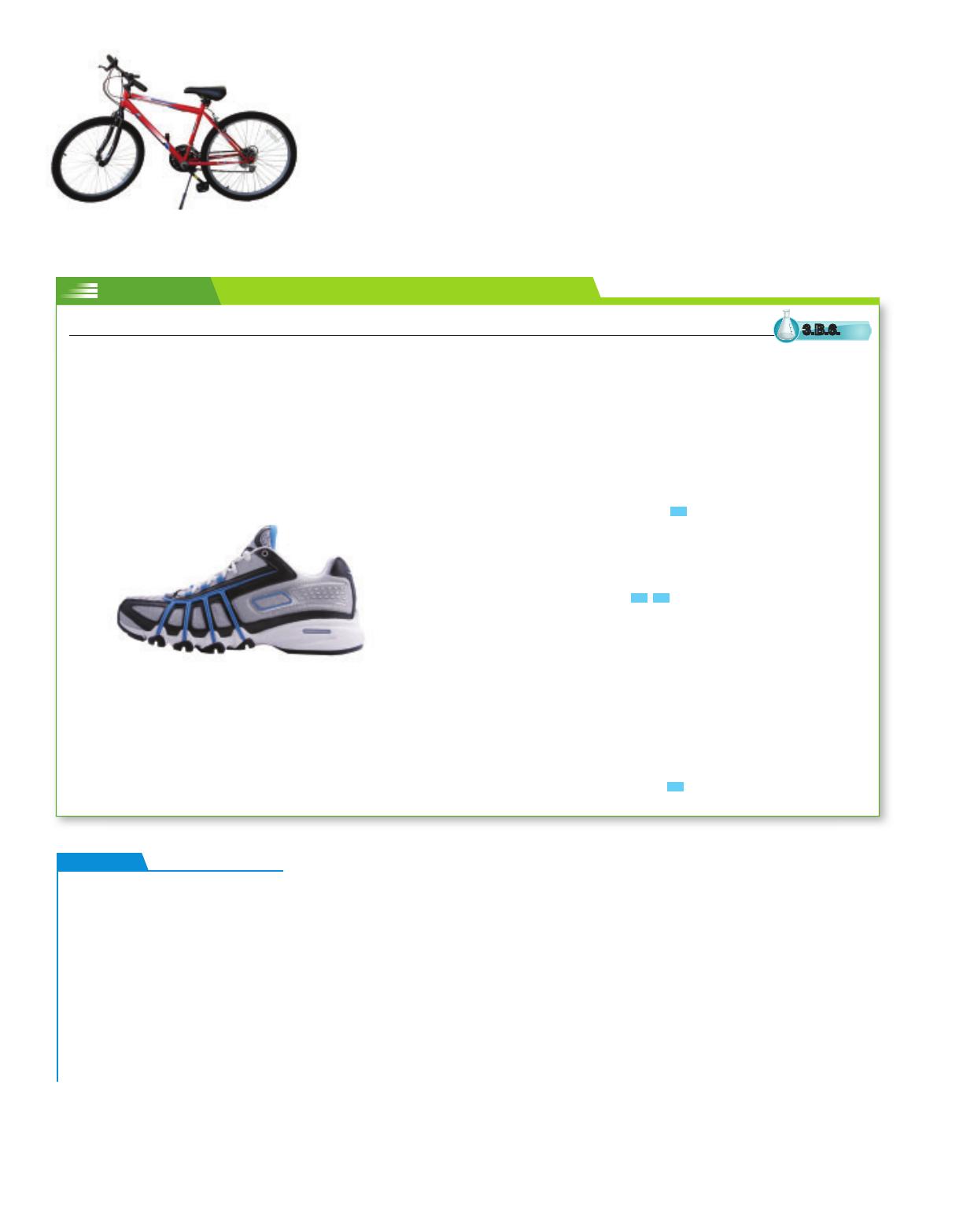
Observations that a bicycle has a mass of 10 kg and is 2.0 m long
are quantitative physical properties of the bicycle because they include
a measurement. Qualitative physical properties of the bicycle are not
measured and include that it is red, shiny, and rigid (Figure 4).
So far, we do not have any information about what will happen if we leave
this bike out in the rain or whether a cola drink would eff ectively remove
rust from the bike. Th ese properties are chemical properties of the bike,
which involve changing the bike’s composition. Chemical properties are
discussed in Section 5.3.
SKILLS: Observing, Analyzing, Evaluating, Communicating
SKILLS HANDBOOK
3.B.6.
Do you spend time and effort shopping for the ultimate running
shoe (Figure 5)? What physical factors infl uence your decision?
Perhaps comfort and support take priority over breathability and
weight. Of course, style and colour are important as well.
In this activity, you will closely examine a running shoe. You will
note how the physical properties of the different materials in it
determine their specifi c function in the shoe.
Equipment and Materials: running shoe
1. Make a table with three columns and record the following
information:
(a) In the fi rst column, list all the different materials used to
make each part of the shoe; for example, rubber soles.
(b) In the second column, record the physical properties of
each material listed; for example, waterproof, fl exible.
(c) In the third column, describe the function of each
physical property you listed in part (b); for example,
keeps the shoe dry, allows the foot to bend.
2. List at least fi ve different quantitative properties of your shoe.
A. Of the physical properties that you listed, which are the most
useful in the running shoe?
A
B. From what you know about the different materials that make
up a running shoe, which ones might present a problem to
the environment when the shoes are eventually discarded?
Explain your answer.
A
C
C. There are different brands of running shoes, and they vary
in price. What factors might infl uence the various prices?
Compare the physical properties of the materials of several
different brands of running shoes. Do they vary signifi cantly?
What other factors determine the retail price of running
shoes? How important should these other factors be when
choosing a pair of running shoes? Make a priority list of
factors you will take into consideration when choosing your
next pair of running shoes.
A
TTRY THIS
CLOSE-UP OF A RUNNING SHOE
Figure 5 A running shoe has important physical properties that
enhance its function.
Figure 4 A bicycle has both quantitative
and qualitative physical properties.
Restating the Main Idea
When you restate the author’s main
idea in the topic sentence of your
summary, you say it in words that you
understand. For example, if the author
says that “some physical properties
are particularly useful in describing
and categorizing substances,” you
might restate this main idea by saying
“physical properties are used to
describe substances.”
WRITING TIP
Some physical properties are particularly useful in describing and
categorizing substances. Common qualitative physical properties include
colour, odour, taste, and texture. Some of the other physical properties of
matter are
•lustre—shininessordullness;manysilverobjectshaveahighlustre
(Figure 6), whereas a rusty nail has low lustre
•opticalclarity—theabilitytoallowlightthrough(Figure7);thinblue
glass is clear and transparent, frosted glass is translucent, and a brick
wall is opaque
•brittleness—breakabilityorflexibility;glassisbrittle(Figure8)whereas
modelling clay is fl exible
•viscosity—theabilityofasubstancetofloworpourreadily;molassesis
viscous (Figure 9) whereas water is less viscous
viscosity the degree to which a
fl uid resists fl ow
180 Chapter 5 • Properties of Matter
NEL
6646_Sci9_ch05_pp170-198.indd 180 7/20/09 8:52:08 AM