Explore comprehensive study materials covering the digestive system, ecosystems, symbiotic relationships, solar system facts, circulatory system functions, and properties of matter. This resource is ideal for biology students and educators seeking detailed explanations and key concepts across multiple topics. Each section includes critical information on anatomy, ecological interactions, planetary characteristics, and chemical principles, making it a valuable tool for exam preparation and academic success.

Key Points

  • Covers key concepts in the digestive system, including nutrient absorption and enzyme functions.
  • Explains ecosystem dynamics, including energy pyramids and nitrogen cycles.
  • Details various symbiotic relationships, such as mutualism and parasitism.
  • Describes solar system characteristics, including planetary features and orbital mechanics.
Haymanot
10 pages
Language:English
Type:Study Guide
Haymanot
10 pages
Language:English
Type:Study Guide
123
/ 10
Digestive system
1. Which organ is primarily responsible for the absorption of water and electrolytes
from indigestible food residue?
A) Small intestine B) Stomach
C) Large intestine (colon) D) Pancreas
2. Where does the chemical digestion of carbohydrates begin?
A) Stomach B) Mouth (Oral cavity) C) Small intestine D) Esophagus
3. Which substance is produced by the liver and stored in the gallbladder to aid in
the digestion of fats
A) Pepsin B) Bile C) Gastrin D) Lipase
4. What is the rhythmic, wave-like contraction of smooth muscles that moves food through the digestive
tract called?
A) Segmentation B) Emulsification C) Peristalsis D) Mastication
5. Which enzyme is primarily responsible for breaking down proteins in the stomach?
A) Amylase B) Trypsin C) Pepsin D) Lactase
6. Most nutrient absorption occurs in which part of the digestive system?
A) Duodenum B) Jejunum and Ileum C) Stomach D) Rectum
7. What is the role of the villi in the small intestine?
A) To produce digestive enzymes B) To increase the surface area for nutrient absorption
C) To move food through the digestive tract D) To store bile
8. Which organ produces insulin and glucagon to regulate blood sugar levels, in addition to secreting
digestive enzymes?
A) Liver B) Gallbladder C) Spleen D) Pancreas
Ecosystem
1. Which of the following is considered an abiotic component of an ecosystem?
A) Bacteria B) Fungi C) Sunlight D) Producers
2. In an energy pyramid, which trophic level typically contains the most energy?
A) Tertiary consumers B) Secondary consumers
C) Primary consumers D) Producers
3. What is the primary source of energy for almost all ecosystems on Earth?
A) Geothermal heat B) Solar radiation
C) Chemical bonds in rocks D) Decomposing organic matter
4. Which term describes the role or "job" an organism plays within its habitat?
A) Biome B) Niche C) Population D) Community
5. Which process is responsible for returning nitrogen from the soil back into the atmosphere?
A) Nitrogen fixation B) Nitrification C) Denitrification D) Assimilation
6. Which of the following is an example of a secondary consumer?
A) A rabbit eating grass B) A hawk eating a snake
C) A grasshopper eating leaves D) A mushroom breaking down a log
7. Biomagnification is most problematic for organisms at which level of the food chain?
A) Producers B) Primary consumers
C) Secondary consumers D) Top predators
Symbiosis(biological association )
1. Which term best describes a symbiotic relationship where one organism benefits while
the other is neither helped nor harmed?
A) Mutualism B) Parasitism
C) Commensalism D) Competition
2. A tick living on the skin of a dog, feeding on its blood, is an example of:
A) Mutualism B) Parasitism
C) Commensalism D) Predation
3. In the relationship between nitrogen-fixing bacteria and leguminous plants, the bacteria receive
carbohydrates from the plant, while the plant receives usable nitrogen. This is an example of:
A) Mutualism B) Parasitism
C) Commensalism D) Amensalism
4. Barnacles attaching to the shell of a whale to gain access to nutrient-rich currents while the whale
remains unaffected is a classic case of:
A) Mutualism B) Parasitism
C) Commensalism D) Neutralism
5. Which of the following is true regarding symbiotic relationships?
A) Both organisms always benefit in all types of symbiosis.
B) Symbiosis can include positive, negative, or neutral effects for the involved species.
C) Parasites always kill their hosts immediately.
D) Commensalism is a type of mutualism.
.. Solar system
/ 10
End of Document
123

FAQs

what is the digestive system

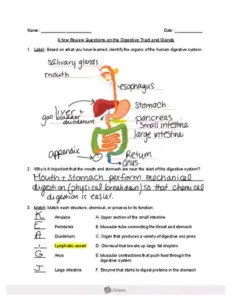
The digestive system is a complex network responsible for breaking down food, absorbing nutrients, and eliminating waste.

  • It includes organs such as the mouth, esophagus, stomach, small intestine, and large intestine.
  • The process begins in the mouth with chewing and saliva, continues in the stomach with acids and enzymes, and culminates in the intestines where nutrients are absorbed.
  • Key functions include mechanical digestion, chemical digestion, and nutrient absorption.

what is an ecosystem

An ecosystem is a community of living organisms interacting with their physical environment.

  • It includes biotic components like plants and animals, and abiotic components such as sunlight and water.
  • Ecosystems can be large, like forests or oceans, or small, like a puddle.
  • They are crucial for maintaining biodiversity and supporting life on Earth.

what is symbiosis

Symbiosis refers to the interaction between two different organisms living in close physical proximity.

  • There are three main types: mutualism (both benefit), commensalism (one benefits, the other is unaffected), and parasitism (one benefits at the expense of the other).
  • Examples include bees pollinating flowers (mutualism) and ticks feeding on mammals (parasitism).
  • Understanding symbiosis is essential for studying ecological relationships and biodiversity.

what are the planets in the solar system

The solar system consists of eight major planets that orbit the Sun.

  • They are: Mercury, Venus, Earth, Mars, Jupiter, Saturn, Uranus, and Neptune.
  • Each planet has unique characteristics, such as size, composition, and atmosphere.
  • For example, Jupiter is the largest planet, while Mars is known as the 'Red Planet.'

how does the circulatory system work

The circulatory system is responsible for transporting blood, nutrients, gases, and waste products throughout the body.

  • It consists of the heart, blood vessels (arteries, veins, capillaries), and blood.
  • The heart pumps oxygenated blood from the lungs to the body and returns deoxygenated blood to the lungs.
  • This system is vital for maintaining homeostasis and supporting cellular functions.

what are the properties of matter

Properties of matter refer to the characteristics that define different substances.

  • These include physical properties (color, density, melting point) and chemical properties (reactivity, flammability).
  • Understanding these properties helps in classifying matter as solids, liquids, gases, or plasma.
  • For example, water is a liquid at room temperature but can exist as ice (solid) or steam (gas) under different conditions.