Unit 5 Part B ● MHR 67
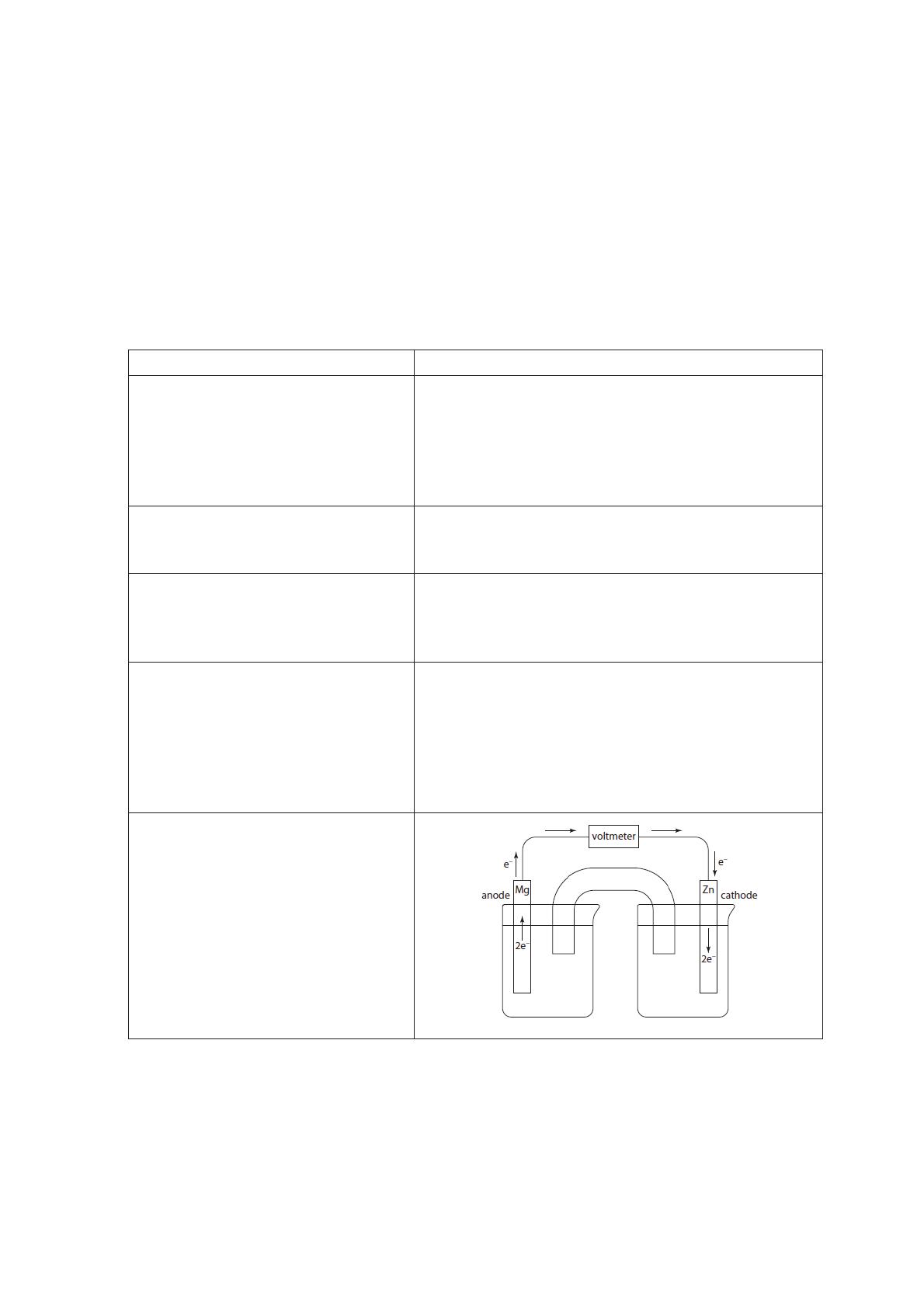
3. Draw a diagram of a galvanic cell involving zinc and magnesium, and indicate the direction
of electron flow.
What Is Required?
You are to draw a galvanic cell, labelling the anode, the cathode, and the direction of electron
flow.
What Is Given?
You are given the electrodes of magnesium and zinc for this galvanic cell.
Identify the pieces of the galvanic
cell.
The magnesium is the anode—the site of oxidation,
where magnesium ions flow into solution and
electrons leave the electrode and flow through the
voltmeter as they move to the zinc cathode. The zinc
is the cathode
the site of reduction, where zinc ions
flow onto the electrode as they pick up electrons.
Identify the direction of electron
flow.
In a galvanic cell, electrons flow from the anode to
the cathode, in t
his case, from the magnesium
electrode to the zinc electrode.
Identify the ion flow in the half-
cells.
Ions of magnesium will flow into the oxidation half-
reaction as the atoms of magnesium lose electrons.
Ions of zinc will flow onto the zinc electrode as
they
pick up electrons during the reduction.
Identify the ion flow in the salt
bridge.
Negative ions in the salt bridge will migrate towards
the oxidation half
reaction and positive charge builds
up in the cell. Positive ions will migrate towards the
red
uction half-cell as positive charge is removed
cell, leaving a net negative charge in
this half
cell that will attract the positive ions in the
salt bridge.
Sketch the apparatus, including the
beakers, electrodes, conducting
wires, voltmeter, salt bridge, and
electron flow.
Check Your Solution
Electrons flow from the site of oxidation at the magnesium anode to the site of reduction at
the zinc cathode. The drawing is correct.