Curvilinear motion explores the dynamics of particles traveling along curved paths, focusing on kinematic quantities and their rectangular components. This chapter delves into the mathematical representation of motion, including velocity and acceleration vectors, and how they relate to the particle’s trajectory. Applications in real-world scenarios, such as aircraft movement and roller coaster design, are discussed to illustrate the principles of curvilinear motion. Ideal for physics students and educators, this chapter provides essential insights into the behavior of objects in motion along non-linear paths.

Key Points

  • Explains the concepts of curvilinear motion and its applications in physics
  • Describes the relationship between velocity, acceleration, and the path of a particle
  • Includes mathematical representations of motion in three dimensions
  • Covers practical examples such as aircraft tracking and roller coaster dynamics
Ekemini Tom
18 pages
Language:English
Type:Lecture Notes
Ekemini Tom
18 pages
Language:English
Type:Lecture Notes
131
/ 18
CURVILINEAR MOTION:
GENERAL & RECTANGULAR COMPONENTS
Today’s Objectives:
Students will be able to:
1. Describe the motion of a
particle traveling along a
curved path.
2. Relate kinematic
quantities in terms of the
rectangular components of
the vectors.
In-Class Activities:
Check Homework
Reading Quiz
Applications
General Curvilinear Motion
Rectangular Components of
Kinematic Vectors
Concept Quiz
Group Problem Solving
Attention Quiz
READING QUIZ
1. In curvilinear motion, the direction of the instantaneous
velocity is always
A) tangent to the hodograph.
B) perpendicular to the hodograph.
C) tangent to the path.
D) perpendicular to the path.
2. In curvilinear motion, the direction of the instantaneous
acceleration is always
A) tangent to the hodograph.
B) perpendicular to the hodograph.
C) tangent to the path.
D) perpendicular to the path.
APPLICATIONS
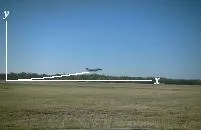
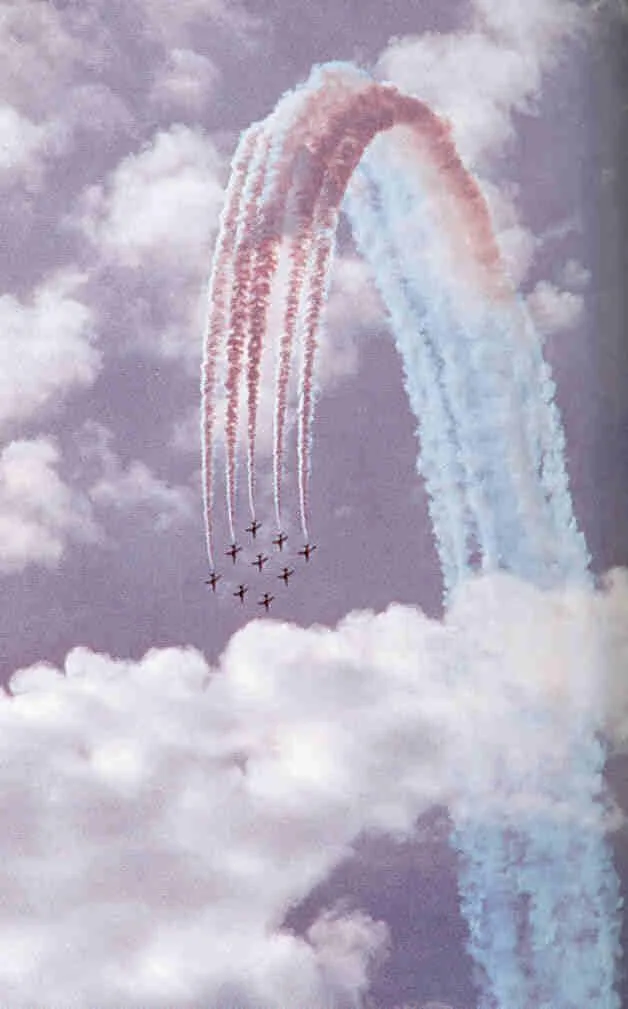
The path of motion of each plane in
this formation can be tracked with
radar and their x, y, and z coordinates
(relative to a point on earth) recorded
as a function of time.
How can we determine the velocity
or acceleration of each plane at any
instant?
Should they be the same for each
aircraft?
/ 18
End of Document
131

FAQs

What is curvilinear motion and how is it described?
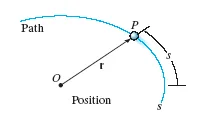
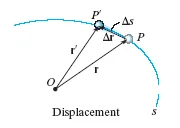
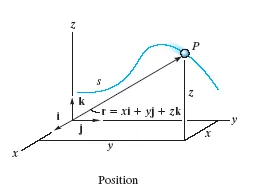
Curvilinear motion refers to the motion of a particle traveling along a curved path. It is often described using vectors, particularly in three-dimensional space. The position of a particle at any instant is represented by the vector r = r(t), where both the magnitude and direction of r can vary with time. This motion is characterized by a path function, s, which defines the trajectory of the particle.
How is the instantaneous velocity defined in curvilinear motion?
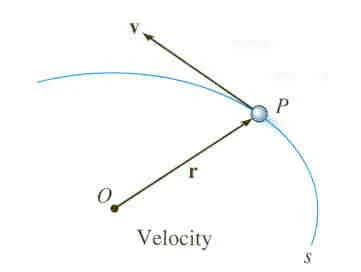
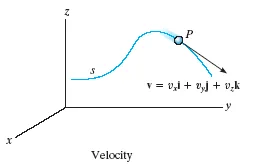
The instantaneous velocity in curvilinear motion is defined as the time derivative of the position vector, expressed as v = dr/dt. This velocity vector is always tangent to the path of motion, indicating the direction in which the particle is moving at any given instant. The magnitude of this velocity vector is referred to as speed, which can also be obtained by differentiating the path function, represented as v = ds/dt.
What role does acceleration play in curvilinear motion?
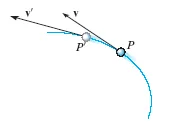
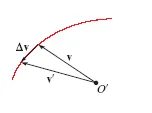
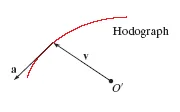
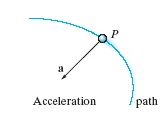
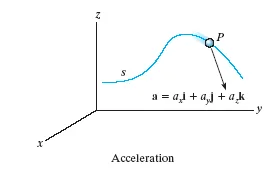
Acceleration in curvilinear motion represents the rate of change of velocity of a particle. It is defined as the time derivative of the velocity vector, expressed as a = dv/dt or a = d²r/dt². The acceleration vector is generally not tangent to the path of motion; instead, it can be visualized through a hodograph, which plots the locus of points defined by the arrowhead of the velocity vector.
How are the rectangular components of motion defined?
The rectangular components of motion in curvilinear motion are defined in terms of the x, y, and z axes, relative to a fixed frame of reference. The position vector can be expressed as r = x i + y j + z k, where x, y, and z are functions of time. This approach allows for a clearer analysis of motion by breaking it down into its components, facilitating the calculation of velocity and acceleration in each direction.
What is the significance of the hodograph in analyzing motion?
The hodograph is significant in analyzing motion as it represents the trajectory of the velocity vector of a particle. It provides a visual representation of how the velocity changes over time, with the acceleration vector being tangent to the hodograph. This concept helps in understanding the relationship between velocity and acceleration in curvilinear motion, illustrating how they interact as the particle moves along its path.
What equations are used to determine the average and instantaneous acceleration?
The average acceleration during a time increment is calculated using the formula a_avg = (v - v')/t, where v is the final velocity and v' is the initial velocity. The instantaneous acceleration, on the other hand, is defined as the time derivative of velocity, expressed as a = dv/dt or a = d²r/dt². These equations are essential for understanding how a particle's motion changes over time.
How can the position of a particle be determined from its velocity?
The position of a particle can be determined from its velocity by integrating the velocity function with respect to time. For example, if the velocity is given as a function of time, vx = dx/dt, integrating this equation allows for the calculation of the x-component of position. This method is crucial for analyzing motion in curvilinear paths, where velocity components change over time.