The Electrostatic Series
Th e electrostatic series, or triboelectric series, is a list of materials in order
of increasing tendency to gain electrons (Table 1). As you move further
down the list, the materials increase in their tendency to gain extra electrons.
We can use the electrostatic series to predict the charge that will be
gained by two objects or materials that are rubbed together. For example,
if two materials from the series are rubbed together, the material that is higher
on the series will lose electrons and become positively charged and the material
that is lower on the series will gain electrons and become negatively charged.
electrostatic series a list of materials
arranged in order of their tendency to gain
electrons
Table 1 Electrostatic Series
Material Charge tendency
human skin
rabbit fur
acetate
glass
human hair
nylon
wool
cat fur
silk
paper
cotton
wood
amber
rubber balloon
vinyl
polyester
ebonite
(weaker
tendency
to gain
electrons)
(stronger
tendency
to gain
electrons)
SAMPLE PROBLEM 1 Using the Electrostatic Series
You rub a piece of wool against your skin. What charge does each material now have?
Step 1 Compare the positions of the materials on the electrostatic series.
Wool is lower on the list than human skin.
Step 2 Compare the attraction for electrons of the two materials.
Since wool is lower on the list than human skin, it has a greater attraction
for electrons than human skin.
The wool will gain electrons from your skin and become negatively charged. Your skin
will lose electrons to the wool and become positively charged.
Practice
You grab a rubber balloon with a wool glove on your hand. What charge does each
material now have?
SKILLS: Performing, Observing, Analyzing, Communicating
SKILLS HANDBOOK
3.B.5., 3.B.6.
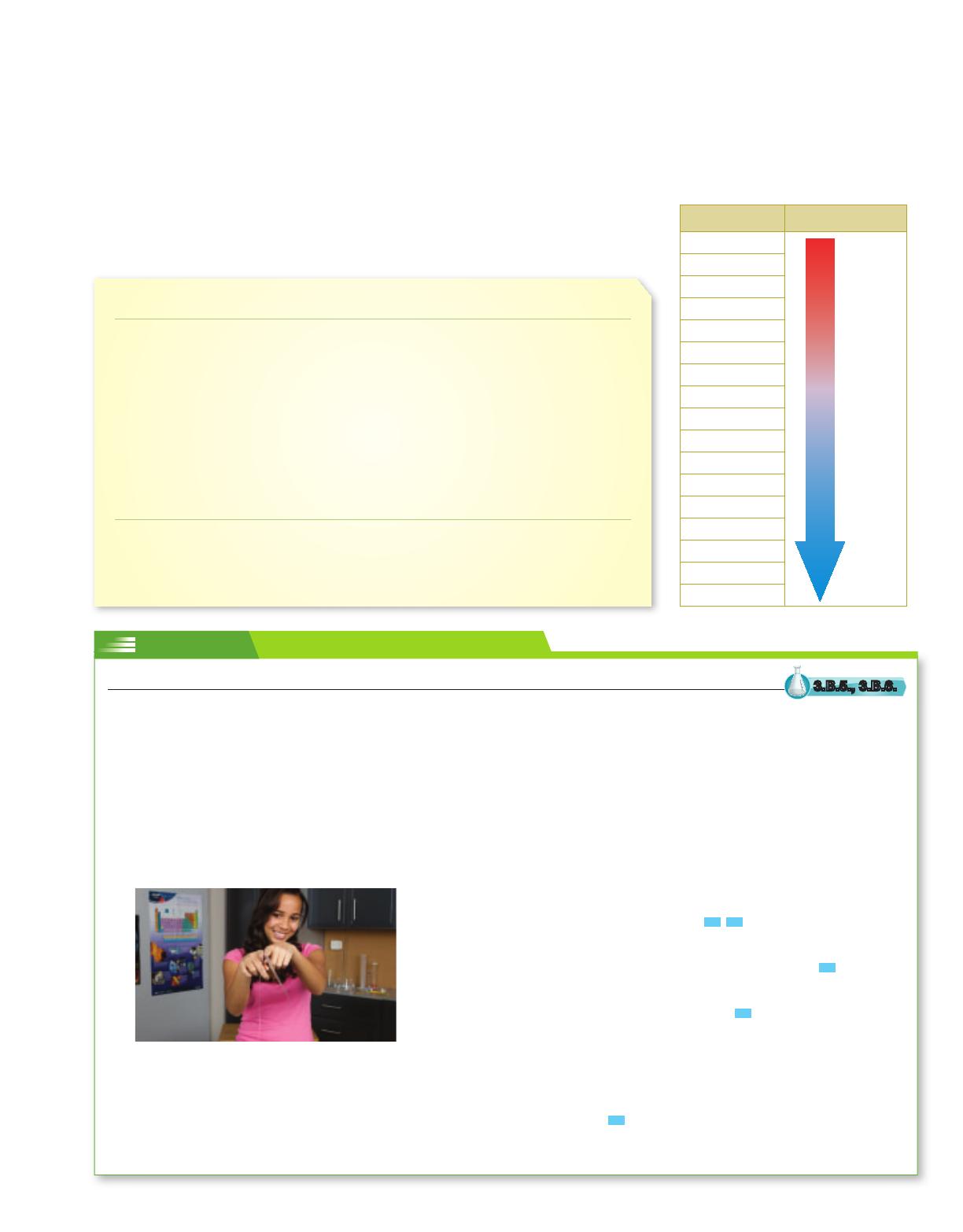
Materials do not always need to be rubbed together to create a
charge imbalance. In this activity, you will explore charging by
friction through simple contact.
Equipment and Materials: roll of clear, plastic adhesive tape
1. Pull two 8–10 cm pieces of tape from the roll.
2. Hold one piece of tape in each hand and bring the two shiny
(non-sticky) sides of the tape close together without letting
them touch (Figure 3). Record your observations.
3. Exhale onto both sides of each piece of tape several times
(over its entire length). Bring the two shiny sides of the tape
close together again without letting them touch. Observe
what happens.
4. Using the same two pieces of tape, allow each piece of
tape to stick to the top of a clean desk without rubbing.
Then quickly pull the pieces off the desk. Bring the shiny,
non-sticky side of one of the pieces close to the edge of the
desk without letting it touch the desk. Observe what happens.
5. Quickly bring the shiny, non-sticky sides of both pieces of
tape close to each other without letting them touch. Observe
what happens.
A. What do your observations in step 2 indicate about the
electric charge on the pieces of tape when they were fi rst
pulled off the roll? Explain.
T/I
C
B. What do your observations in step 3 indicate about the
electric charge on the pieces of tape? Explain.
T/I
C. Why is there a difference in the electric charge on the pieces
of tape between steps 2 and 3?
T/I
D. Write a question you have about the observations you made
in this activity. Exchange questions with a classmate and
decide how you may fi nd answers to your questions. Then
design and carry out simple experiments to answer your
questions.
T/I
TTRY THIS
CHARGING BY FRICTION
Figure 3
11.2 Charging by Contact 473
NELNEL
6646_Sci9_ch11_pp456-477.indd 473 8/3/09 2:16:34 PM