AQA GCSE Physics Topic 2 focuses on electricity, covering essential concepts such as electrical charge, current, and circuit symbols. The notes explain the behavior of resistors, series and parallel circuits, and the principles of mains electricity. This resource is ideal for GCSE students preparing for their exams, providing clear explanations and key formulas. Topics include Ohm’s Law, power calculations, and the National Grid, making it a comprehensive study aid for understanding electricity in physics.

Key Points

  • Explains electrical charge flow and the importance of a closed circuit.
  • Covers the relationship between current, voltage, and resistance using Ohm’s Law.
  • Describes the differences between series and parallel circuits, including their total resistance.
  • Details the characteristics of resistors and how resistance changes with temperature and light.
  • Discusses mains electricity, including AC and DC current, and safety features in electrical systems.
Yukta Peerannawar
7 pages
Language:English
Type:Notes
Yukta Peerannawar
7 pages
Language:English
Type:Notes
37
/ 7
AQA GCSE Physics
Topic 2: Electricity
Notes
(Content in bold is for Higher Tier only)
www.pmt.education
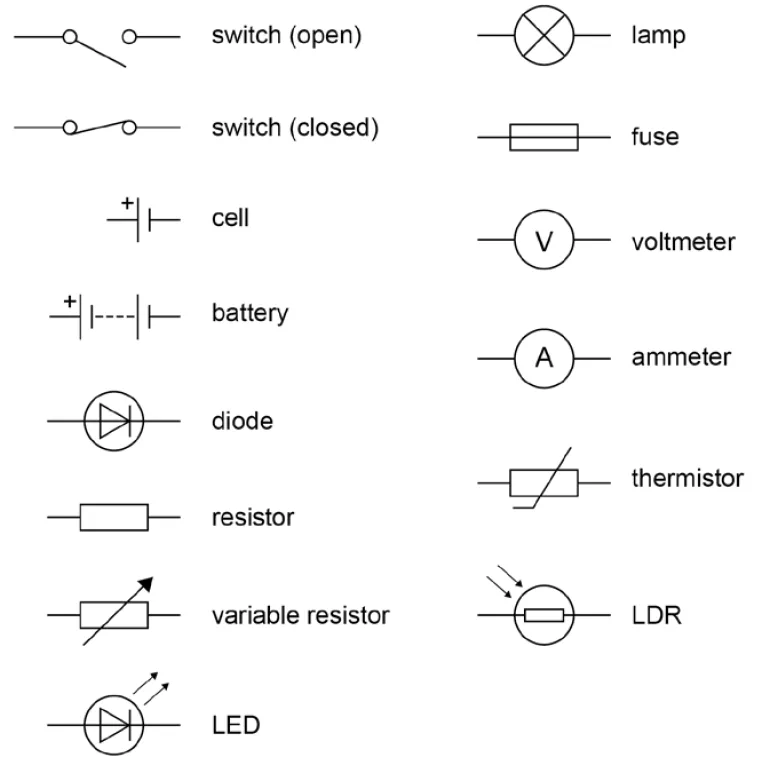
Circuit Symbols:
Electrical Charge:
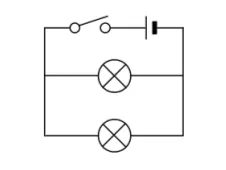
- For charge to flow:
o Circuit must be closed (no open switches)
o There must be a source of potential difference (battery/cell)
Electrical Current
- Current is the flow of electrical charge
- Greater the rate of flow of charge, greater current
𝑄𝑄 = 𝐼𝐼𝐼𝐼
Where Q is the charge flow, in coulombs C, I is the current, in amperes A and t is the time in
seconds s.
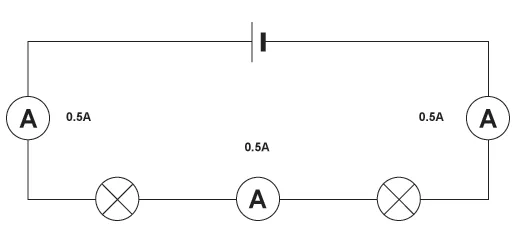
- In a single closed loop, the current has the same value at any point
- The current (I) through a component depends on both the resistance (R) of the component
and the potential difference (V) across the component.
- The greater the resistance of the component the smaller the current for a given potential
difference (pd) across the component.
- Current, potential difference or resistance can be calculated using the equation:
𝑉𝑉 = 𝐼𝐼𝐼𝐼
- Where V is the potential difference in volts V, I is the current in amperes A, and R is the
resistance in ohms Ω.
www.pmt.education
Resistors
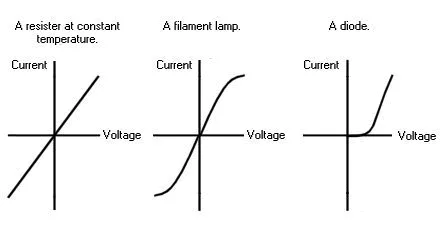
- If the resistance is constant, an ohmic conductor, current is directly proportional to the
potential difference, in this case the graph is linear.
- If the resistance of components such as lamps, diodes, thermistors and LDRs is not constant
it changes with the current through the component, so the graph is nonlinear, for example,
the resistance of a filament lamp increases as the temperature of the filament increases and
the current through a diode flows in one direction only, so it has a higher resistance in the
reverse direction.
How does the resistance change?
- With current
o As current increases, electrons (charge) has more energy
o When electrons flow through a resistor, they collide with the atoms in the resistor
o This transfers energy to the atoms, causing them to vibrate more
o This makes it more difficult for electrons to flow through the resistor
So resistance increases, and current decreases
- With temperature
o Normal wires - See above, the same process occurs as atoms vibrate when hot
o Thermistor
In hotter temperatures the resistance is lower
These are often used in temperature detectors/thermostats
- With length
o The greater the length, the more resistance and the lower the current
o Electrons have to make their way through more resistor atoms, so it is harder than
using a shorter wire
- With light
o LDR (Light Dependent Resistor)
The greater the intensity of light, the lower the resistance
So the resistance is greatest when it is dark
These are used in automatic night lights.
- With voltage
o Diodes
Diode allows current to flow freely in one direction
In the opposite direction, it has a very high resistance so no current can flow
The gradient of each is 1/resistance, so a sharper gradient means a lower resistance (inteleducationresources.intel.co.uk)
www.pmt.education
/ 7
End of Document
37

FAQs

What are the key components of a circuit in electricity?

A circuit requires a closed path, meaning no open switches, and a source of potential difference, such as a battery or cell. The essential components include the live wire, neutral wire, and earth wire in a plug, which facilitate the flow of electrical charge. Additionally, circuit symbols represent various components like switches, lamps, and resistors, which are crucial for understanding circuit diagrams.

How does resistance change with temperature in electrical components?

Resistance in components like thermistors decreases with higher temperatures, making them useful in temperature detectors and thermostats. In contrast, normal wires exhibit increased resistance as temperature rises due to the greater vibration of atoms, which makes it harder for electrons to flow. This relationship between temperature and resistance is critical for understanding how different materials behave under varying conditions.

What is the difference between series and parallel circuits?

In a series circuit, components are connected end to end, resulting in the same current flowing through all parts, and the total resistance is the sum of individual resistances. Conversely, in a parallel circuit, components are connected separately to the power supply, allowing current to split into multiple paths. This means the potential difference is the same across each branch, and the total resistance is less than the smallest individual resistor in the circuit.

What is the formula for calculating electrical power?

Electrical power can be calculated using the formula P = IV, where P is power in watts, I is current in amperes, and V is potential difference in volts. Additionally, energy transferred can be expressed as E = Pt, where E is energy in joules, P is power in watts, and t is time in seconds. Understanding these formulas is essential for analyzing energy consumption in electrical devices.

What is the National Grid and its purpose?

The National Grid is a system of cables and transformers that connects power stations to consumers across the UK. It facilitates the transfer of electrical power from power stations to consumers. Step-up transformers increase the potential difference for efficient transmission, reducing energy loss, while step-down transformers decrease the potential difference for consumer safety. This system ensures a stable and reliable electricity supply.

How does electrical charge behave in terms of attraction and repulsion?

Electrical charge can be either positive or negative, and like charges repel each other while opposite charges attract. When two insulators are rubbed together, electrons are transferred, resulting in one object becoming positively charged and the other negatively charged. This phenomenon leads to electrostatic forces that can exert attraction or repulsion between charged objects, depending on their charge types.

What are the effects of resistance on current flow in a circuit?

Resistance affects the flow of current in a circuit; as resistance increases, the current decreases for a given potential difference. This relationship is described by Ohm's Law, V = IR, where V is potential difference, I is current, and R is resistance. Components like resistors, diodes, and thermistors exhibit varying resistance, which influences how current flows through them in different conditions.