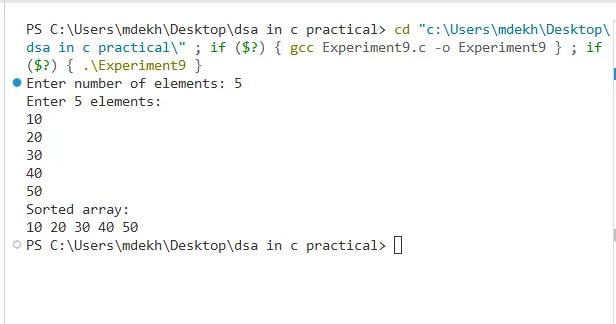
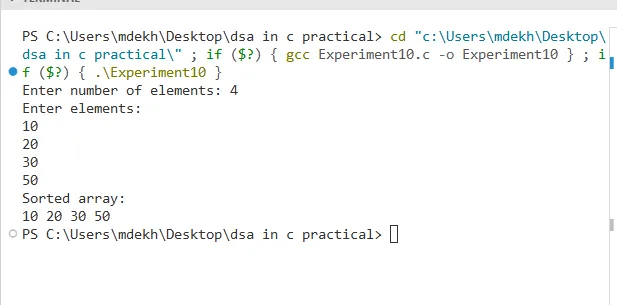
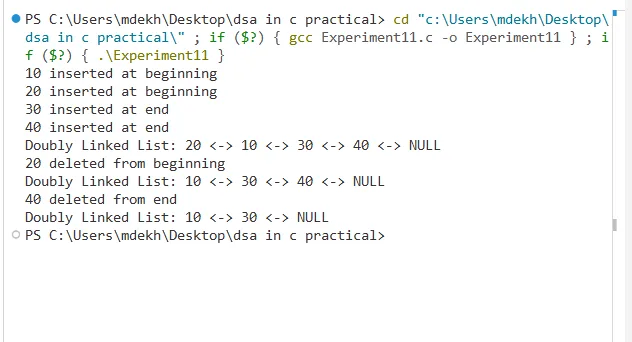
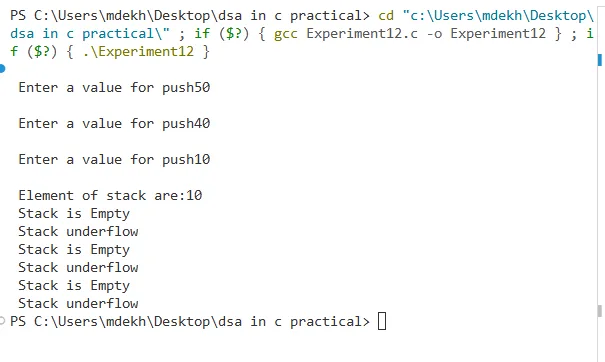
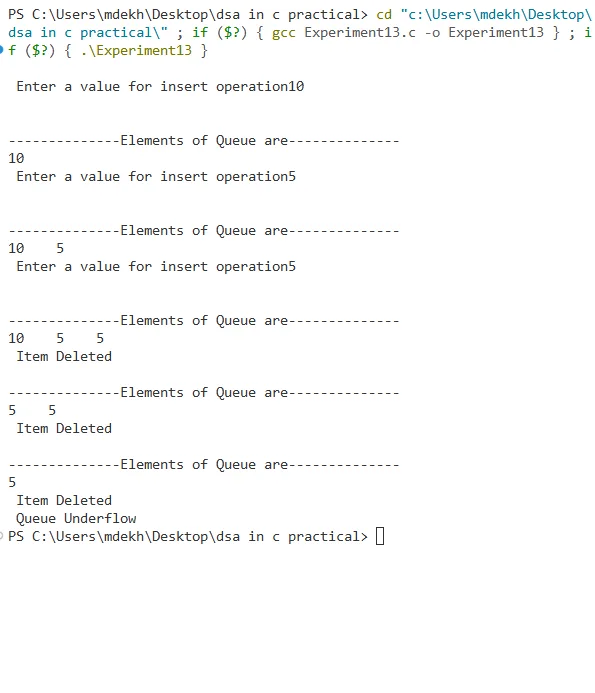
C Programming Experiments provides practical coding examples and exercises for students learning C programming. This document covers various algorithms and data structures, including GCD calculation, Fibonacci sequence generation, string manipulation, and linked list operations. Ideal for beginners and intermediate programmers, it serves as a hands-on guide to mastering C programming concepts. Each experiment includes code snippets and expected outputs, making it a valuable resource for anyone preparing for programming exams or enhancing their coding skills.

Key Points

  • Includes practical C programming exercises covering GCD, Fibonacci, and string manipulation.
  • Demonstrates linked list operations with insertion and deletion methods.
  • Provides clear code examples with expected outputs for each experiment.
  • Ideal for students and programmers looking to improve their C coding skills.

ekta
40 pages
Language:English
Type:Notes
ekta
40 pages
Language:English
Type:Notes
61
/ 40
Experiment no:- 1
#include<stdio.h>
int gcd(int a, int b)
{
while(b != 0){
int temp = b;
b = a%b;
a=temp;
}
return a;
}
int main ()
{
int num1,num2,result;
printf("Enter two numbers:");
scanf("%d %d",&num1,&num2);
result = gcd(num1,num2);
printf("GCD of %d and %d is %d",num1, num2, result);
return 0;
}
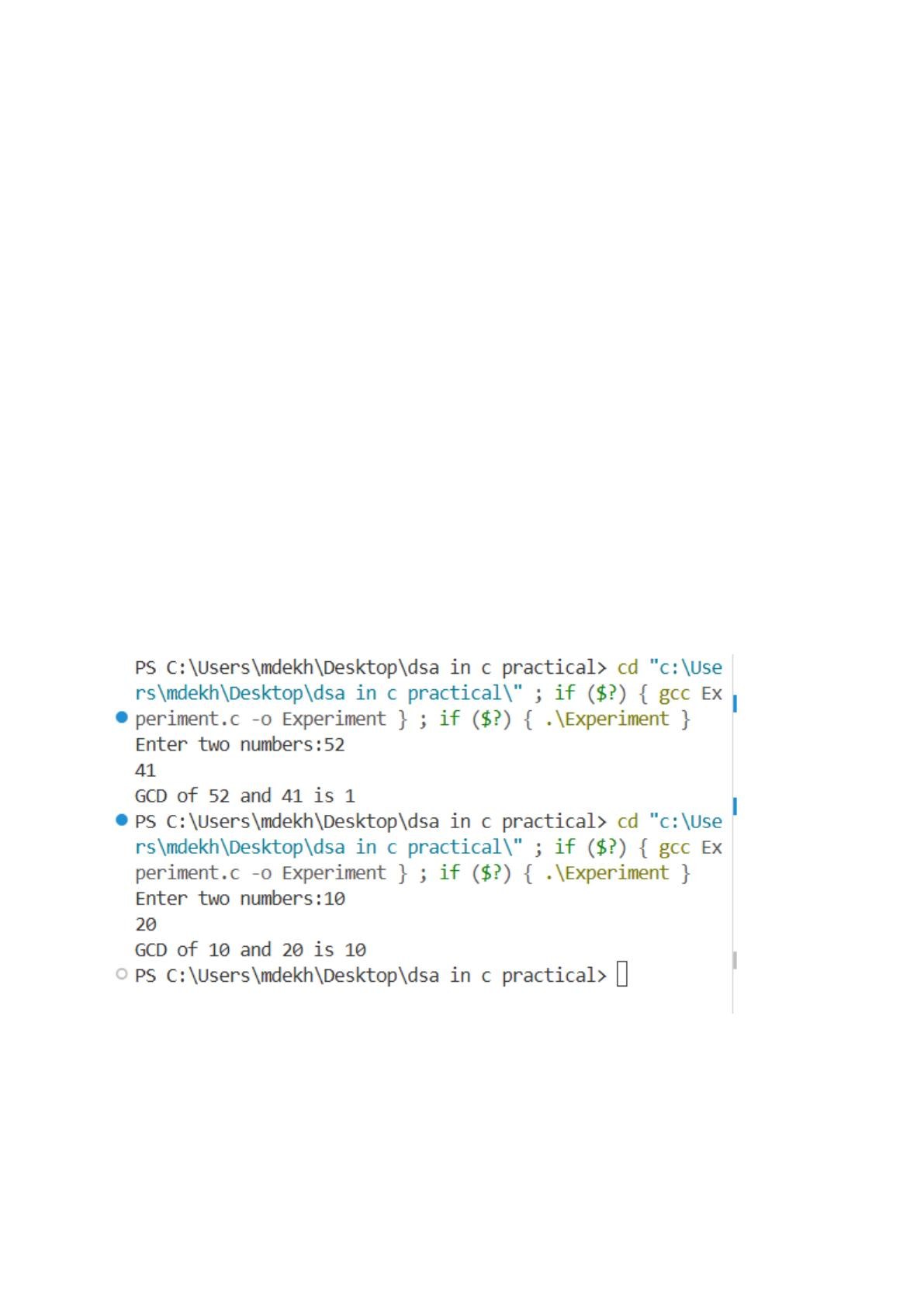
OUTPUT:-
Experiment no:- 2
#include<stdio.h>
int fibonacci(int n) {
if(n==0)
return 0;
else if(n == 1)
return 1;
else
return fibonacci(n-1)+fibonacci(n-2);
}
int main() {
int n,i;
printf("Enter a number of terms: ");
scanf("%d",&n);
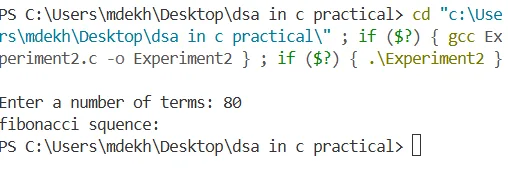
printf("fibonacci squence:\n");
/ 40
End of Document
61

FAQs

what is C programming experiments - code examples and exercises

C Programming Experiments - Code Examples and Exercises is a comprehensive guide that covers practical coding exercises in C programming.

  • It includes various experiments that help reinforce programming concepts.
  • Each experiment is designed to solve specific problems using C language.
  • The document provides code snippets, explanations, and outputs for better understanding.

how to find GCD in C programming experiments

Finding the GCD (Greatest Common Divisor) in C programming experiments involves using the Euclidean algorithm.

  • The algorithm repeatedly replaces the larger number by the remainder of the larger number divided by the smaller number.
  • This process continues until one of the numbers becomes zero.
  • The non-zero number at this point is the GCD.

what are the different C programming experiments included

The document includes various C programming experiments that cover fundamental concepts.

  • Examples include GCD calculation, Fibonacci sequence generation, string manipulation, and linked list operations.
  • Each experiment provides detailed code examples and expected outputs.
  • Additional experiments cover sorting algorithms and data structure implementations.

how to implement Fibonacci sequence in C programming experiments

Implementing the Fibonacci sequence in C programming experiments can be done using recursion or iteration.

  • The recursive method calls itself with decremented values until it reaches the base cases (0 and 1).
  • Alternatively, an iterative approach uses a loop to generate the sequence up to a specified number.
  • Both methods demonstrate the use of functions and control structures in C.

what is string concatenation in C programming experiments

String concatenation in C programming experiments refers to joining two strings into one.

  • This is typically done using a custom function that iterates through both strings.
  • The function appends characters from the second string to the end of the first.
  • It ensures the resulting string is null-terminated for proper display.

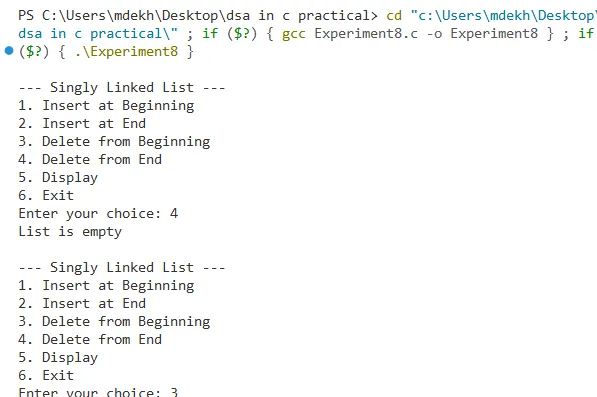
how to create a linked list in C programming experiments

Creating a linked list in C programming experiments involves defining a node structure and implementing functions to manipulate the list.

  • Each node contains data and a pointer to the next node.
  • Functions for insertion, deletion, and display are crucial for managing the list.
  • This experiment highlights dynamic memory allocation and pointer usage in C.

how to sort an array in C programming experiments

Sorting an array in C programming experiments can be achieved using various algorithms like bubble sort, selection sort, or insertion sort.

  • Each sorting algorithm has its own methodology for arranging elements in ascending or descending order.
  • The document provides code examples and outputs for each sorting method.
  • Understanding these algorithms helps in grasping fundamental programming concepts.

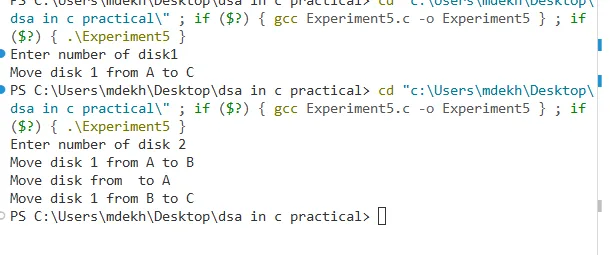
what is the tower of Hanoi in C programming experiments

The Tower of Hanoi in C programming experiments is a classic problem that demonstrates recursion.

  • The objective is to move a stack of disks from one peg to another, following specific rules.
  • The experiment provides a recursive function that outlines the steps to solve the puzzle.
  • This exercise enhances understanding of recursive problem-solving techniques in programming.