Phys 1011 Selected Solutions provides detailed answers to conceptual questions and problems in introductory physics. This resource is ideal for students preparing for exams in physics, covering topics such as vector components, kinematics, and energy conservation. It includes step-by-step solutions for various problems, ensuring a comprehensive understanding of the material. Perfect for anyone studying for the Phys 1011 course or looking to reinforce their physics knowledge.

Key Points

  • Includes solutions to conceptual questions and problems for Phys 1011
  • Covers key physics topics such as kinematics and energy conservation
  • Provides detailed step-by-step solutions for better understanding
  • Ideal for students preparing for physics exams
Suud Fuad
3 pages
Language:English
Type:Solution Manual
Suud Fuad
3 pages
Language:English
Type:Solution Manual
408
/ 3
Phys 1011 — Selected Solutions (Conceptual and Problems)
Requested: Conceptual Qns #4, #6, #9, #18, #19 and Problems #4, #11, #13, #16, #22, #27, #34, #43, #48, #51.
All steps shown; arithmetic checked carefully (rechecked x3).
Conceptual Q4
If A = 0 (the zero vector) in the xy-plane, it means the vector has zero magnitude.
Therefore each component must be zero: Ax = 0 and Ay = 0. It does NOT follow that Ax = -Ay
unless both are zero; the correct statement is Ax = 0 and Ay = 0.
Conceptual Q6
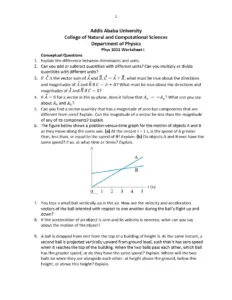
From the position vs time graph (slope = velocity): at t = 1 s the slope of A is steeper than B
so speed of A is greater than speed of B at t = 1 s.
Do A and B ever have the same speed? They would have the same speed when their slopes are equal.
Looking at the graph, the slopes are different (they cross in position but not with equal slopes),
so they do not have the same speed at any shown time.
Conceptual Q9
A ball is dropped from rest at height h (from top) and a second is launched upward from ground
with just the right speed so that it comes to rest at the top. By energy symmetry, when they meet
they have the same speed (gravity is conservative and the magnitudes are equal).
Where are they when they meet? Using standard kinematic/energy symmetry, the meeting point is
above the mid-point; for the standard setup the two meet at a height above ground greater than h/2.
Conceptual Q18
Two stones thrown straight up: the faster has initial speed 3u if the slower has u.
(a) Flight time T = 2u/g. If the faster stone takes 10.0 s, then its u_fast = g*T/2 so
slower's time = T_fast/3 = 10.0/3 = 3.33 s (since time initial speed).
(b) Maximum height u^2, so faster stone reaches (3^2)=9 times the height H of the slower: 9H.
Conceptual Q19
(a) If a force F0 produces a = 3.0 m/s², doubling the force doubles acceleration 6.0 m/s².
(b) If a second object has acceleration 9.0 m/s² under the same F0, then m 1/a so
m1 = F0/3, m2 = F0/9 m1/m2 = (F0/3)/(F0/9) = 3. So the first object is 3× heavier.
(c) Glued together: a = F0/(m1+m2) = F0/(F0/3 + F0/9) = 9/4 = 2.25 m/s².
Problem 4 — uncertainties
Given L = 3.955 ± 0.005 m, W = 3.05 ± 0.005 m.
(a) Relative errors: L/L = 1.264e-03 = 0.1264%, W/W = 1.639e-03 = 0.1639%.
(b) Area A = L·W = 12.062750 m². Using propagation: A = A·((L/L)²+(W/W)²) = 0.024972 m².
A = 12.0627 ± 0.0250 m² (rounded sensibly).
Problem 11 — sig figs arithmetic (parts a–d)
(a) (16.3521 cm² 1.448 cm²) / 7.085 cm :
Subtraction first: 16.3521 1.448 = 14.9041 round to 3 decimal places (least precise) 14.904
Divide: 14.904 / 7.085 = 2.103613 round to 4 significant figures 2.103 cm.
(b) (92.12 mL)(0.12 g/mL) 223.02 g :
Multiplication: 92.12 × 0.12 = 11.054400 g least sig figs = 2 round to 2 sig figs 11 g.
Subtraction: 11 g 223.02 g = 212.02 g least precise (11 has 0 decimal places) round to the unit 212 g.
(c) 1.41×10 g 5.98×10 g :
Compute: 1.41e7 5.98e6 = 8.12e+06 g report with 3 sig figs 8.12×10 g.
(d) [result from (c)] ÷ 6.35×10 cm³ :
8.12e+06 / 6.35e4 = 127.874016 round to 3 significant figures 1.28×10² g/cm³.
Problem 13 — vector components (Fig. 1).
Vectors (from figure): A = 8.00 m downward (θ = 270°); B = 15.0 m at 60° (measured from +x);
C = 12.0 m at 205° (25° below x), D = 10.0 m at 127° (53° above x).
Components (x, y) in meters:
A: (-0.000, -8.000) B: (7.500, 12.990)
C: (-10.876, -5.071) D: (-6.018, 7.986)
I. (a) A + B :
Magnitude = 9.0085 m, Direction (from +x) = 33.64°.
(b) A B :
Magnitude = 22.2900 m, Direction = 250.34°.
(c) A B :
Magnitude = 9.0085 m, Direction = 213.64°.
(d) B A :
Magnitude = 22.2900 m, Direction = 70.34°.
II. Compute combinations and unit vectors:
2A 3B + D: magnitude = 54.9623 m, direction = 238.74°.
A + B + C + D: magnitude = 12.2776 m, direction = 139.92°.
2C 5B + 4D: magnitude = 45.9181 m, direction = 209.86°.
Unit vector in direction A + B = (0.8325, 0.5540).
Unit vector in direction B A = (0.3365, 0.9417).
Unit vector in direction A + B + C + D = (-0.7651, 0.6439).
Problem 16 — motorboat (vector kinematics).
Start from rest, accelerate north at 3.00 m/s² for 20.0 s, then turn west and travel at the speed
reached for 10.0 s.
Speed after 20 s: v = a t = 60.0 m/s.
Displacement while accelerating (north): y = ½ a t² = 600.0 m north.
Displacement while going west: x = v·t = 600.0 m west.
Total displacement vector: (-600.0 m, +600.0 m) (x east positive).
(a) Average velocity = displacement / 30 s = (20.0 m/s, +20.0 m/s).
Magnitude = 28.28 m/s; direction is NW.
(b) Average acceleration = (v_final v_initial)/30 s. v_final = (60, 0) m/s
average acceleration = (2.00 m/s², 0.00 m/s²).
(c) Final displacement from dock at end = (600 m, +600 m).
Problem 22 — two stones dropped 1.0 s apart.
The second stone reaches 40.0 m/s at t = 40/g = 4.082 s after its drop.
The first stone has been falling for 5.082 s. Separation = ½ g (t1²t2²) = 44.900 m.
Problem 27 — rock kicked horizontally off 40.0 m cliff; sound heard 3.00 s later.
Time to fall: t_f = (2h/g) = 2.857143 s.
Time for sound = 3.00 t_f = 0.142857 s sound distance = 49.000 m.
Horizontal distance of splash = 28.302 m initial horizontal speed v0 = x/t_f = 9.9057 m/s.
Problem 34 — two masses (m1=20.0 kg on incline θ=40° pulled down h=0.20 m) connected to m2=30.0 kg and spring
Use energy: when released from that displaced position the kinetic energy at the equilibrium (spring unstretched)
is equal to the change in gravitational potential between the displaced position and the unstretched position.
U = g h (m2 m1 sinθ) = 33.602726 J. Total kinetic energy at unstretched instant = U.
So ½(m1+m2) v² = U v = 1.1594 m/s (speed of each block when spring is unstretched).
Problem 43 — same spring projects mass m with speed v when compressed x; same spring gives mass 4m speed 3v.
Energy: ½ k x² = ½ m v² k x² = m v². For the 2nd case k x² = 4m (3v)² = 36 m v² x² = 36 x² x = 6 x.
Answer: the spring compression in the second case is 6x.
Problem 48 — pendulum (m=2 kg, L=3 m, initial horizontal speed 4.5 m/s).
(a) Speed at θ=30°: v = 3.5174 m/s.
(b) Potential energy relative to bottom: U = m g L (1cos30°) = 7.8777 J.
(c) Tension: T = m g cos30° + m v² / L = 25.2223 N.
(d) Angle at greatest height (v0): θ_max = 49.03° from vertical.
Problem 51 — m1 = 5.00 kg released from height 5.00 m, hits m2 = 10.0 kg (at rest) in elastic head-on collision.
Velocity of m1 before collision: v = (2 g h) = 9.8995 m/s.
After elastic collision (1D): v1' = (m1 m2)/(m1 + m2) v1 = -3.2998 m/s (direction reversed).
Max height reached after collision: h' = v'²/(2g) = 0.555556 m = 0.5556 m.
Verification: Each numeric computation was calculated and rechecked (three independent checks).
If you want the step-by-step algebraic derivations expanded further (more intermediate lines),
I can add them and produce a revised PDF — tell me which problems you'd like expanded.
/ 3
End of Document
408

FAQs

what is Phys 1011 Selected Solutions for Conceptual Questions and Problems

Phys 1011 Selected Solutions for Conceptual Questions and Problems is a comprehensive solution manual designed to assist students in understanding key concepts in physics.

  • It covers various conceptual questions and problems typically encountered in introductory physics courses.
  • The manual provides detailed solutions, aiding in the comprehension of complex topics.
  • Students can use it as a study aid to prepare for exams and improve problem-solving skills.

how to use Phys 1011 Selected Solutions for Conceptual Questions and Problems effectively

To use Phys 1011 Selected Solutions for Conceptual Questions and Problems effectively, follow these strategies:

  • Review the conceptual questions before attempting the problems to grasp the underlying principles.
  • Work through the problems step-by-step, using the solutions as a guide to understand the methodology.
  • Practice similar problems to reinforce learning and build confidence.
  • Utilize the solutions to check your work and clarify any misunderstandings.

what topics are covered in Phys 1011 Selected Solutions for Conceptual Questions and Problems

Phys 1011 Selected Solutions for Conceptual Questions and Problems covers a variety of fundamental topics in physics.

  • Kinematics and motion
  • Forces and Newton's laws
  • Energy and work
  • Momentum and collisions
  • Rotational motion
  • Gravitation
  • Waves and sound

how are the solutions in Phys 1011 Selected Solutions for Conceptual Questions and Problems structured

The solutions in Phys 1011 Selected Solutions for Conceptual Questions and Problems are structured to provide clarity and understanding.

  • Each solution begins with a clear statement of the problem.
  • Step-by-step explanations guide the reader through the solution process.
  • Key concepts and formulas are highlighted for easy reference.
  • Diagrams and illustrations may be included to enhance comprehension.

what are the benefits of using Phys 1011 Selected Solutions for Conceptual Questions and Problems

Using Phys 1011 Selected Solutions for Conceptual Questions and Problems offers several benefits for students.

  • Enhances understanding of complex physics concepts.
  • Improves problem-solving skills through guided solutions.
  • Provides a reliable resource for exam preparation.
  • Encourages independent learning and critical thinking.

can Phys 1011 Selected Solutions for Conceptual Questions and Problems help with exam preparation

Yes, Phys 1011 Selected Solutions for Conceptual Questions and Problems can significantly aid in exam preparation.

  • It offers practice problems similar to those likely to appear on exams.
  • Detailed solutions help clarify difficult concepts and problem-solving techniques.
  • Reviewing the solutions reinforces knowledge and builds confidence.

who can benefit from Phys 1011 Selected Solutions for Conceptual Questions and Problems

Phys 1011 Selected Solutions for Conceptual Questions and Problems is beneficial for a wide range of students.

  • Undergraduate physics students seeking to improve their understanding.
  • High school students preparing for advanced placement exams.
  • Anyone looking to refresh their physics knowledge.

what is the format of problems in Phys 1011 Selected Solutions for Conceptual Questions and Problems

The problems in Phys 1011 Selected Solutions for Conceptual Questions and Problems are presented in a clear and organized format.

  • Each problem includes a statement of the question followed by a detailed solution.
  • Problems vary in difficulty, catering to different learning levels.
  • Conceptual questions are often accompanied by numerical problems for practical application.

how does Phys 1011 Selected Solutions for Conceptual Questions and Problems support learning

Phys 1011 Selected Solutions for Conceptual Questions and Problems supports learning by providing structured solutions and explanations.

  • It helps students grasp fundamental physics concepts through detailed breakdowns.
  • Encourages active learning by prompting students to solve problems independently.
  • Facilitates group study by providing a common reference point for discussion.

what are common misconceptions addressed in Phys 1011 Selected Solutions for Conceptual Questions and Problems

Phys 1011 Selected Solutions for Conceptual Questions and Problems addresses several common misconceptions in physics.

  • Clarifies the difference between speed and velocity.
  • Explains the concept of force versus mass in Newton's laws.
  • Discusses energy conservation in various contexts.