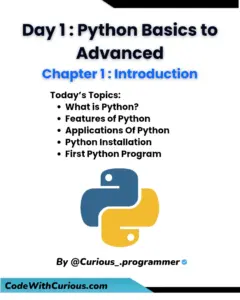
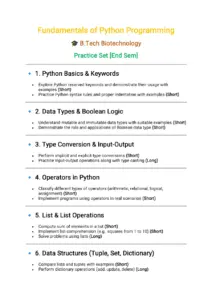
Python Programming covers essential concepts from Chapters 1 to 5, focusing on the basics of Python, data types, and control flow. This resource is ideal for beginners and intermediate learners looking to enhance their programming skills. Key topics include setting up Python, understanding variables, and utilizing loops and conditionals. With practical exercises and assignments, students can solidify their understanding of Python programming fundamentals.

Key Points

  • Introduces Python programming basics including installation and setup.
  • Covers data types and variables essential for effective coding.
  • Explains control flow using if statements and loops.
  • Includes practical exercises and assignments for hands-on learning.
Sodiqson Ramziyah
12 pages
Language:English
Type:Notes
Sodiqson Ramziyah
12 pages
Language:English
Type:Notes
118
/ 12
Python Programming
Comprehensive Notes, Exercises & Assignments
Covering All 12 Topics • Beginner to Intermediate
Topic 1: Basics of Python
1.1 What is Python?
Python is a high-level, interpreted, general-purpose programming language created by Guido
van Rossum in 1991. It emphasizes code readability and simplicity, making it ideal for beginners
while remaining powerful for professionals.
Key Characteristics
• Interpreted code runs line by line without compilation
• Dynamically typed — no need to declare variable types
• Indentation-based uses whitespace to define code blocks
• Versatile — used in web, data science, AI, automation, scripting
1.2 Setting Up Python
1. Download Python from https://python.org (version 3.x)
2. Run the installer check 'Add Python to PATH'
3. Verify installation: open terminal and type python --version
4. Choose an editor: VS Code, PyCharm, IDLE, or Jupyter Notebook
1.3 Your First Python Script
The classic 'Hello, World!' program introduces the print() function:
# This is a comment
print("Hello, World!")
# You can print multiple values
print("My name is", "Alice")
print("2 + 3 =", 2 + 3)
1.4 Indentation and Syntax
Python uses indentation (4 spaces or 1 tab) to define code blocks. Incorrect indentation causes
an IndentationError.
# Correct indentation
if True:
print('This is inside the if block')
print('Also inside')
print('This is outside')
# IndentationError example DO NOT do this:
if True:
print('Wrong!') # Missing indentation
Exercise 1: Hello Python
1. Write a script that prints your full name.
2. Print your age on the next line.
3. Print the result of 15 * 4 using the print() function.
4. Add a comment above each print statement explaining what it does.
Assignment 1: My Introduction Script
Create a Python script called my_intro.py that prints:
• Your name, city, and hobby (each on separate lines)
• A simple calculation showing your birth year subtracted from 2025
• A motivational quote of your choice
Ensure all lines have appropriate comments.
/ 12
End of Document
118

FAQs

what is python programming

Python programming is a high-level, interpreted, general-purpose programming language created by Guido van Rossum in 1991.

It emphasizes code readability and simplicity, making it ideal for beginners while remaining powerful for professionals. Key characteristics include:

  • Interpreted: Code runs line by line without compilation.
  • Dynamically typed: No need to declare variable types.
  • Indentation-based: Uses whitespace to define code blocks.
  • Versatile: Used in web development, data science, AI, automation, and scripting.

how to set up python programming

Setting up Python programming involves a few straightforward steps.

  1. Download Python from python.org (version 3.x).
  2. Run the installer and check 'Add Python to PATH'.
  3. Verify installation by opening a terminal and typing python --version.
  4. Choose an editor like VS Code, PyCharm, IDLE, or Jupyter Notebook.

Following these steps will ensure you have a functional Python environment ready for coding.

what is the first python programming script

The first Python programming script is typically the classic 'Hello, World!' program.

This simple script introduces the print() function, which outputs text to the console. Here’s how it looks:

# This is a comment
print("Hello, World!")
# You can print multiple values
print("My name is", "Alice")
print("2 + 3 =", 2 + 3)

This example showcases basic syntax and the use of comments in Python.

what are the data types in python programming

Python programming includes several fundamental data types.

These data types allow you to store various kinds of data:

  • Integer: Whole numbers (e.g., age = 25).
  • Float: Decimal numbers (e.g., height = 5.7).
  • String: Text data (e.g., name = 'Alice').
  • Boolean: Represents True or False values (e.g., is_student = True).

Understanding these data types is crucial for effective programming in Python.

what are operators in python programming

Operators in Python programming are special symbols that perform operations on variables and values.

They can be categorized into several types:

  • Arithmetic Operators: Used for mathematical operations (e.g., +,-,*,/).
  • Comparison Operators: Used to compare values (e.g., ==, !=, >, <).
  • Logical Operators: Used to combine conditional statements (e.g., and, or, not).

Each operator serves a distinct purpose, making them essential for controlling the flow of a program.

how does control flow work in python programming

Control flow in Python programming determines the order in which statements are executed.

This is primarily managed through:

  • Conditional Statements: Use if, elif, and else to execute code based on conditions.
  • Loops: Use while and for loops to repeat code blocks.

Understanding control flow is essential for creating dynamic and responsive programs.

what are lists in python programming

Lists in Python programming are ordered collections that can hold multiple items.

They are defined using square brackets and can store items of different data types:

  • Example: fruits = ['apple', 'banana', 'cherry']

Common list operations include:

  • Appending: fruits.append('mango')
  • Inserting: fruits.insert(1, 'kiwi')
  • Removing: fruits.remove('banana')

Lists are versatile and widely used for data storage and manipulation.

what are dictionaries in python programming

Dictionaries in Python programming are unordered collections of key-value pairs.

They are defined using curly braces and allow for fast data retrieval:

  • Example: student = {'name': 'Alice', 'age': 20, 'grade': 'A'}

Key operations include:

  • Accessing: student['name'] returns 'Alice'.
  • Adding: student['email'] = '[email protected]' adds a new key.
  • Deleting: del student['grade'] removes a key.

Dictionaries are particularly useful for organizing and managing structured data.

what are common python programming errors

Common Python programming errors can hinder code execution and debugging.

Some frequent issues include:

  • Syntax Errors: Mistakes in the code structure (e.g., missing colons or parentheses).
  • Indentation Errors: Incorrect use of whitespace can lead to unexpected behavior.
  • Type Errors: Occur when an operation is applied to an inappropriate data type.

Recognizing these errors is essential for effective debugging and writing robust Python code.

what are the benefits of learning python programming

Learning Python programming offers numerous benefits for aspiring developers.

Some key advantages include:

  • Easy to Learn: Python's syntax is straightforward and beginner-friendly.
  • Versatile Applications: It is used in web development, data analysis, AI, and more.
  • Strong Community Support: A large community provides ample resources and libraries.

These factors make Python a popular choice for both beginners and experienced programmers alike.