

Python is a high-level, interpreted, multi-paradigm programming language celebrated for its focus on code readability, expressive syntax, and robust structural agility. Far from being restricted to basic automation scripts, Python operates as a foundational engineering engine driving modern web backends, data engineering pipelines, DevOps automation, and artificial intelligence architectures. By abstracting lower-level system complexities—such as manual memory allocation, pointer manipulation, and hardware-specific compilation—Python allows software developers to focus on architectural logic and rapid prototyping. To assist students scaling from junior syntax tracking to senior systems implementation, our comprehensive Programming category hosts a deep vault of source materials, script templates, and language tutorials.
The functional identity of Python is anchored in its dynamic typing system and automated garbage collection mechanics. Python handles variable initialization fluidly via duck typing (“if it walks like a duck and quacks like a duck, it’s a duck”), binding data types at runtime rather than during compile phases. Underlying this flexibility is an object-centric memory framework: every variable, function, module, and primitive data type within a Python runtime environment is structured as a distinct heap-allocated object. To manage these allocations cleanly without developer intervention, Python implements a hybrid memory reclamation engine combining Reference Counting with a cyclic-isolation Garbage Collector, ensuring that orphaned memory addresses are unmapped continuously.
Python’s flexibility stems directly from its native multi-paradigm design. It allows developers to seamlessly blend Imperative, Object-Oriented Programming (OOP), and Functional programming styles within a single application. Its OOP engine leverages explicit class declarations, runtime attribute binding, and robust multiple inheritance hierarchies backed by the C3 Linearization (MRO) algorithm. Concurrently, Python embeds clean functional programming primitives—such as lambda expressions, first-class function objects, list comprehensions, and lazy-evaluating generator expressions. These functional paradigms allow for elegant, declarative operations over complex data structures without mutating global application states.
Beyond standalone logic execution, Python’s massive standard library (“batteries included”) and sprawling package ecosystem make it an industry-standard interface layer across technical fields. Python acts as the primary API wrapper for intense compute frameworks, including deep connectionist networks and machine learning pipelines, as explored in the master class text Deep Learning Fundamentals. Its high-speed file manipulation capabilities and parsing streams make it perfect for building complex data extraction tools, semantic file converters, and website analytics handlers. It also powers web optimization layouts and custom automation modules designed to run on scalable virtual machines.
However, scaling Python systems to enterprise production volumes requires a deep understanding of its internal runtime constraints. The most prominent architectural boundary is the Global Interpreter Lock (GIL), a mutex mechanism within the standard CPython implementation that prevents multiple native threads from executing Python bytecodes concurrently. While this design ensures absolute thread safety for internal object tracking and simplifies extensions, it restricts pure Python applications to a single CPU core during multi-threaded CPU-bound operations. To bypass the GIL and unlock true multi-core processing power, developers must master horizontal scaling strategies, such as process-level isolation (multiprocessing), asynchronous scheduling frameworks (asyncio), and offloading high-compute tasks to pre-compiled, highly optimized C/C++ backend extensions.
To see how the expansive landscape of Python engineering and scripting design maps its operational domains and core software applications, review the following academic taxonomy:
Parent Category: Computer Science
Academic Branch: Programming
Core Language: Python
Subfields & Architectural Systems:
Foundational Semantics (Control Flow, Dynamic Typing, Scoping Matrices)
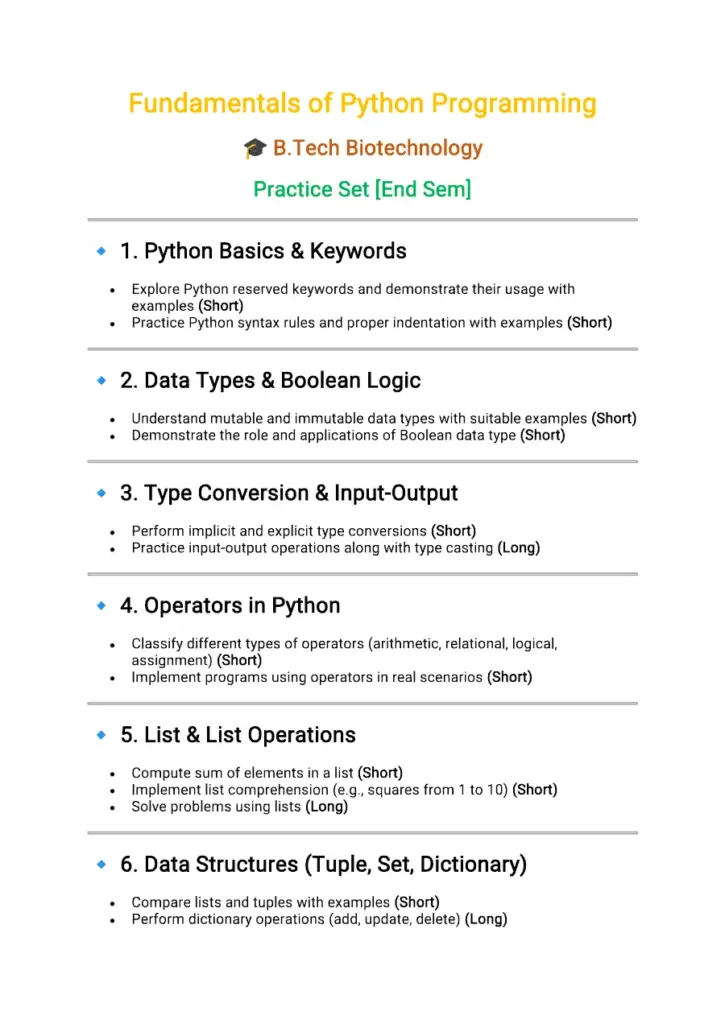
Data Structure Abstractions (Lists, Tuples, Dictionaries, Sets, Hashing Mechanics)
Object-Oriented Design (Classes, Polymorphism, Multiple Inheritance, Metaprogramming)
Functional Tooling (Iterators, Generators, Closures, Decorators, Lambda Functions)
Runtime Internals & Memory (CPython Bytecode, GIL Mutex, Reference Counting)
Concurrency Frameworks (Multiprocessing Pools, Asynchronous Event Loops, Threading)
| Data Structure | Mutability State | Internal Implementation | Average Search Time | Optimal Application Scenario |
| List | Mutable | Dynamic array of pointers | $O(n)$ linear sweep | Sequential data collections, stacks, queues, order-dependent iterations |
| Tuple | Immutable | Static fixed-size array | $O(n)$ linear sweep | Unchanging record structures, dictionary tracking keys, coordinate vectors |
| Dictionary | Mutable | Resizable Hash Table matrix | $O(1)$ constant time | High-speed key-value mapping, database record caching, lookup indices |
| Set | Mutable | Hash Table using dummy values | $O(1)$ constant time | Deduplication tasks, mathematical group checks (unions, intersections) |
Chesser Resources is a free online study-and-research library at chesserresources.com. It holds 300,000+ documents — books, textbooks, past papers, lecture notes, study guides, research papers and much more — across exams, the sciences, math, literature, the humanities and beyond. Everything is readable in the browser with no account, alongside free AI summaries, an Ask-AI chatbot, highlights, notes and read-aloud audio. Instead of a subscription, downloads are unlocked by contributing back to the community, so the library stays genuinely free.
The Global Interpreter Lock (GIL) is a mutual exclusion lock (mutex) used by the default CPython implementation to ensure that only a single native thread executes Python bytecode at any given moment. This constraint is necessary because CPython’s underlying memory management engine is not inherently thread-safe. By preventing concurrent threads from simultaneously altering reference count variables on heap objects, the GIL completely eliminates race conditions within the core interpreter, simplifying the integration of external C extensions.
To execute true concurrent processing on multi-core CPU architectures, developers bypass the GIL by utilizing the multiprocessing module instead of standard threads. This approach instantiates entirely separate operating system processes, each possessing its own independent Python interpreter instance and isolated memory heap space, effectively giving each process its own GIL. Alternatively, high-compute algorithms can be offloaded to third-party C/C++ extensions (like NumPy or OpenCV) that explicitly release the GIL during long mathematical computations.
An Iterator is an object that implements the iterator protocol, requiring the dual structural methods __iter__() and __next__() to step through a sequence. A Generator is a specialized, elegant subclass of iterator that simplifies this architecture by using the yield keyword within a standard function block instead of a return statement. When called, a generator returns a lazy evaluation object that pauses its execution state between iterations, computing next-in-line values on demand to achieve near-zero memory utilization on massive data streams.
Python monitors heap memory allocation primarily through reference counting. Every object created in memory contains an internal counter field (ob_refcnt) that tracks how many active variables, data structures, or code namespaces currently point to that object. When a variable is assigned to an object, its reference count increments; when a variable goes out of scope or is explicitly deleted, its count decrements. The moment an object’s reference counter hits absolute zero, its allocated heap space is instantly reclaimed by the environment.
While reference counting handles the immediate destruction of simple objects, it is incapable of detecting and cleaning up cyclic references. A cyclic reference occurs when two or more objects hold reference variables pointing directly to one another (e.g., Object A references Object B, and Object B references Object A), but they are completely disconnected from the application’s global or local namespaces. Because their reference counts can never hit zero, they trigger memory leaks. Python’s generational garbage collector solves this by periodically parsing the heap to isolate and purge these unreferenced object clusters.
When a variable name is referenced inside a Python script, the runtime system resolves its identity by searching through four nested scoping tiers in a strict sequential order:
L (Local): Names defined within the currently executing function or lambda block.
E (Enclosing): Names defined within any outer wrapping or non-local functions (relevant to closures).
G (Global): Names declared at the top-most level of the active module file.
B (Built-in): Keywords and functions pre-loaded natively by the language (e.g., len, range).
A closure is a persistent nested function object that retains access to variables from its outer, enclosing lexical scope, even after the parent outer function has completely finished executing. A closure is constructed when a nested function references a variable within its enclosing function’s namespace and the outer function returns that inner function object as a first-class citizen, preserving an isolated execution environment.
A Python decorator is an advanced metaprogramming tool that takes an existing function object as an input argument, wraps its execution inside an inner wrapper function that injects extra operational behavior (such as logging, authentication, or caching), and returns this modified wrapper function object to replace the original. This leverages Python’s first-class function architecture, enabling clean aspect-oriented modifications via the clean @decorator_name syntax prefix.
The Method Resolution Order (MRO) dictates the exact linear path Python uses to search for methods or attributes across complex multi-layered multiple inheritance object graphs. To resolve search paths cleanly and prevent the classic “Diamond Problem” (where a subclass inherits from two intermediate classes that share a single base ancestor), modern Python applies the C3 Linearization algorithm, which enforces strict monotonic ordering and preserves local subclass priority rules.
A shallow copy constructs a fresh wrapping collection object, but populates it with references pointing directly to the exact same nested objects and memory addresses found in the original structure. A deep copy recursively duplicates the entire hierarchy, instantiating completely independent copies of every single nested child object. Consequently, modifications made to a nested element inside a shallow copy will alter the original, whereas a deep copy prevents any cross-contamination.
List comprehensions provide an elegant alternative to iterative code loops by compiling list assembly procedures down to highly optimized bytecode executed natively inside the underlying C code infrastructure of the interpreter. This specialized processing minimizes loop overhead and cuts down on repetitive lookup costs associated with appending values to an array, significantly accelerating array compilation.
An unbound function represents the abstract execution logic defined inside a class block before an actual instance of that class is constructed. A bound method is generated automatically at runtime when a class function is accessed through a specific object instance. This instantiation creates a callable wrapper object that automatically injects the instance’s own unique heap memory reference as the primary implicit argument (self) into the function execution pipeline.
Python dictionaries achieve an average search complexity of $O(1)$ by using internal open-addressing Hash Tables. When a key-value pair is requested, the interpreter runs the key through an internal hashing algorithm to generate an integer index that maps directly to a specific bucket slot in an underlying memory array. This direct mapping allows the query engine to pinpoint the exact memory address of the target object instantly, completely avoiding linear traversal loops.
__slots__) inside a Python class?By default, Python structures object instances by storing their attributes inside a dynamic, writable dictionary (__dict__). While flexible, this dictionary structure carries a massive memory overhead due to its sparse hash table footprint. Declaring a fixed sequence of allowed attributes via the __slots__ attribute instructs the interpreter to drop the instance dictionary entirely, mapping variables to a highly compact, optimized array layout that slashes memory consumption and accelerates attribute lookups.
is operator differ from the == comparison operator?The double-equals operator (==) evaluates equality of value; it checks whether the contents of two distinct objects are structurally identical by invoking the underlying __eq__() magic method. The identity operator (is) evaluates equality of reference; it checks whether two variables point to the exact same physical object address in heap memory by comparing their unique memory identifiers (id()), matching true only if both variables point to the same structural entity.