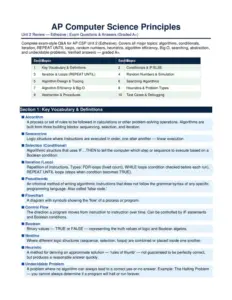
Computer Science Summary provides an overview of essential concepts in computer science, including number systems, data representation, and logical binary shifts. It covers how binary, denary, and hexadecimal systems function and their importance in computing. The summary also discusses data storage units, data compression techniques, and the representation of text, images, and sound in binary. Ideal for students and professionals looking to reinforce their understanding of foundational computer science principles.

Key Points

  • Explains number systems including binary, denary, and hexadecimal.
  • Covers data representation methods for text, images, and sound.
  • Details logical binary shifts and their effects on data values.
  • Discusses data storage units and their significance in computing.
  • Outlines data compression techniques, including lossy and lossless methods.
Blessing Ruvimbo
2 pages
Language:English
Type:Notes
Blessing Ruvimbo
2 pages
Language:English
Type:Notes
324
/ 2
Computer Science Notes - Summary
1. Number Systems
Computers use binary (base 2) because circuits only have ON (1) and OFF (0). Binary uses powers
of 2 while denary uses powers of 10 and hexadecimal uses powers of 16. Conversions between
binary, denary and hexadecimal are essential in Computer Science.
Binary operations include addition, subtraction and multiplication. 8bit binary ranges from 0 to 255
(unsigned) and -128 to 127 (signed). Overflow occurs when results exceed available bits.
2. Logical Binary Shifts
Logical shift left moves bits left and multiplies value by 2. Logical shift right moves bits right and
divides value by 2. Overflow occurs when bits are shifted out of the leftmost position.
3. Data Representation
Computers store all data in binary including text, images and sound.
Text Representation
Text is stored using ASCII and Unicode. ASCII uses 7 bits (128 characters) while Unicode uses 16
bits or more and supports global languages and emojis.
Image Representation
Images are made of pixels. Resolution and colour depth determine quality. More pixels and higher
colour depth increase file size.
Sound Representation
Sound is stored using sampling and quantisation. Higher sampling rate and bit depth improve
quality but increase file size.
4. Data Storage Units
Bit is smallest unit. 8 bits = 1 byte. 1 KiB = 1024 bytes, 1 MiB = 1024 KiB, 1 GiB = 1024 MiB. Always
use 1024 in Computer Science calculations.
5. Data Compression
Data compression reduces file size. Lossy compression removes data permanently and reduces
quality. Lossless compression keeps all data and allows original file restoration. Run Length
Encoding is a common lossless method.
Final Key Points
Computers use binary. Data can be text, images or sound. Storage units use powers of 1024.
Compression reduces file size. Logical shifts perform fast multiplication and division.
/ 2
End of Document
324

FAQs

what is computer science summary key concepts and data representation

The document 'Computer Science Summary: Key Concepts and Data Representation' covers essential topics in computer science, focusing on how data is represented and manipulated in computing systems.

  • Number Systems: Explains binary, denary, and hexadecimal systems.
  • Data Representation: Discusses how text, images, and sound are stored in binary.
  • Data Storage Units: Details the hierarchy of data storage from bits to gigabytes.
  • Data Compression: Describes methods of reducing file sizes.

how does data representation work in computer science summary

Data representation in 'Computer Science Summary: Key Concepts and Data Representation' refers to how different types of data are encoded in binary format.

  • Text Representation: Uses ASCII and Unicode for character encoding.
  • Image Representation: Involves pixels, resolution, and color depth.
  • Sound Representation: Covers sampling and quantization techniques.

This document provides insights into how these representations affect data processing and storage efficiency.

what are the key concepts in computer science summary

The 'Computer Science Summary: Key Concepts and Data Representation' outlines several fundamental concepts crucial for understanding computer science.

  • Binary Systems: The foundation of computer operations.
  • Logical Shifts: Techniques for multiplying and dividing binary values.
  • Data Compression: Methods to optimize storage space.
  • Data Storage Units: Definitions and conversions of bits, bytes, and larger units.

These concepts are essential for anyone studying or working in the field of computer science.

how is data compression explained in computer science summary

Data compression in 'Computer Science Summary: Key Concepts and Data Representation' is explained as a method to reduce file sizes while maintaining data integrity.

  • Lossy Compression: Permanently removes some data, often reducing quality.
  • Lossless Compression: Retains all original data, allowing for complete restoration.
  • Run Length Encoding: A common lossless method that compresses data by reducing sequences of repeated values.

This section emphasizes the trade-offs between quality and file size in data storage.

what are the data storage units in computer science summary

The 'Computer Science Summary: Key Concepts and Data Representation' defines various data storage units crucial for understanding computer memory.

UnitEquivalent
1 BitSmallest unit of data
1 Byte8 Bits
1 KiB1024 Bytes
1 MiB1024 KiB
1 GiB1024 MiB

Understanding these units is essential for effective data management and computing.

what is binary operations in computer science summary

Binary operations in 'Computer Science Summary: Key Concepts and Data Representation' refer to mathematical processes performed using binary numbers.

  • Addition: Combining binary numbers to produce a sum.
  • Subtraction: Finding the difference between binary values.
  • Multiplication: Using binary digits to perform multiplication, often through shifting techniques.

These operations are foundational for programming and algorithm development in computer science.

how are logical binary shifts explained in computer science summary

Logical binary shifts in 'Computer Science Summary: Key Concepts and Data Representation' are methods for shifting bits in binary numbers.

  • Logical Shift Left: Moves bits to the left, effectively multiplying the number by 2.
  • Logical Shift Right: Moves bits to the right, dividing the number by 2.

These operations can lead to overflow if bits are shifted out of bounds, which is a critical concept in computer programming.

what is the importance of number systems in computer science summary

Number systems are fundamental in 'Computer Science Summary: Key Concepts and Data Representation' as they form the basis for data processing in computers.

  • Binary (Base 2): Used in digital circuits for ON (1) and OFF (0) states.
  • Denary (Base 10): Commonly used by humans for everyday counting.
  • Hexadecimal (Base 16): Used for compact representation of binary data.

Understanding these systems is crucial for converting and manipulating data in programming and computer architecture.

what does ascii and unicode mean in computer science summary

ASCII and Unicode are character encoding standards discussed in 'Computer Science Summary: Key Concepts and Data Representation'.

  • ASCII: Uses 7 bits to represent 128 characters, primarily for English text.
  • Unicode: Extends character representation to 16 bits or more, accommodating global languages and emojis.

These encoding methods are vital for text representation in software applications and web development.