The feasibility study investigates the use of bamboo grids as a sustainable alternative to geogrids for reinforcing soil-rock mixtures in subgrade applications. It explores the mechanical properties of bamboo reinforcement, including tensile, shear, and flexural strengths, demonstrating its effectiveness in enhancing stability and reducing maintenance costs in highway construction. The research compares uniaxial and biaxial bamboo grids under varying vertical loads, revealing significant improvements in interfacial friction and shear stress with the biaxial design. This study is essential for civil engineers and environmentalists seeking eco-friendly construction solutions in mountainous regions.

Key Points

  • Analyzes the mechanical properties of bamboo grids for soil-rock reinforcement
  • Compares uniaxial and biaxial bamboo grids under different loads
  • Demonstrates bamboo’s superior tensile strength of 236.01 MPa
  • Highlights the environmental benefits of using renewable bamboo materials
Dhruva Patel
11 pages
Language:English
Type:Research Paper
Dhruva Patel
11 pages
Language:English
Type:Research Paper
Dhruva Patel
11 pages
Language:English
Type:Research Paper
326

Feasibility Study on the Bamboo Grid Instead of Geogrid for Soil–Rock Mixture Subgrade Reinforcing pdf

/ 11
Citation: Hu, Y.; Chen, S.; Xie, C.;
Zhong, W.; Yin, H.; Luo, Z.; Luo, B.;
Liang, B.; He, M.; Huang, J.
Feasibility Study on the Bamboo Grid
Instead of Geogrid for Soil–Rock
Mixture Subgrade Reinforcing.
Materials 2022, 15, 4047. https://
doi.org/10.3390/ma15124047
Academic Editor: Dario De
Domenico
Received: 1 May 2022
Accepted: 5 June 2022
Published: 7 June 2022
Publishers Note: MDPI stays neutral
with regard to jurisdictional claims in
published maps and institutional affil-
iations.
Copyright: © 2022 by the authors.
Licensee MDPI, Basel, Switzerland.
This article is an open access article
distributed under the terms and
conditions of the Creative Commons
Attribution (CC BY) license (https://
creativecommons.org/licenses/by/
4.0/).
materials
Article
Feasibility Study on the Bamboo Grid Instead of Geogrid for
Soil–Rock Mixture Subgrade Reinforcing
Yong Hu
1
, Shanling Chen
2
, Cekun Xie
3
, Weilin Zhong
1
, Hongda Yin
1
, Zhengdong Luo
3,
*, Biao Luo
3,
* ,
Bin Liang
4
, Min He
4
and Junjie Huang
5
1
Yueyang City Roads and Bridge Construction Corporation, Yueyang 414021, China;
huyong02@sohu.com (Y.H.); zhongwl123@163.com (W.Z.); yinhd0101@sohu.com (H.Y.)
2
Department of Transportation of Hunan Province, Traffic Manufacturing Cost Management Station,
Changsha 410116, China; chenshanling001@sohu.com
3
College of Civil Engineering and Mechanics, Xiangtan University, Xiangtan 411105, China;
cekunxie11@sohu.com
4
College of Civil Engineering, Hunan University of Technology, Zhuzhou 412007, China;
liangbingg123@sina.com (B.L.); heemingg@163.com (M.H.)
5
China Construction Technology of Hunan Co., Ltd., Changsha 410600, China; huangjunjiee@aliyun.com
* Correspondence: luozhengdong0425@163.com (Z.L.); luobiao1995@foxmail.com (B.L.)
Abstract:
To promote the application of the bamboo grid in the soil–rock mixture subgrade in
mountain areas, the mechanical properties of bamboo reinforcement were investigated in this study,
and the reinforcement effect and interface characteristics of uniaxial/biaxial bamboo grid on the
soil–rock mixture under different vertical loads was comparatively analyzed. The results show that
the tensile force (2% elongation) of the bamboo reinforcement is 50.21 kN/m, and its average tensile
strength is 236.01 MPa. Moreover, bamboo reinforcement has excellent shear and flexural properties.
In general, the reinforcement effect of the biaxial bamboo grid on the soil–rock mixed subgrade is
better than that of the uniaxial bamboo grid. In the case of using a uniaxial bamboo grid, its pull-out
curve is generally a strain-softening type. As for the biaxial bamboo grid, due to the existence of
bite force, its pull-out curve usually presents a strain-hardening type. Compared with the uniaxial
bamboo grid, the friction coefficient of the reinforcement–soil interface using the biaxial bamboo grid
is higher, and the interfacial shear stress is increased by 72.2–91.2%.
Keywords: bamboo grid; soil–rock mixture; subgrade; pull-out test; bamboo reinforcement
1. Introduction
Highways are inevitably distributed in mountain areas and foothills [
1
,
2
], and their
construction is restricted by complex geography. The soil–rock mixture produced by
mountain excavation, as subgrade filler, has gradually become the main construction form
of mountain highway construction [
3
5
]. The soil–rock mixture is a kind of special filler
composed of stones and soil, and its properties are different from cataclastic rock and
homogeneous soil [
6
8
]. Existing studies have shown that due to the characteristics of
large particle size, the high content of coarse particles, and inhomogeneity in the soil–rock
mixture, it is difficult to compact or unevenly compact in subgrade construction [
9
13
].
Defects such as lateral spreading, breakage, and differential settlement occur due to the
inhomogeneity and granularity of the soil–rock mixture, under the upper load. These
problems will reduce the safety of highway operations and increase maintenance costs,
thereby inhibiting regional economic development. Horizontal reinforcement is one of the
effective methods that can be used to solve the above problems.
Geosynthetics as reinforcing elements are a cost-effective solution for improving the
load-bearing properties of granular fill subgrade. The most representative of them is the
geogrid, which is often used as the horizontal reinforcement material of the subgrade. It
Materials 2022, 15, 4047. https://doi.org/10.3390/ma15124047 https://www.mdpi.com/journal/materials
Materials 2022, 15, 4047 2 of 11
can significantly improve the overall stability and horizontal deformation control of the
subgrade structure [
14
16
]. According to the different types of weaving, geogrids are
divided into uniaxial, biaxial, and multiaxial [
17
,
18
]. Liu et al. [
19
] laid a geogrid inside the
fill to form a load-bearing composite, which effectively restrained the lateral deformation
and improved the overall stress state of the soil. Sweta et al. [
11
] found that the utilization
of geogrids directly enhanced the shear strength of ballast and reduced the percentage of
breakage by 9.24%. Esmaeili et al. [
20
] reported that the number of geogrid layers is one
of the important factors affecting the lateral resistance of a single sleeper/track panel. In
another study, Gao et al. [
21
] performed model tests based on transparent soil technology
and digital image technology to comprehensively study the effect of the layers and types of
geogrids on the reinforcement effect of foundation soil. In addition, due to the excellent
tensile properties of the geogrid, it can also be used as the wrapping material of the gravel
pile to limit the lateral deformation of the gravel pile. In addition, due to the excellent
tensile properties of the geogrid, it can be used as the wrapping material of the gravel pile
to limit its lateral deformation [
22
24
]. However, the widely used geosynthetic material
is a chemical product made of a high molecular polymer as a raw material, which is a
non-renewable resource. Additionally, its production process will produce a large amount
of sulfide, nitrogen oxides and carbon dioxide, and other gases, which will pollute the
environment [
25
]. At present, the construction industry advocates green and low-carbon
development and searches for sustainable reinforcement materials similar to geogrids,
which have important theoretical and environmental significance in the field of soil–rock
mixture reinforcement.
Bamboo is a natural biomaterial with high strength, high toughness, and renewable,
and is easily accessible in Asia. It is also widely distributed in mountain areas where
highway construction is carried out. In China, the growing area of bamboo has reached
7.2 million hectares. Bamboo can be used in civil engineering simply by optimizing
its anti-corrosion ability of bamboo. Generally, bamboos are mostly used for auxiliary
structures and members, but some are also used as a part of load-bearing structures. Several
studies have confirmed the ability of bamboo as a reinforcement material in composite
panels, concrete elements, and shear connectors, and put forward the idea of large-scale
application [
26
30
]. In addition, the biggest advantage of bamboo is its high tensile
properties. It is estimated that the tensile strength and elastic modulus of bamboo grids
are about 20 times and 30 times that of geogrids, respectively, while the elongation is only
1/6 of those of geogrids. Therefore, the bamboo grid woven with bamboo reinforcements
instead of geogrids has broad application prospects in geotechnical engineering [
31
33
].
Hegde et al. [
34
] performed model tests and found that the combination of geocells and
geogrids increased the bearing capacity of the clay bed by six times, and the settlement and
deformation of the foundation were effectively controlled. Ahirwar et al. [
35
] found that
parameters such as laying position, grid size, number of reinforcement layers, and grid
shape all affect the bearing capacity of the foundation reinforced with the bamboo grid.
All the above studies report the applicability of bamboo as an alternative material for
geogrid/rebar. Moreover, the research on the reinforcement of the foundation by bamboo
grids is basically carried out on the soft clay/sand layer system with few coarse particles and
well graded. However, there are few experimental studies on the improvement of special
soil–rock mixture subgrades with the bamboo grid. In order to promote the application of
bamboo grids in the reinforcement of soil–rock mixture, this study mainly investigated the
tensile, shear, and flexural properties of bamboo reinforcement. Further, a field pull-out
test was performed to study the interfacial friction properties of uniaxial/biaxial bamboo
grid reinforced soil–rock mixtures under different vertical loads.
2. Mechanical Properties Test of Bamboo Reinforcement
The premise of using bamboo reinforcement as a subgrade reinforcement material is
to ensure that its strength meets the performance requirements required by actual working
conditions. Previous studies have shown that the mechanical properties of bamboo are

Materials 2022, 15, 4047 3 of 11
closely related to the growth years of Moso bamboo, and the bamboo strength gradually
increases with time in the early growth period (within 3 years). When the bamboo age
reaches 3 to 5 years, the bamboo strength reaches its maximum value and tends to be stable.
After that, bamboo gradually loses its strength with time. From this, a 3-year Moso bamboo
with a diameter of 40–60 mm and a thickness of 8–12 mm was selected for this study.
2.1. Parallel-to-Grain Tensile Strength
The tensile strength is mainly controlled by bamboo age, size, grain, etc. In order to
reduce interference factors, we prepared bamboo reinforcements along the grain that was
consistent with the bamboo growth direction. The fabrication of tensile test specimens
and the design of test procedures were carried out in accordance with JG/T 199-2007 [
36
].
According to the specification [
36
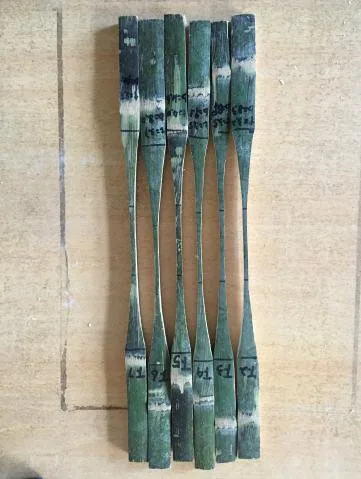
], six specimens were prepared for the test, as shown in
Figure 1a. The size of the tensile test specimen is detailed in Figure 1b, where b is the
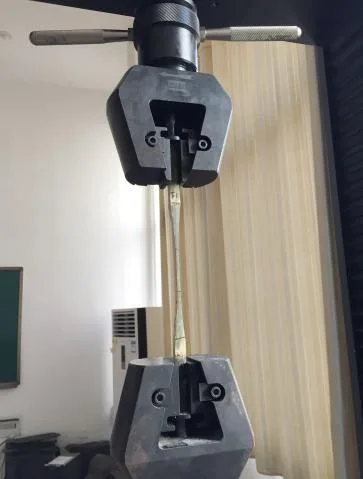
effective width and t is the thickness. The prepared specimens were performed by a
CMT5105 universal testing machine (Figure 1c), and the loading rate was 1 mm/min.
Materials 2022, 15, x FOR PEER REVIEW 3 of 11
2. Mechanical Properties Test of Bamboo Reinforcement
The premise of using bamboo reinforcement as a subgrade reinforcement material
is to ensure that its strength meets the performance requirements required by actual
working conditions. Previous studies have shown that the mechanical properties of
bamboo are closely related to the growth years of Moso bamboo, and the bamboo

strength gradually increases with time in the early growth period (within 3 years). When
the bamboo age reaches 3 to 5 years, the bamboo strength reaches its maximum value
and tends to be stable. After that, bamboo gradually loses its strength with time. From
this, a 3-year Moso bamboo with a diameter of 4060 mm and a thickness of 812 mm
was selected for this study.
2.1. Parallel-to-Grain Tensile Strength
The tensile strength is mainly controlled by bamboo age, size, grain, etc. In order to
reduce interference factors, we prepared bamboo reinforcements along the grain that
was consistent with the bamboo growth direction. The fabrication of tensile test speci-
mens and the design of test procedures were carried out in accordance with JG/T
199-2007 [36]. According to the specification [36], six specimens were prepared for the
test, as shown in Figure 1a. The size of the tensile test specimen is detailed in Figure 1b,
where b is the effective width and t is the thickness. The prepared specimens were
performed by a CMT5105 universal testing machine (Figure 1c), and the loading rate
was 1 mm/min.
P
unit: mm
P
80
55
60
55
80
b
330
R
2
8
0
15
t
(a) (b) (c)
Figure 1. Tensile test specimens and instruments: (a) tensile test specimens; (b) dimensional in-
formation; (c) tensile test.
The specific tensile strength results are shown in Table 1. The tensile force of the
bamboo reinforcement is 50.21 kN/m, corresponding to 2% elongation, and its average
tensile strength is 236.01 MPa.
Table 1. Tensile strength test results.
Label b/mm t/mm Calculation Formula P/N f
t
/MPa
T1 4.12 10.28
bt
P
f
t
=
where f
t
is the tensile strength (unit MPa) and P
is
the failure load (unit N).
9280 219.11
T2 3.95 9.62 9760 256.85
T3 3.86 9.77 9630 255.36
T4 4.05 10.22 8810 212.85
T5 4.15 10.16 1046 232.09
T6 3.88 10.18 8840 223.81
Average value
4.00 10.04 - 9463 236.01
Figure 1.
Tensile test specimens and instruments: (
a
) tensile test specimens; (
b
) dimensional informa-
tion; (c) tensile test.
The specific tensile strength results are shown in Table 1. The tensile force of the
bamboo reinforcement is 50.21 kN/m, corresponding to 2% elongation, and its average
tensile strength is 236.01 MPa.
Table 1. Tensile strength test results.
Label b/mm t/mm Calculation Formula P/N f
t
/MPa
T1 4.12 10.28
f
t
=
P
bt
where f
t
is the
tensile strength (unit
MPa) and P is the
failure load (unit N).
9280 219.11
T2 3.95 9.62 9760 256.85
T3 3.86 9.77 9630 255.36
T4 4.05 10.22 8810 212.85
T5 4.15 10.16 1046 232.09
T6 3.88 10.18 8840 223.81
Average value 4.00 10.04 - 9463 236.01
2.2. Shear Strength
In order to gain a detailed understanding of the mechanical properties of bamboo
reinforcements and determine appropriate reinforcement sizes, this study also investigated
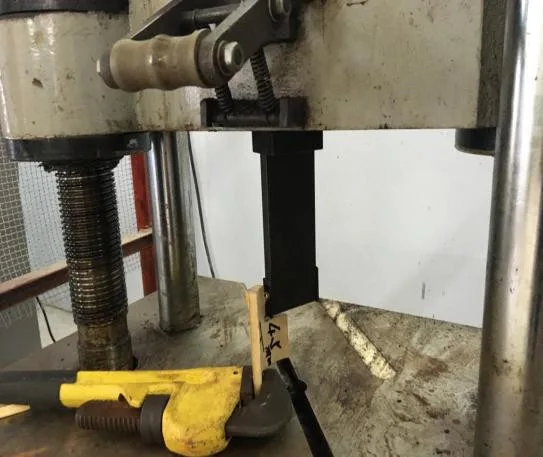
the shear strength of bamboo reinforcements. As shown in Figure 2a, a total of four
specimens with the same thickness (10 mm) and different shear lengths (40, 42, 44, and
45 mm
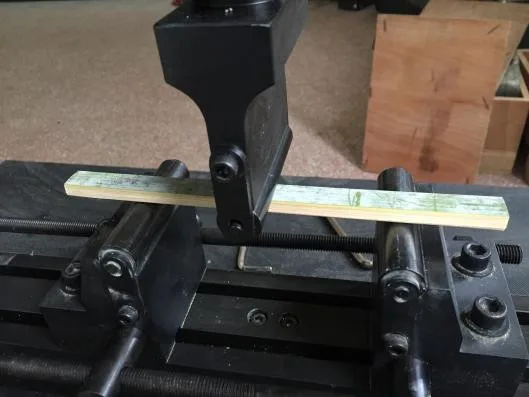
) were prepared. The shear strength of the bamboo reinforcement was tested using a
WE-100B universal testing machine with a maximum load of 100 kN. The bottom of the
/ 11
End of Document
326

FAQs

What are the mechanical properties of bamboo reinforcement?
The tensile force of bamboo reinforcement at 2% elongation is 50.21 kN/m, with an average tensile strength of 236.01 MPa. Additionally, bamboo exhibits excellent shear and flexural properties, making it a strong candidate for subgrade reinforcement. The study indicates that bamboo's tensile strength is significantly higher compared to traditional geogrids, highlighting its potential in geotechnical applications.
How does the biaxial bamboo grid compare to the uniaxial bamboo grid?
The study found that the biaxial bamboo grid provides a better reinforcement effect on soil-rock mixtures compared to the uniaxial bamboo grid. Specifically, the interfacial shear stress increased significantly with the biaxial grid, showing higher friction coefficients and interfacial cohesion. The biaxial grid's design allows for bite force interactions with the soil, enhancing its performance under vertical loads.
What were the findings of the pull-out tests conducted in the study?
The pull-out tests revealed that the uniaxial bamboo grid exhibited a strain-softening behavior, while the biaxial bamboo grid showed a strain-hardening feature. Maximum shear stresses for the uniaxial grid varied with vertical loads, reaching up to 39.80 kPa at 100 kPa vertical load. In contrast, the biaxial grid demonstrated maximum shear stresses up to 68.53 kPa, indicating a significant improvement in interfacial performance.
What is the significance of bamboo as an alternative to geogrid materials?
Bamboo serves as a sustainable and high-strength alternative to traditional geogrid materials, which are often made from non-renewable resources. The study emphasizes bamboo's high tensile properties and its environmental benefits, as it is a renewable resource readily available in many regions. Using bamboo can contribute to greener construction practices while providing effective reinforcement for soil-rock mixtures.
What were the vertical loads tested in the study and their effects?
The study tested vertical loads of 20, 40, 60, 80, and 100 kPa during the pull-out tests. It was found that increasing vertical loads enhanced the interfacial confinement of the reinforced soil, affecting both the peak shear stress and the displacement at which it occurred. The results indicated that higher vertical loads led to increased maximum shear stresses and influenced the friction coefficient between the bamboo grid and the soil.
What methodology was used to assess the mechanical properties of bamboo?
Mechanical properties of bamboo were assessed through a series of tests, including tensile, shear, and flexural strength tests. Specimens were prepared according to specific dimensions and tested using a universal testing machine. The study followed established standards to ensure accurate measurements of tensile strength, shear strength, and flexural strength, providing a comprehensive evaluation of bamboo's performance as a reinforcement material.