PHYDW501 Dynamics and Waves is a comprehensive teacher’s guide designed for educators covering the principles of dynamics and waves in physics. This module includes detailed explanations of motion in orbits, Kepler’s laws, and the Lorentz force law, providing practical learning activities and assessments to enhance student understanding. The guide is structured to facilitate group discussions and workshops, making it ideal for educators teaching advanced physics concepts. It also includes formative assessments to evaluate student learning outcomes effectively. Published in 2022, this resource is essential for teachers looking to deepen their students’ grasp of physics principles related to motion and forces.

Key Points

  • Covers motion in orbits and the application of Kepler’s laws in celestial mechanics.
  • Includes practical activities on Lorentz force law and magnetic forces.
  • Features formative assessments to measure student understanding of dynamics and waves.
  • Provides a structured approach to teaching advanced physics concepts in the classroom.
siladji gashagaza
Edition:2022
213 pages
Language:English
Type:Textbook
siladji gashagaza
Edition:2022
213 pages
Language:English
Type:Textbook
175
/ 213
1
RQF LEVEL 5
TRADE:
TEACHER’S GUIDE
MODULE CODE: PHYDW501 DYNAMICS AND WAVES
Module name: DYNAMICS AND
WAVES
1
MODULE NAME:PHYDW501 DYNAMICS AND WAVES
2
/ 213
End of Document
175

FAQs

What are the key characteristics of sound waves?
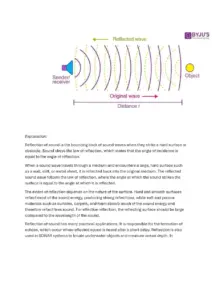
Sound waves are longitudinal mechanical waves that can travel through solids, liquids, or gases. They are produced by vibrating objects and propagate through a medium by causing the particles of the medium to oscillate. The characteristics used to describe sound waves include frequency, wavelength, amplitude, and speed. The frequency determines the pitch of the sound, while amplitude affects the loudness. Sound waves can also undergo phenomena such as reflection, refraction, diffraction, and interference.
How is the Doppler effect related to sound waves?
The Doppler effect is observed whenever the source of sound waves is moving relative to an observer. It describes the apparent change in frequency of the sound as the source approaches or recedes from the observer. When the source moves towards the observer, the frequency appears higher, resulting in a higher pitch. Conversely, as the source moves away, the frequency appears lower, leading to a lower pitch. This effect is commonly experienced with passing sirens or vehicles.
What is the relationship between frequency and pitch in sound waves?
The pitch of a sound is directly related to its frequency. Higher frequency sound waves correspond to higher pitches, while lower frequency waves correspond to lower pitches. For example, a sound wave with a frequency of 300 Hz is perceived as a lower pitch compared to a sound wave with a frequency of 600 Hz, which is recognized as a higher pitch. This relationship helps in understanding how different sounds are categorized in music and audio.
What is the significance of the electromagnetic spectrum?
The electromagnetic spectrum encompasses all types of electromagnetic radiation, which varies in wavelength and frequency. It includes radio waves, microwaves, infrared, visible light, ultraviolet, X-rays, and gamma rays. Understanding the electromagnetic spectrum is crucial in various fields, including telecommunications, medical imaging, and environmental science. Each type of electromagnetic wave has unique properties and applications, making the spectrum a fundamental concept in physics.
What are the differences between constructive and destructive interference in sound waves?
Constructive interference occurs when two sound waves meet in phase, resulting in a wave of greater amplitude. This means that the waves reinforce each other, leading to a louder sound. In contrast, destructive interference happens when the waves meet out of phase, causing them to partially or completely cancel each other out, resulting in a reduced amplitude or softer sound. These phenomena are essential in understanding how sound waves interact in various environments.
How does a transformer operate based on electromagnetic induction?
A transformer operates on the principle of electromagnetic induction through mutual induction. It consists of two coils of wire, where a changing current in one coil induces a voltage in the second coil. This allows transformers to change voltage levels efficiently. Step-up transformers increase voltage, while step-down transformers decrease voltage. The design of transformers enables them to operate effectively in electrical power distribution systems.
What is the role of a diode in electronic circuits?
A diode is a semiconductor device that acts as a one-way switch for electric current. It allows current to flow easily in one direction while restricting it in the opposite direction. Diodes are crucial in converting alternating current (AC) into direct current (DC), making them essential components in power supplies and rectifiers. Various types of diodes, such as Zener diodes and light-emitting diodes (LEDs), serve specific applications in electronic circuits.