DLD QB provides an in-depth exploration of critical concepts related to DLD (Developmental Language Disorder). It discusses the implications of DLD on communication skills and academic performance, making it essential for educators, speech therapists, and parents. The content includes practical strategies for supporting individuals with DLD, emphasizing the importance of early intervention. This resource is valuable for professionals seeking to enhance their understanding of DLD and its impact on learning and development.

Key Points

  • Explains the characteristics and challenges associated with Developmental Language Disorder (DLD)
  • Offers strategies for educators and therapists to support students with DLD
  • Discusses the role of early intervention in improving outcomes for individuals with DLD
  • Includes case studies illustrating the impact of DLD on communication and learning
computer science
2 pages
Language:English
Type:Lecture Notes
computer science
2 pages
Language:English
Type:Lecture Notes
270
/ 2
UNIT 1: Boolean Algebra & Logic Circuits
Q1. Draw logic symbols and truth tables for the basic logic gates and universal gates.
Why are NAND and NOR called universal gates?
Q2. Convert the following numbers:
(a) (10110)2 to decimal.
(b) (157)8 to binary.
(c) (93)10 to hexadec.
Q3. Express the Boolean function 𝐹(𝐴, 𝐵, 𝐶) = Σ𝑚(1,3,5,7) in SOP and POS forms.
Q4. Simplify the following Boolean expression using Boolean algebra: 𝐹 = 𝐴𝐵
ˉ
+ 𝐴𝐵 + 𝐴
ˉ
𝐵
Mention the law used at each step.
Q5. Simplify the following function using a 3-variable K-map: 𝐹(𝐴, 𝐵, 𝐶) = Σ𝑚(0,1,3,5,7).
Q6. Simplify using a 4-variable K-map: 𝐹
(
𝐴, 𝐵, 𝐶, 𝐷
)
= Σ𝑚
(
2,3,6,7,10,11,14,15
)
.
UNIT 2: Combinational Logic Circuits
Q7. Design a half adder and full adder. Explain the concept of Carry in binary addition.
Q8. Design a half subtractor and full subtractor. Explain the concept of borrow in binary
subtraction.
Q9. Design a 4-bit binary to Gray code converter using K-maps and logic gates.
State one advantage of Gray code.
Q10. Implement the Boolean function 𝐹(𝐴, 𝐵, 𝐶) = Σ𝑚(1,2,6,7) using a 4:1 multiplexer.
Q11. Explain the working of a 4-bit magnitude comparator.
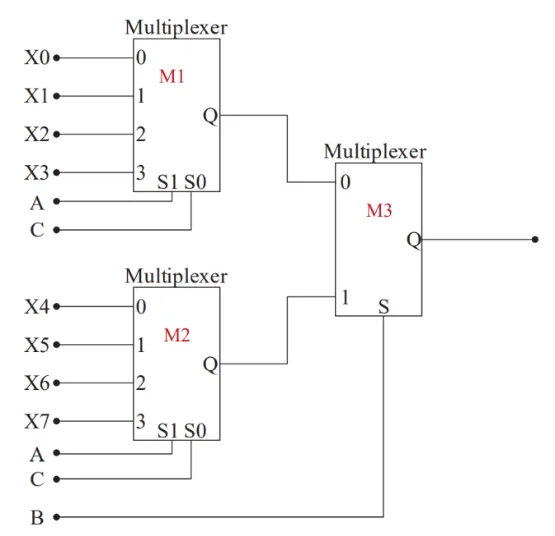
Q12. What will be the Final output of the MUX circuit given below if X1, X2, X5, X6 = 1; &
X0, X3, X4, X7=0;
Q13. Implement the following logic circuit using a 3:8 line decoder.
F1 = minterms(1,2,7), F2 = minterms(2,3,4), F3 = minterms(0,4,6).
UNIT 3: Sequential Logic Circuits
Q14. Define sequential logic circuits. Differentiate between combinational and sequential
circuits.
Q15. Explain the working of SR, JK, D, and T flip-flops with truth tables. Why is JK flip-flop
preferred over SR flip-flop?
Q16. Convert a JK flip-flop into:
(a) D flip-flop. (b) T flip-flop.
Q17. Implement T to J-K and SR to J-K Flipflop.
Q18. Design a 2-bit asynchronous up counter using JK flip-flops. Draw timing diagrams.
Q19. Design a synchronous 3-bit up counter using D flip-flops.
Q20. Design a random sequence generator using JK flip-flops for the sequence:
001 → 011 → 101 → 111 → 001.
Q21. A Binary ripple counter is used to count upto (2047)10, How many FF’s will be required
for its designing.
Q22. For the communication system given below, what will be the output frequency?
Q23. Define the terms: a). Setup time, b). Hold time, c). Negative edge triggered circuit,
d). Propagation Delay, e). Flipflop, f). Max. clock Frequency.
UNIT 4: Counters
Q24. Design a 3 bit asynchronous up/down counter.
Q25. Design an asynchronous MOD-7 up counter using J-K FF. Show the reset logic clearly.
Q26. Design an asynchronous MOD-4 down counter using T FF. Show the reset logic clearly.
Q27. Design a 2-bit synchronous up/down counter using J-K FF.
Q28. Design a type T counter that goes through states 0, 3, 5, 6, 0, …, Is the counter self-
starting? If its not a self-starting, then modify the circuit.
Q29. Design a type D counter that goes through states 0, 1, 2, 4, 0, … The unused/ unwanted
states must go to zero(000) on next clock pulse.
Q30. Design a J-K counter that goes through states 3, 4, 6, 7 and 3… . Is the counter self-
starting? Modify the circuit such that if it goes to an invalid state it comes back to state 3.

/ 2
End of Document
270

FAQs

What are the key concepts of Boolean algebra discussed in the document?
The document outlines fundamental concepts of Boolean algebra, including variables, truth values, and logical operations such as AND, OR, and NOT. It explains how these operations form the basis of logic circuits and provides examples of truth tables for basic gates. Additionally, the document highlights the significance of universal gates like NAND and NOR, which can be used to construct any Boolean function.
How does the document explain the design of a half adder?
The document describes the half adder as a combinational logic circuit that performs the addition of two binary digits. It outlines its structure, which includes an XOR gate for the sum output and an AND gate for the carry output. The document also explains the truth table for the half adder, demonstrating how it processes inputs to produce the correct outputs.
What is the significance of K-maps in simplifying Boolean functions?
Karnaugh maps (K-maps) are emphasized in the document as a crucial tool for simplifying Boolean functions. They provide a visual method for minimizing expressions, which helps in reducing the number of logic gates needed in circuit design. The document includes examples of using K-maps to simplify functions with three and four variables, illustrating the step-by-step process and its effectiveness in achieving simpler circuit designs.
What types of flip-flops are explained in the document?
The document explains several types of flip-flops, including SR, JK, D, and T flip-flops. Each type is described with its respective truth table and functionality. The JK flip-flop is highlighted for its versatility and preference over the SR flip-flop due to its ability to toggle states without the risk of invalid states. The document also discusses the conversion of JK flip-flops into D and T flip-flops.
What is the purpose of a 4-bit magnitude comparator as described in the document?
According to the document, a 4-bit magnitude comparator is designed to compare two 4-bit binary numbers and determine their relative magnitude. It outputs signals indicating whether one number is greater than, less than, or equal to the other. The document details the logic behind the comparator's design and its application in digital circuits, emphasizing its role in decision-making processes in computing.