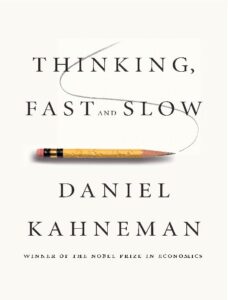
Thinking Fast and Slow by Daniel Kahneman Summarized by Erik Johnson 3
64). Because things that are familiar seem more true teachers, advertisers, marketers,
authoritarian tyrants, and even cult leaders repeat their message endlessly. Potential for
error? If we hear a lie often enough we tend to believe it.
CHAPTER SIX: NORMS, SURPRISES, AND CAUSES
Heuristic #3: COHERENT STORIES (ASSOCIATIVE COHERENCE). To make
sense of the world we tell ourselves stories about what’s going on. We make associations
between events, circumstances, and regular occurrences. The more these events fit into
our stories the more normal they seem. Things that don’t occur as expected take us by
surprise. To fit those surprises into our world we tell ourselves new stories to make them
fit. We say, “Everything happens for a purpose,” “God did it,” “That person acted out of
character,” or “That was so weird it can’t be random chance.” Abnormalities, anomalies,
and incongruities in daily living beg for coherent explanations. Often those explanations
involve 1) assuming intention, “It was meant to happen,” 2) causality, “They’re homeless
because they’re lazy,” or 3) interpreting providence, “There’s a divine purpose in
everything.” “We are evidently ready from birth to have impressions of causality, which
do not depend on reasoning about patterns of causation,” (page 76). “Your mind is ready
and even eager to identify agents, assign them personality traits and specific intentions,
and view their actions as expressing individual propensities,” (page 76). Potential for
error? We posit intention and agency where none exists, we confuse causality with
correlation, and we make more out of coincidences than is statistically warranted.
CHAPTER SEVEN: A MACHINE FOR JUMPING TO CONCLUSIONS
Heuristic #4: CONFIRMATION BIAS. This is the tendency to search for and find
confirming evidence for a belief while overlooking counter examples. “Jumping to
conclusions is efficient if the conclusions are likely to be correct and the costs of an
occasional mistake acceptable, and if the jump saves much time and effort. Jumping to
conclusions is risky when the situation is unfamiliar, the stakes are high, and there is no
time to collect more information,” (page 79). System 1 fills in ambiguity with automatic
guesses and interpretations that fit our stories. It rarely considers other interpretations.
When System 1 makes a mistake System 2 jumps in to slow us down and consider
alternative explanations. “System 1 is gullible and biased to believe, System 2 is in
charge of doubting and unbelieving, but System 2 is sometimes busy, and often lazy,”
(page 81). Potential for error? We are prone to over-estimate the probability of unlikely
events (irrational fears) and accept uncritically every suggestion (credulity).
Heuristic #5: THE HALO EFFECT. “This is the tendency to like or dislike everything
about a person—including things you have not observed,” (page 82). The warm emotion
we feel toward a person, place, or thing predisposes us to like everything about that
person, place, or thing. Good first impressions tend to positively color later negative
impressions and conversely, negative first impressions can negatively color later positive
impressions. The first to speak their opinion in a meeting can “prime” others’ opinions. A
list of positive adjectives describing a person influences how we interpret negative