Real Numbers explores the properties of positive integers, including Euclid’s division algorithm and the Fundamental Theorem of Arithmetic. It delves into the unique factorization of composite numbers and the nature of irrational numbers. This educational resource is ideal for students studying mathematics, particularly in understanding divisibility and prime factorization. The document also provides examples and exercises to reinforce learning, making it suitable for classroom use or self-study.

Key Points

  • Explains Euclid’s division algorithm for integer divisibility
  • Covers the Fundamental Theorem of Arithmetic and prime factorization
  • Includes examples of irrational numbers and their properties
  • Provides exercises for practicing HCF and LCM calculations
A Nak
9 pages
Language:English
Type:Textbook
A Nak
9 pages
Language:English
Type:Textbook
313
/ 9
REAL N
UMBERS 1
1
1.1 Introduction
In Class IX, you began your exploration of the world of real numbers and encountered
irrational numbers. We continue our discussion on real numbers in this chapter. We
begin with very important properties of positive integers in Sections 1.2, namely the
Euclids division algorithm and the Fundamental Theorem of Arithmetic.
Euclids division algorithm, as the name suggests, has to do with divisibility of
integers. Stated simply, it says any positive integer a can be divided by another positive
integer b in such a way that it leaves a remainder r that is smaller than b. Many of you
probably recognise this as the usual long division process. Although this result is quite
easy to state and understand, it has many applications related to the divisibility properties
of integers. We touch upon a few of them, and use it mainly to compute the HCF of
two positive integers.
The Fundamental Theorem of Arithmetic, on the other hand, has to do something
with multiplication of positive integers. You already know that every composite number
can be expressed as a product of primes in a unique way this important fact is the
Fundamental Theorem of Arithmetic. Again, while it is a result that is easy to state and
understand, it has some very deep and significant applications in the field of mathematics.
We use the Fundamental Theorem of Arithmetic for two main applications. First, we
use it to prove the irrationality of many of the numbers you studied in Class IX, such as
and
. Second, we apply this theorem to explore when exactly the decimal
expansion of a rational number, say
, is terminating and when it is non-
terminating repeating. We do so by looking at the prime factorisation of the denominator
q of
. You will see that the prime factorisation of q will completely reveal the nature
of the decimal expansion of
.
So let us begin our exploration.
REAL NUMBERS
Reprint 2026-27
2 MATHEMATICS
1.2 The Fundamental Theorem of Arithmetic
In your earlier classes, you have seen that any natural number can be written as a
product of its prime factors. For instance, 2 = 2, 4 = 2 × 2, 253 = 11 × 23, and so on.
Now, let us try and look at natural numbers from the other direction. That is, can any
natural number be obtained by multiplying prime numbers? Let us see.
Take any collection of prime numbers, say 2, 3, 7, 11 and 23. If we multiply
some or all of these numbers, allowing them to repeat as many times as we wish,
we can produce a large collection of positive integers (In fact, infinitely many).
Let us list a few :
7 × 11 × 23 = 1771 3 × 7 × 11 × 23 = 5313
2 × 3 × 7 × 11 × 23 = 10626 2
3
× 3 × 7
3
= 8232
2
2
× 3 × 7 × 11 × 23 = 21252
and so on.
Now, let us suppose your collection of primes includes all the possible primes.
What is your guess about the size of this collection? Does it contain only a finite
number of integers, or infinitely many? Infact, there are infinitely many primes. So,
if we combine all these primes in all possible ways, we will get an infinite
collection of numbers, all
the primes and all possible
products of primes. The
question is can we
produce all the composite
numbers this way? What
do you think? Do you
think that there may be a
composite number which
is not the product of
powers of primes?
Before we answer this,
let us factorise positive
integers, that is, do the
opposite of what we have
done so far.
We are going to use
the factor tree with which
you are all familiar. Let us
take some large number,
say, 32760, and factorise
it as shown.
Reprint 2026-27
REAL NUMBERS 3
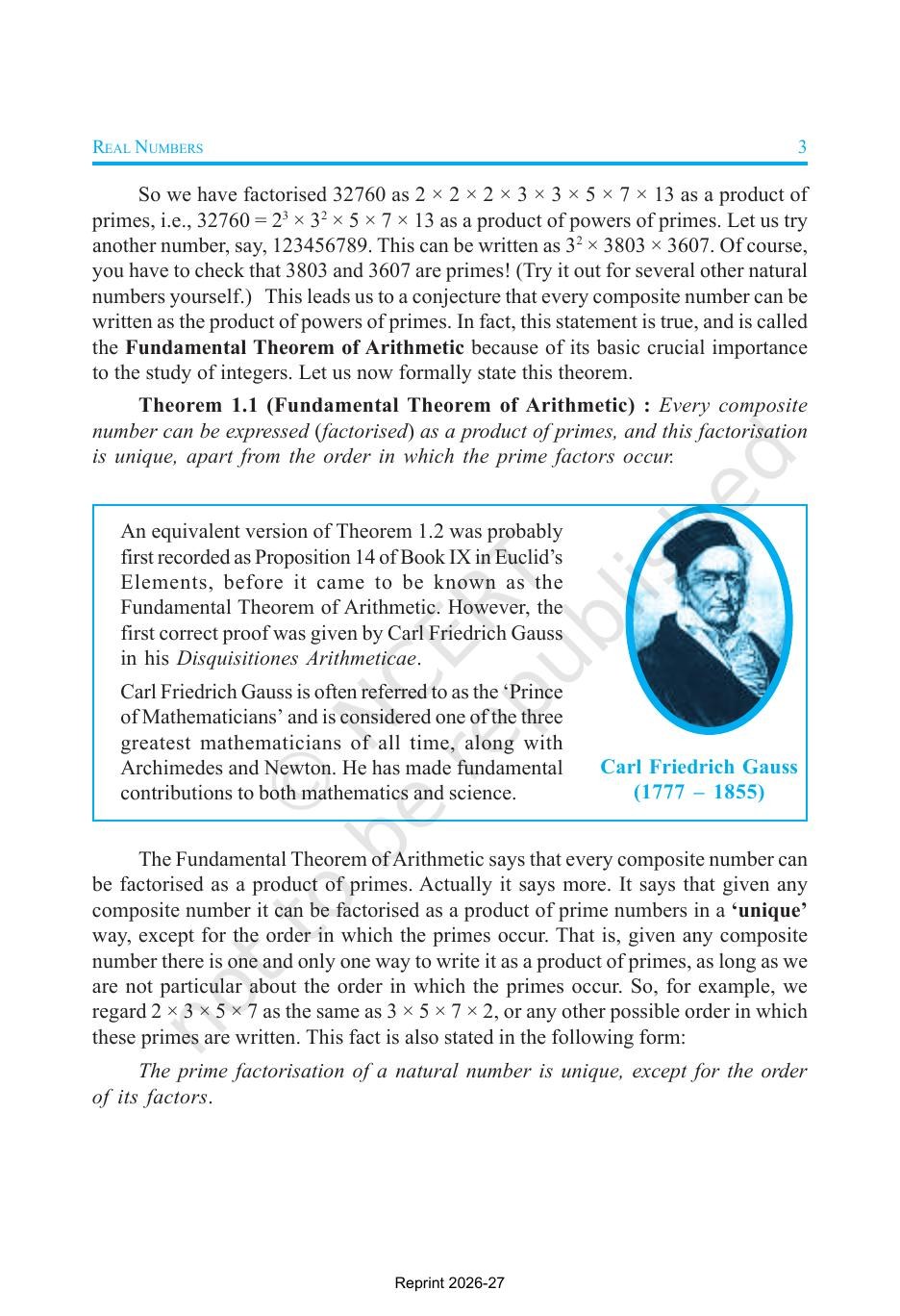
Carl Friedrich Gauss
(1777 1855)
An equivalent version of Theorem 1.2 was probably
first recorded as Proposition 14 of Book IX in Euclids
Elements, before it came to be known as the
Fundamental Theorem of Arithmetic. However, the
first correct proof was given by Carl Friedrich Gauss
in his Disquisitiones Arithmeticae.
Carl Friedrich Gauss is often referred to as the Prince
of Mathematicians and is considered one of the three
greatest mathematicians of all time, along with
Archimedes and Newton. He has made fundamental
contributions to both mathematics and science.
So we have factorised 32760 as 2 × 2 × 2 × 3 × 3 × 5 × 7 × 13 as a product of
primes, i.e., 32760 = 2
3
× 3
2
× 5 × 7 × 13 as a product of powers of primes. Let us try
another number, say, 123456789. This can be written as 3
2
× 3803 × 3607. Of course,
you have to check that 3803 and 3607 are primes! (Try it out for several other natural
numbers yourself.) This leads us to a conjecture that every composite number can be
written as the product of powers of primes. In fact, this statement is true, and is called
the Fundamental Theorem of Arithmetic because of its basic crucial importance
to the study of integers. Let us now formally state this theorem.
Theorem 1.1 (Fundamental Theorem of Arithmetic) : Every composite
number can be expressed (factorised) as a product of primes, and this factorisation
is unique, apart from the order in which the prime factors occur.
The Fundamental Theorem of Arithmetic says that every composite number can
be factorised as a product of primes. Actually it says more. It says that given any
composite number it can be factorised as a product of prime numbers in a unique
way, except for the order in which the primes occur. That is, given any composite
number there is one and only one way to write it as a product of primes, as long as we
are not particular about the order in which the primes occur. So, for example, we
regard 2 × 3 × 5 × 7 as the same as 3 × 5 × 7 × 2, or any other possible order in which
these primes are written. This fact is also stated in the following form:
The prime factorisation of a natural number is unique, except for the order
of its factors.

Reprint 2026-27
/ 9
End of Document
313

FAQs

what is real numbers properties and applications

Real numbers encompass all the numbers on the number line, including rational and irrational numbers. The properties of real numbers are foundational in mathematics, as they include the commutative, associative, and distributive properties. Understanding these properties is crucial for solving equations and performing calculations.

  • Commutative Property: a + b = b + a
  • Associative Property: (a + b) + c = a + (b + c)
  • Distributive Property: a(b + c) = ab + ac

how to apply real numbers in mathematics

Real numbers are essential in various mathematical applications, including algebra, calculus, and geometry. They are used to represent quantities, solve equations, and model real-world scenarios. The application of real numbers often involves understanding their properties and performing operations like addition, subtraction, multiplication, and division.

  • Algebra: Solving equations and inequalities.
  • Calculus: Analyzing functions and limits.
  • Geometry: Measuring lengths, areas, and volumes.

what are the examples of real numbers

Real numbers include a wide range of numbers that can be found on the number line. Examples of real numbers are:

  • Rational Numbers: Numbers that can be expressed as a fraction, such as 1/2, 3, and -4.
  • Irrational Numbers: Numbers that cannot be expressed as a simple fraction, such as √2, π, and e.
  • Integers: Whole numbers that include negative numbers, zero, and positive numbers, such as -3, 0, and 5.

how to find the HCF and LCM of real numbers

Finding the Highest Common Factor (HCF) and Least Common Multiple (LCM) of real numbers involves using their prime factorization. The HCF is the product of the smallest powers of all common prime factors, while the LCM is the product of the greatest powers of all prime factors involved.

  • Steps to find HCF:
  1. Factor the numbers into primes.
  2. Identify the common prime factors.
  3. Multiply the smallest powers of these common factors.
  • Steps to find LCM:
    1. Factor the numbers into primes.
    2. Identify all prime factors involved.
    3. Multiply the greatest powers of these prime factors.

    what is the significance of real numbers in daily life

    Real numbers play a crucial role in everyday life, as they are used in various practical applications. From financial transactions to measurements and calculations, understanding real numbers helps individuals navigate daily tasks effectively.

    • Finance: Calculating expenses, budgets, and investments.
    • Measurements: Using real numbers for distances, weights, and volumes in cooking, construction, and travel.
    • Statistics: Analyzing data and making informed decisions based on numerical information.

    how are real numbers used in geometry

    In geometry, real numbers are used to measure lengths, areas, and volumes. They help define shapes, calculate dimensions, and solve geometric problems. Understanding real numbers is essential for working with geometric concepts.

    • Lengths: Measuring the sides of shapes.
    • Areas: Calculating the space within shapes using formulas.
    • Volumes: Determining the capacity of three-dimensional objects.

    what are the properties of real numbers

    The properties of real numbers are fundamental rules that govern their behavior in mathematical operations. These properties include:

    • Closure Property: The sum or product of any two real numbers is also a real number.
    • Identity Property: The sum of any number and zero is the number itself; the product of any number and one is the number itself.
    • Inverse Property: For every real number, there exists another number that, when added or multiplied, results in the identity element.

    how to prove that certain numbers are irrational

    To prove that certain numbers are irrational, one common method is to use proof by contradiction. This involves assuming the number can be expressed as a fraction and showing that this leads to a contradiction.

    • Example: Proving that √2 is irrational involves assuming it can be expressed as p/q, leading to the conclusion that both p and q must be even, contradicting the assumption that they are coprime.
    • Steps:
    1. Assume the number is rational.
    2. Express it as a fraction.
    3. Show that this leads to a contradiction.

    what is the difference between rational and irrational numbers

    Rational and irrational numbers are two categories of real numbers. The key difference lies in their definitions and representations.

    Rational NumbersIrrational Numbers
    Can be expressed as a fraction (p/q).Cannot be expressed as a fraction.
    Examples: 1/2, 3, -4.Examples: √2, π, e.

    how do real numbers relate to algebra

    Real numbers are foundational in algebra, as they are used to represent variables and constants in equations. Understanding real numbers allows for solving algebraic equations and performing operations.

    • Variables: Represent unknown values in equations.
    • Constants: Fixed values that can be real numbers.
    • Operations: Addition, subtraction, multiplication, and division of real numbers are fundamental in algebraic expressions.