The general characteristics of Phylum Protozoa detail the diverse forms and functions of these microscopic organisms. Protozoa exist as single-celled entities or in colonies, showcasing a variety of life forms including free-living and parasitic types. This resource is essential for biology students studying the fundamental traits of protozoans, including their body organization, locomotion, and reproduction methods. Key examples include Amoeba, Euglena, and Paramecium, illustrating the complexity and adaptability of these organisms in various environments.

Key Points

  • Explains the two main life forms of protozoans: free-living and parasitic.
  • Describes the unicellular structure and simple body organization of protozoa.
  • Highlights the various locomotory organs such as pseudopodia, flagella, and cilia.
  • Discusses the nutritional modes of protozoans, including holozoic and holophytic.
Anahit Kaur
3 pages
Language:English
Type:Notes
Anahit Kaur
3 pages
Language:English
Type:Notes
329
/ 3
PHYLUM- PROTOZOA
Protozoa may be defined as “microscopic acellular animalcules existing singly or in
colonies, without tissue and organs, having one or more nuclei”.
Water microorganisms
https://www.youtube.com/watch?v=iHPDW12kG8k
Paramecium under microscope
https://www.youtube.com/watch?v=a4aZE5FQ284
Amoeba eating Paramecium
https://www.youtube.com/watch?v=mv6Ehv06mXY
Euglena under microscope
https://www.youtube.com/shorts/1XI_0MJzkHo
Plasmodium life cycle
https://www.youtube.com/watch?v=qvlTOhCmxvY
GENERAL CHARACTERISTICS OF PROTOZOANS
1. There are about 50,000 known species of Phylum Protozoa.
2. Protozoans exhibit mainly two forms of life; free-living (aquatic, freshwater, seawater)
and parasitic (ectoparasites or endoparasites). They are also commensal in habitat.
3. They are small, usually microscopic, not visualized without a microscope.
4. They are the simplest and primitive of all animals.
5. They have a simple body organization. i.e. with a protoplasmic grade of organization.
6. The body is unicellular (without tissue and organs).
7. They have one or more nuclei which are monomorphic or dimorphic.
8. Body naked or bounded by a pellicle, but in some forms may be covered with shells and often
provided with an internal skeleton.
9. They are solitary (existing alone/single) or colonial (individuals are alike and independent).
10. Body shape variables may be spherical, oval, elongated or flattened.
11. Body symmetry either none or bilateral or radial or spherical.
12. Body form usually constant, varied in some, while changing with environment or age in many.
13. Body protoplasm is differentiated into an outer ectoplasm and inner endoplasm.
14. The single-cell body performs all the essential and vital activities, which characterize the
animal body; hence only subcellular physiological division of labor.
15. Locomotory organs are fingers like pseudopodia, whip-like flagella, hair-like cilia or none.
16. Nutrition may be holozoic (animal-like), holophytic (plant-like), saprozoic or parasitic.
17. Digestion occurs intracellularly which takes place inside the food vacuoles.
18. Respiration occurs by diffusion through the general body surface.
19. Excretion occurs through the general body surface, but in some forms through a temporary
opening in the ectoplasm or through a permanent pore called cytopyge.
20. Contractile vacuoles perform osmoregulation in freshwater forms and also help in removing
excretory products.
21. Reproduction asexual (binary or multiple fission, budding, sporulation) or sexual (conjugation
(hologamy), gamete formation (syngamy).

22. The life cycle often complicated with alternation of asexual and sexual phases (alternation of
generation).
23. Encystment commonly occurs to resist unfavorable conditions of food, temperature, and
moisture, and also helps in dispersal.
24. The single-celled individual not differentiated into somatoplasm and germplasm; therefore,
exempt from natural death which is the price paid for the body.
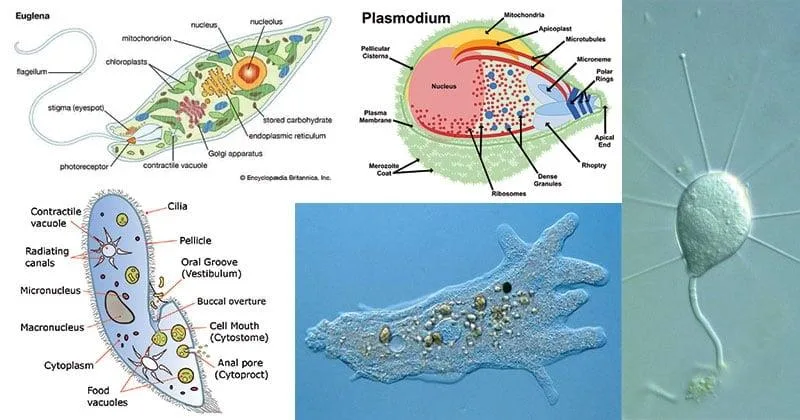
25. Examples: Euglena, Amoeba, Plasmodium, Paramecium, Podophyra, etc.
/ 3
End of Document
329

FAQs

what are the general characteristics of phylum protozoa

Protozoa are defined as microscopic acellular animalcules existing singly or in colonies, without tissue and organs, having one or more nuclei.

  • Approximately 50,000 known species.
  • Exhibit free-living and parasitic forms.
  • Body organization is unicellular, with a simple protoplasmic structure.
  • Locomotion can occur via pseudopodia, flagella, or cilia.
  • Nutrition can be holozoic, holophytic, saprozoic, or parasitic.
  • Reproduction can be asexual or sexual.

how do protozoans reproduce

Protozoans reproduce both asexually and sexually, showcasing a variety of methods.

  • Asexual reproduction includes binary fission, multiple fission, budding, and sporulation.
  • Sexual reproduction involves conjugation (hologamy) and gamete formation (syngamy).

  • The life cycle may involve alternation of asexual and sexual phases, known as alternation of generations.

what types of nutrition do protozoa have

Protozoa exhibit various types of nutrition, reflecting their diverse ecological roles.

  • Holozoic: Animal-like nutrition, where organisms ingest solid food.
  • Holophytic: Plant-like nutrition, utilizing photosynthesis.
  • Saprozoic: Absorption of dissolved organic matter.
  • Parasitic: Deriving nutrients from a host organism.

what are the locomotory organs of protozoans

Protozoans possess various locomotory organs that facilitate movement in their environments.

  • Pseudopodia: Finger-like extensions of the cell body.
  • Flagella: Whip-like structures that propel the organism.
  • Cilia: Hair-like projections that aid in movement and feeding.
  • Some protozoans may lack any locomotory structures.

how do protozoans perform respiration

Respiration in protozoans occurs primarily through diffusion across their body surface.

  • Oxygen enters and carbon dioxide exits the cell membrane directly.
  • This process is efficient due to their small size and high surface area to volume ratio.
  • Some protozoans may have specialized structures for gas exchange, but most rely on simple diffusion.

what is the body organization of protozoans

The body organization of protozoans is unicellular, making them the simplest form of life.

  • They lack specialized tissues and organs.
  • The body is composed of protoplasm, which is differentiated into ectoplasm and endoplasm.
  • Some forms may have a pellicle or be covered with shells.

what is encystment in protozoans

Encystment is a survival strategy employed by protozoans to withstand unfavorable environmental conditions.

  • During encystment, protozoans form a protective cyst.
  • This process helps them resist extreme temperatures, lack of food, and moisture.
  • Encystment also aids in dispersal to new environments.

what are the different body shapes of protozoans

Protozoans exhibit a variety of body shapes, reflecting their adaptability to different environments.

  • Common shapes include spherical, oval, elongated, and flattened forms.
  • Body shape can be constant or may change with environmental conditions or age.
  • Some protozoans may also exhibit bilateral, radial, or spherical symmetry.

what are the examples of protozoans

Several well-known examples of protozoans illustrate the diversity within this phylum.

  • Euglena: A flagellated organism known for its photosynthetic capabilities.
  • Amoeba: A shapeshifting organism that uses pseudopodia for movement and feeding.
  • Plasmodium: A parasitic protozoan responsible for malaria.
  • Paramecium: A ciliated protozoan often studied in biology.