Chapter 5 of PGE 101 focuses on fundamental concepts in petroleum reservoir engineering systems. It covers essential topics such as porosity, permeability, and fluid saturations, providing a comprehensive understanding for students in petroleum engineering. The chapter discusses various methods for measuring porosity and the factors affecting it, along with the significance of rock compressibility. Designed for students and professionals in the petroleum industry, this chapter serves as a crucial resource for understanding reservoir behavior and fluid dynamics.

Key Points

  • Explains porosity as a measure of void space in rock and its significance in hydrocarbon storage.
  • Describes various methods for measuring porosity, including logging and core analysis techniques.
  • Covers the classification of porosity based on pore connection and geological factors.
  • Discusses the importance of permeability in fluid conductance and its historical context in reservoir engineering.

213
/ 28
PGE 101 Introduction to Petroleum
and Gas Industry
FALL 2025/2026
By
Dr. Samuel O. Osisanya, PE
BSPE(UI,1976), MSPE (UT Austin, 1986), PhDPE (UT Austin,1991)
Visiting Retired Professor
Department of Petroleum Engineering
The University of Oklahoma, Oklahoma, USA
2
Chapter 5 - Fundamental
Concepts for Petroleum Reservoir
Engineering Systems
3
Porosity
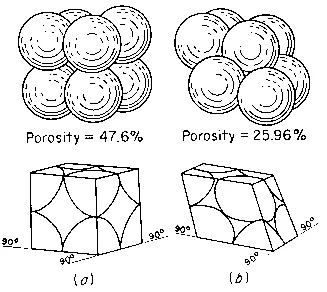
Porosity is a measure of the void space in rock,
hence measures how much HC in rock
Porosity = V
p
/V
b
= (V
b
-V
m
)/V
b
; V
b
= V
p
+ V
m
theoretically, varies from 0% - 47.6%
in practice, varies between 3% and 37%
Porosity is a function of particle size distribution:
framework materials (sandstone) - high
interstitial materials (shaly-sand) - low
/ 28
End of Document
213

FAQs

what is PGE 101: Fundamental Concepts for Petroleum Reservoir Engineering Systems about

PGE 101: Fundamental Concepts for Petroleum Reservoir Engineering Systems provides an overview of essential principles in petroleum reservoir engineering.

  • It covers topics such as porosity, permeability, and fluid saturations.
  • The course emphasizes the significance of these concepts in understanding hydrocarbon reservoirs.
  • Students learn about measurement techniques and the classification of porosity.

how to calculate porosity in PGE 101: Fundamental Concepts for Petroleum Reservoir Engineering Systems

Calculating porosity in PGE 101 involves using the formula: Porosity (Φ) = (Vp/Vb) = (Vb - Vm)/Vb.

  • Vp is the volume of pores, Vb is the bulk volume, and Vm is the volume of the matrix.
  • Porosity values typically range from 3% to 37% in practice.
  • Methods for measuring porosity include core analysis and logging techniques.

what are the key factors affecting porosity in PGE 101: Fundamental Concepts for Petroleum Reservoir Engineering Systems

Key factors affecting porosity in PGE 101 include particle shape, arrangement, and cementing materials.

  • Particle size distribution plays a critical role in determining porosity levels.
  • Framework materials like sandstone tend to have higher porosity compared to interstitial materials like shaly-sand.
  • Compaction and burial depth also significantly influence porosity.

what is permeability in PGE 101: Fundamental Concepts for Petroleum Reservoir Engineering Systems

Permeability in PGE 101 refers to the fluid conductance capacity of a rock.

  • It is defined by Darcy's law, which states that flow rate (Q) is proportional to the area of flow (A) and the pressure difference (dP).
  • The permeability constant (K) is influenced by the arrangement and size of the sand pack.
  • Units of permeability include Darcy and millidarcy, with 1 darcy equal to 1000 millidarcys.

how is fluid saturation measured in PGE 101: Fundamental Concepts for Petroleum Reservoir Engineering Systems

Fluid saturation in PGE 101 is measured using direct and indirect methods.

  • Direct methods include core analysis, while indirect methods involve well logs and capillary pressure data.
  • Initially, most reservoir rocks are saturated with saline water, affecting hydrocarbon recovery.
  • Understanding saturation is crucial for evaluating reservoir performance.

what are the types of porosity discussed in PGE 101: Fundamental Concepts for Petroleum Reservoir Engineering Systems

PGE 101 discusses various types of porosity based on pore connection and geological factors.

  • Types based on pore connection include absolute (total) porosity and effective porosity.
  • Geologically, porosity can be classified as primary (intergranular) or secondary (due to fractures).
  • Each type has implications for fluid movement and reservoir behavior.

what is the significance of rock compressibility in PGE 101: Fundamental Concepts for Petroleum Reservoir Engineering Systems

Rock compressibility in PGE 101 is significant as it affects porosity and fluid flow in reservoirs.

  • It is generally reduced by increased compaction due to burial depth.
  • Three types of compressibility are discussed: rock-matrix, rock-bulk, and pore-volume compressibility.
  • Understanding compressibility helps in predicting reservoir behavior under various conditions.

how is porosity calculated using the coating method in PGE 101: Fundamental Concepts for Petroleum Reservoir Engineering Systems

Porosity using the coating method in PGE 101 is calculated by measuring the mass of a dry sample and its changes when coated and immersed in water.

  • Key steps include determining the mass of the dry sample, the mass of the coated sample, and the volume of water displaced.
  • Using these measurements, the bulk volume can be calculated, leading to the determination of total porosity.

what are the assumptions used in Darcy's equation in PGE 101: Fundamental Concepts for Petroleum Reservoir Engineering Systems

Darcy's equation in PGE 101 is based on several key assumptions.

  • Assumptions include steady-state flow, viscous or laminar flow, and complete saturation with one fluid.
  • The equation also assumes that the fluid does not react with the rock and that the formation is homogeneous and isotropic.
  • These assumptions are critical for accurate permeability calculations.