Global supply chains encompass the processes and networks involved in the production and distribution of goods across international borders. This document explores the benefits of global supply chains, including lower costs, greater variety, and broader market access. It discusses the impact of political relationships on trade, food security challenges, and the role of export processing zones. Ideal for students and professionals interested in understanding the complexities of global trade and supply chain management.

Key Points

  • Explains the benefits of global supply chains, such as lower costs and increased variety.
  • Discusses the impact of political relationships on international trade and food security.
  • Covers challenges faced in feeding a growing population, including malnutrition and famine.
  • Examines the role of export processing zones in promoting economic growth.
Jacky
28 pages
Language:English
Type:Textbook
Jacky
28 pages
Language:English
Type:Textbook
109
/ 28
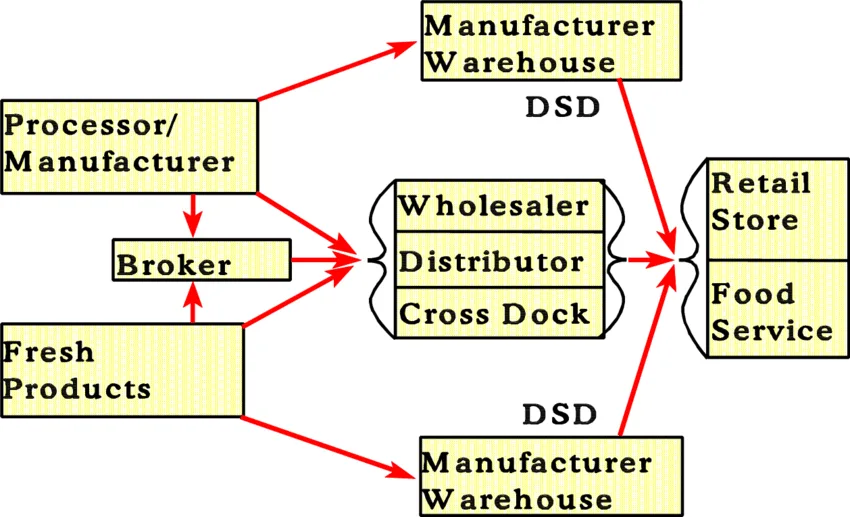
Global Supply Chain
RRHS APHG 2025-2026
Agriculture is a practice that is about as “local” as an economic activity can get it
happens on the ground in a given location and is susceptible to an infinite number of
variables including fluctuations in local weather and local politics. Such variables,
however, make it very challenging to study agriculture too “zoomed in”. So, like other
topics in geographic study, geographers “zoom out” too look at the big picture. There
is a significant amount of simplification in explaining the global supply chain, as
simplification is necessary to understand patterns rather than being overwhelmed
by too many details. Maps must also contain simplified data in order to allow
visualizations to take form.
Benefits of a global supply chain:
1. Lower Costs. While it's important to factor in things like freight costs and shipping
time, the cost savings from purchasing goods from other countries can be significant.
.. 2. Greater Variety. Different foods grow in different parts of the world. The desire
for variety was what inspired the explorers to set off to new locations (i.e., the silk
road, the Indian ocean trade routes, European exploration, etc.)
3. Broader Perspective on Business. Businesses that operate in multiple nations learn
from each other to improve their practices (more on this in our Industry unit)
4. Higher Volume more produced
1
5. International Customers more markets
1
Global Supply Chain
Export
commodities
Infrastructure
Export
processing
zones
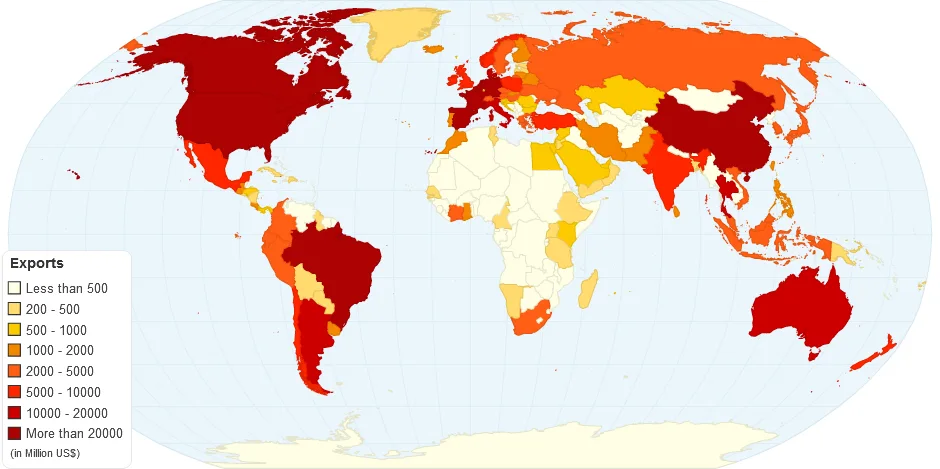
An Export Commodity is a raw material or agricultural product that is produced and
sold primarily for export to another country. The map above shows export of food
products (by millions of $US) the darker red the country, the higher the value of the
total food exports. Notice that many of the top food exporting countries are More
Developed countries. Keep in mind that these countries tend to have a wide variety
of exports, from food to highly specialized consumer goods; conversely, the countries
showing lower total value of food exports here may be much more dependent on the
revenue from those food exports as they make up a greater portion of the economic
activity within the country.
Commodity exporters include countries with large deposits of natural resources or
large amounts of farmland. Sometimes, the country has a populations too small to
use all their own resources. Other times, the export commodity system has been set
up through colonialism (historically) or neocolonialism (contemporary). The trade of
many commodity exporters is dominated by a single commodity (such as bananas,
coffee, sugarcane, etc.). Most least developed countries are reliant on agricultural or
mineral exports (even though, according to the map above, the total value of their
exports is low when compared to more developed countries).
2
/ 28
End of Document
109

FAQs

what is global supply chain

A global supply chain refers to the interconnected systems that manage the flow of goods and services across international borders.

  • It involves various stages, including production, processing, and distribution.
  • Understanding global supply chains is crucial for businesses aiming to optimize operations and reduce costs.

how does global supply chain work

The global supply chain operates by coordinating the production and distribution of goods through various stakeholders across different countries.

  • It involves sourcing raw materials, manufacturing products, and delivering them to consumers.
  • Efficient logistics and communication are essential for managing these complex networks.

what are the benefits of global supply chains

Global supply chains offer numerous benefits, including cost savings, access to diverse markets, and increased efficiency.

  • They allow companies to leverage lower production costs in different countries.
  • Access to a wider variety of products enhances consumer choice and satisfaction.

what challenges does global supply chain face

Global supply chains face challenges such as political instability, trade restrictions, and environmental factors.

  • Natural disasters and geopolitical tensions can disrupt supply routes and availability of goods.
  • Companies must develop strategies to mitigate these risks and ensure continuity.

how does political relationship affect global supply chain

Political relationships significantly impact global supply chains by influencing trade agreements, tariffs, and regulations.

  • Positive diplomatic ties can facilitate smoother trade operations and lower costs.
  • Conversely, tensions can lead to sanctions and trade barriers, complicating supply chain logistics.