Unit 8 of the Economic Environment in India course focuses on the public sector’s role in India’s economic development. It explores the definition of public sector enterprises, their contributions to employment generation, infrastructure development, and balanced regional growth. The unit also addresses the challenges faced by public enterprises, including management inefficiencies and financial losses. Additionally, it discusses the shift towards privatization and the implications for the economy. This material is essential for students studying commerce and economics, particularly those interested in public sector dynamics.

Key Points

  • Explains the role of public sector enterprises in India’s economic development
  • Covers challenges faced by public enterprises, including inefficiencies
  • Discusses the impact of privatization on the Indian economy
  • Highlights the importance of public sector in employment generation and infrastructure
Sariq khan
24 pages
Language:English
Type:Textbook
Sariq khan
24 pages
Language:English
Type:Textbook
Sariq khan
24 pages
Language:English
Type:Textbook
194

Economic Environment in India – Unit 8: Public Sector pdf

/ 24
DCM1206: Economic Environment in India Manipal University Jaipur (MUJ)
Unit 8 : Public Sector in India 1
BACHELOR OF COMMERCE
SEMESTER 2
DCM1206
ECONOMIC ENVIRONMENT IN INDIA
DCM1206: Economic Environment in India Manipal University Jaipur (MUJ)
Unit 8 : Public Sector in India 2
Unit 8
Public Sector in India
SL
No
Topic
Fig No / Table /
Graph
SAQ /
Activity
Page No
1
Introduction
-
-
3
1.1
Learning Objectives
-
-
2
Introduction to Public Sector in India
1, 2
1
4 - 6
3
Role of Public Sector in Economic
Development
3
2
7 - 11
4
Problems of Public Sector
-
3
12 - 15
5
A Shift From Public Sector: Emergence of
Privatisation
-
4
16 - 18
6
Concept Map
4
-
19
7
Summary
-
-
20
8
Glossary
-
-
21
9
Terminal Questions
-
-
21
10
Answers
-
-
22 - 24
11
Suggested Books and E-References
-
-
24
Table of Contents
DCM1206: Economic Environment in India Manipal University Jaipur (MUJ)
Unit 8 : Public Sector in India 3
In the previous unit, you learned about the role of private sector in India. Before the
emergence of the private sector, the public sector fulfilled the specific objectives of planning
in India. When India gained independence, there were serious gaps in the industrial
structure of the country. Essential goods industries required large capital investment. Due
to the lack of funds, the private sector could not come forward to establish such industries,
therefore public sector succeeded in filling up these gaps through rapid industrialization.
The industries in the public sector are primarily set up for the welfare of the workers, as well
as the society. The profits made are utilized towards financing the economic development of
the country. Though there are many shortcomings of the public sector such as ineffective
management, lack of financial controls, wastage of resources, and unstable pricing policy.
Still, the pc sector has provided large employment and contributed to the saving rate and
capital formation in the economy. It has provided the industrial base to the economy such as
infrastructure. Based on the serious role played by the public enterprises, there is a need to
understand the status of the public sector enterprises in the country.
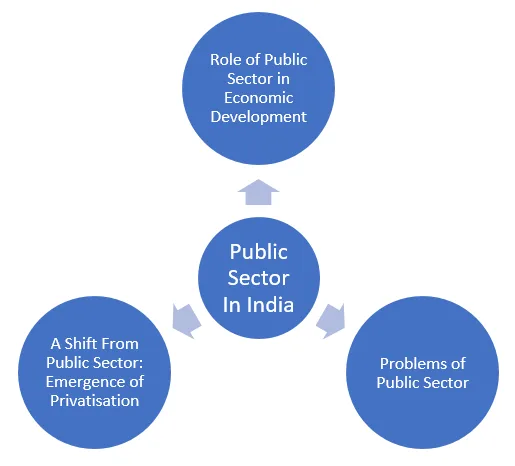
In this unit, you will learn about the concept of public sector in India and the role of public
sector in economic development. The unit will detail about the problems of public sector and
the shift from public sector to private sector.
1.1 Learning objectives
After studying this unit, you should be able to:
Explain the concept of public sector in India
Describe the role of public sector in economic development
Elaborate on the problems of public sector
Discuss about the shift from public sector
1. INTRODUCTION
/ 24
End of Document
194

FAQs

What defines a public sector company in India?
In India, a public sector company is defined as a company in which the Union Government, State Government, or any Territorial Government owns a share of 51% or more. Certain sectors, such as railways, police, taxation, atomic energy, and explosive materials, are reserved exclusively for government ownership. The Industrial Policy Resolution of 1956 categorized industries that remain under government control, emphasizing the role of public enterprises in achieving socio-economic objectives.
What are the main roles of the public sector in economic development?
The public sector plays several crucial roles in the economic development of India. It promotes economic development by filling gaps in the industrial structure and provides infrastructural facilities essential for growth. Additionally, it undertakes economic activities in strategically significant areas, checks monopolies, promotes balanced regional development, and reduces disparities in income and wealth. The sector also creates employment opportunities and enhances self-reliance by reducing dependence on foreign aid and technology.
What problems does the public sector in India face?
The public sector in India faces numerous challenges, including poor project planning, unclear objectives, and over-capitalization. Many public enterprises do not earn reasonable returns compared to their substantial investments due to issues like ineffective management, overstaffing, and lack of financial controls. Delayed public projects lead to increased costs, and excessive overheads contribute to financial losses. Political interference further hampers the efficiency and autonomy of public enterprises.
How has privatization affected the public sector in India?
The shift from public sector to privatization began in 1991, marking a significant change in India's economic landscape. This transition was driven by factors such as the external debt crisis and the need for economic liberalization. The liberalization regime led to the restructuring and consolidation of Indian industry, increasing the role of the private sector in various fields, including agriculture, education, and services. As a result, the private sector now plays a pivotal role in driving economic growth and development.
What are the categories of public enterprises in India?
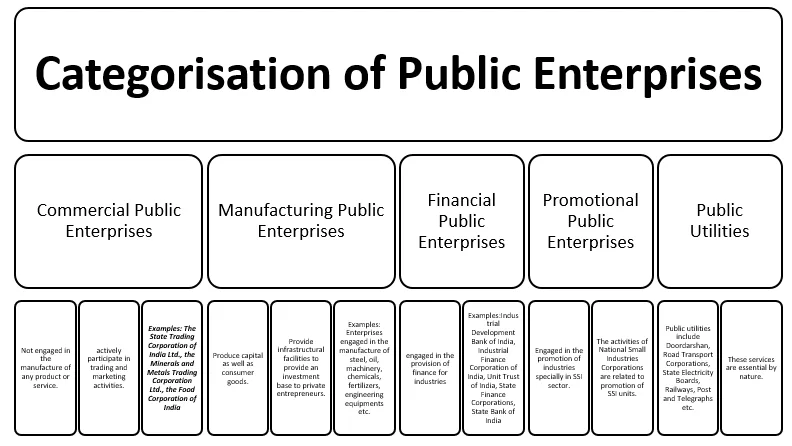
Public enterprises in India are categorized into several types, including Commercial Public Enterprises, Manufacturing Public Enterprises, Financial Public Enterprises, Promotional Public Enterprises, and Public Utilities. Each category serves different functions, with manufacturing enterprises producing both capital and consumer goods, while commercial enterprises focus on services without engaging in manufacturing. This categorization helps in understanding the diverse roles these enterprises play in the economy.
What is the significance of balanced regional development in the public sector?
Balanced regional development is a crucial objective of the public sector, aiming for uniform distribution of planned investments across various regions. This approach helps eliminate regional disparities in income and wealth, thereby improving living standards in less developed areas. Public sector industries often focus on establishing facilities in backward regions, providing essential services and infrastructure that transform socio-economic conditions. Examples include the establishment of steel plants and fertilizer factories in underdeveloped areas.
How does the public sector contribute to employment generation?
The public sector is a significant source of employment in India, accounting for about two-thirds of total employment in the organized industrial sector. It creates millions of jobs and improves working and living conditions for workers. Public enterprises also protect jobs by taking over sick units and provide stable employment linked to benefits such as retirement and health care. This role is vital for maintaining community safety and productivity.