The Indian Banking System and Performance Evaluation focuses on the structure and functions of banking in India, including key regulations such as the RBI Act and the Banking Regulation Act. It discusses the roles of scheduled and non-scheduled banks, development banks, and cooperative banks. This unit is essential for students and professionals in banking and finance, providing insights into financial statements and the evaluation of banking performance. It serves as a foundational resource for understanding the Indian banking landscape and its regulatory framework.

Key Points

  • Explains the structure of the Indian banking system, including scheduled and non-scheduled banks.
  • Covers key regulations like the RBI Act, Banking Regulation Act, and Negotiable Instruments Act.
  • Details the functions of banks, including accepting deposits and granting loans.
  • Discusses the importance of financial statements in evaluating bank performance.
Gugan
25 pages
Language:English
Type:Lecture Notes
Gugan
25 pages
Language:English
Type:Lecture Notes
168
/ 25
BA4003 BANKING AND FINANCIAL SERVICES
UNIT I
INTRODUCTION TO INDIAN BANKING SYSTEM
AND PERFORMANCE EVALUATION
1) Overview & Structure of Indian Banking System
2) Functions of Indian Banking
3) Key Regulations in Indian Banking sector
4) RBI Act, 1934/2006
5) Banking Regulation Act,1949
6) Negotiable Instruments Act 1881/2002
7) Provision for NPA’s
8) Overview of Financial Statements of banks
Balance Sheet
Income Statement
9) CAMEL
1) INDIAN BANKING SYSTEM & STRUCTURE
I) INDIAN BANKING SYSTEM
The Reserve Bank is the central bank in India
The banking system in India works under the guidelines of RBI
A bank is a financial institution and its purpose is
o To receive deposits (Savings and Current accounts)
o Provides credit to individuals and business (loans and Credit Cards)
o Invest funds in securities for returns and Safeguard people’s money
II) STRUCTURE OF THE INDIAN BANKING SYSTEM
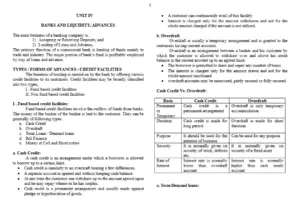
The banking system of India can be broadly divided into three as below
I) Scheduled banks II) non-scheduled banks and III) development banks
I) Scheduled Banks
Banks that are included in the second schedule of the Reserve Bank of India Act,1934 are
scheduled banks.
All scheduled banks enjoy the following facilities:
Such a bank becomes eligible for debts/loans on bank rate from the RBI
Such a bank automatically acquires the membership of a clearing house
Scheduled banks are further divided into 1) commercial and 2) cooperative banks.
1) Commercial Banks
The institutions that accept deposits from the general public and advance loans with the
purpose of earning profits are known as Commercial Banks.
Commercial banks can be broadly divided into i) public sector ii) private sector
iii) foreign banks and iv) RRBs.
i) Public Sector Banks:
The majority stake is held by the government. After the recent amalgamation of smaller banks
with larger banks, there are 12 public sector banks in India as of now.
An example of Public Sector Bank is State Bank of India.
RBI
Scheduled
Banks
Commercial
Banks
Public Sector
Banks
Private
Sector Banks
Foreign Bank
Regional
Rural Banks
Cooperative
Banks
Rural
Cooperative
Banks
Urban
Cooperative
Banks
Non-
Scheduled
Banks
Development
Banks
IFCI IDBI EXIM SIDBI NABARD
ii) Private Sector Banks:
The major stakes in the equity are owned by private stakeholders or business houses.
A few major private sector banks in India are HDFC Bank, Kotak Mahindra Bank, ICICI
Bank etc.
iii) Foreign Bank:
Foreign Bank has headquarters outside India but runs its offices as a private entity within
India.
Such banks are operating under the regulations provided by the Reserve Bank of India and
parent organization located outside India.
An example of Foreign Bank in India is Citi Bank.
iv) Regional Rural Banks (RRB):
Regional Rural Banks (RRB) were established under the Regional Rural Banks
Ordinance,1975 with the aim of credit for agriculture and other rural sectors.
The area of operation of RRBs is limited to the area notified by the Government.
RRR are owned jointly by the Government of India, the State Government and Sponsor
Banks.
An example of RRB in India is Arunachal Pradesh Rural Bank.
2) Cooperative Banks
A Cooperative Bank is a financial entity that belongs to its members, who are also the owners
as well as the customers of the bank.
They provide their members with numerous banking and financial services.
Cooperative banks support of agricultural activities, some small-scale industries and self-
employed workers.
II) NON-SCHEDULED BANKS
All banks which are not included in the second section of the Reserve Bank of India Act,1934
are Non-Scheduled Banks.
They are not eligible to borrow from the RBI for normal banking purpose except for
emergencies.
III) DEVELOPMENT BANKS
Development Banks are financial institutions that provide long-term credit to support capital-
investments for long period at low rates of interest are known as Development Banks.
The major development banks in India are:
1) Industrial Finance Corporation of India (IFCI) 1948,
2) Industrial Development Bank of India (IDBI) 1964,
3) Export-Import Banks of India (EXIM) 1982,
4) Small Industries Development Bank of India (SIDBI) 1989,
5) National Bank for Agriculture and Rural Development (NABARD) 1982.

/ 25
End of Document
168

FAQs

What are the main functions of the Indian banking system?
The Indian banking system primarily performs two major functions: accepting deposits and granting loans and advances. Accepting deposits involves mobilizing public funds and providing a safe custody for savings, while granting loans allows banks to support businesses and individuals. Additionally, banks offer various types of deposit accounts, including savings, fixed, current, and recurring deposits, each with distinct features and interest rates.
What is the structure of the Indian banking system?
The Indian banking system is broadly divided into scheduled banks, non-scheduled banks, and development banks. Scheduled banks include commercial and cooperative banks, while commercial banks are further categorized into public sector banks, private sector banks, foreign banks, and regional rural banks. Development banks provide long-term credit for capital investments and include institutions like the Industrial Development Bank of India (IDBI) and the National Bank for Agriculture and Rural Development (NABARD).
How does the Reserve Bank of India regulate banks?
The Reserve Bank of India (RBI) regulates the banking system through the Banking Regulation Act of 1949. This act provides a framework for the supervision and regulation of all banks, granting the RBI the authority to issue licenses and set operational guidelines. Specific regulations include requirements for foreign banks, foreign direct investment limits, and norms for establishing new banks. The RBI also ensures compliance with various acts related to banking operations, such as the Foreign Exchange Management Act.
What are Non-Performing Assets (NPA) in the banking context?
Non-Performing Assets (NPA) refer to loans and advances that are overdue for more than 90 days. The RBI defines NPAs based on criteria such as overdue installments and accounts that are out of order. NPAs are classified into three categories: substandard assets, doubtful assets, and loss assets, each with specific criteria regarding the duration and nature of the overdue amounts. The presence of NPAs is detrimental to the banking system as it reduces profitability and capital adequacy.
What types of deposits do Indian banks accept?
Indian banks accept various types of deposits, including savings deposits, fixed deposits, current deposits, and recurring deposits. Savings deposits encourage saving habits among the public and offer low interest rates with no withdrawal restrictions. Fixed deposits require money to be locked in for a specified period, offering higher interest rates. Current deposits are primarily for businesses and allow overdraft facilities, while recurring deposits involve regular contributions over time, yielding compounded interest.
What is the CAMELS rating system in banking?
The CAMELS rating system is an international framework used to evaluate financial institutions based on six factors: Capital adequacy, Asset quality, Management, Earnings, Liquidity, and Sensitivity to market risk. Each factor is rated from one to five, with one being the best. A bank with an average score of less than two is considered high-quality, while scores above three indicate less-than-satisfactory institutions. This system helps regulators assess the overall health and stability of banks.
What are the key regulations governing the Indian banking industry?
Key regulations governing the Indian banking industry include the Reserve Bank of India Act, 1934, which establishes the RBI's functions, and the Banking Regulation Act, 1949, which provides a framework for bank supervision. Other important regulations include the Foreign Exchange Management Act, 1999, and various RBI guidelines on capital adequacy and ownership of banks. These regulations ensure that banks operate within a structured environment to maintain financial stability.