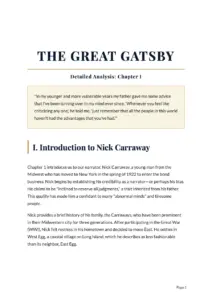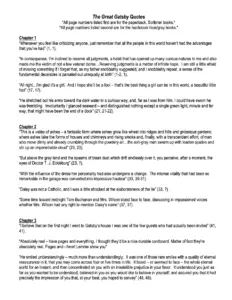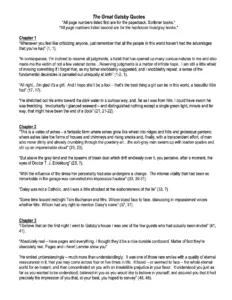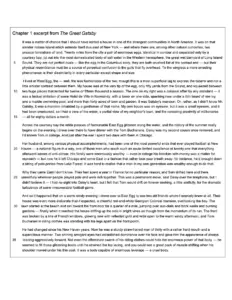
The Great Gatsby, written by F. Scott Fitzgerald, explores themes of wealth, class, and the American Dream through the eyes of narrator Nick Carraway. This summary provides detailed chapter breakdowns, highlighting key events and character developments throughout the novel. Readers will gain insights into the lives of Jay Gatsby, Daisy Buchanan, and Tom Buchanan, as well as the social dynamics of the 1920s. Ideal for students and literature enthusiasts, this summary aids in understanding the complex narrative and its historical context.

Key Points

  • Summarizes each chapter of The Great Gatsby, focusing on character arcs and themes
  • Explains the significance of the American Dream as depicted in the novel
  • Highlights the social class distinctions between East Egg and West Egg
  • Discusses the impact of wealth and moral decay in the 1920s setting
newtopiccyclegrowin
Author:F. Scott Fitzgerald
5 pages
Language:English
Type:Study Guide
newtopiccyclegrowin
Author:F. Scott Fitzgerald
5 pages
Language:English
Type:Study Guide
376
/ 5
The Great Gatsby
c Pearson Education Limited 2008
The Great Gatsby - Teacher’s notes 1 of 5
Teacher’s notes LEVEL 5
PENGUIN READERS
Teacher Support Programme
About the author
F. Scott Fitzgerald was a so-called ‘Jazz Age’ novelist
and short-story writer who is considered to be one of
the greatest American writers of the twentieth century.
His most famous and respected novel, The Great Gatsby
(1925), is one of the most penetrating descriptions of
American life in the 1920s.
Born in St. Paul, Minnesota, on 24 September 1896,
Francis Scott Key Fitzgerald was named after his ancestor
Francis Scott Key, the writer of the American national
anthem, The Star-Spangled Banner. Fitzgerald grew up
in Minnesota and enrolled at Princeton University in
1913. Although he became a prominent figure in the
literary life of the university, he struggled academically
and never graduated. He joined the army in November
1917. While stationed in Montgomery, Alabama, he
met and fell in love with Zelda Sayre, the daughter of an
Alabama Supreme Court judge. Zelda agreed to marry
him, but she broke off the engagement because of her
overpowering desire for wealth and leisure. With the
publication of This Side of Paradise (1920), Fitzgerald
became a celebrity. He finally convinced Zelda to marry
him. With his new wealth and fame, Fitzgerald fell into a
lavish lifestyle of parties and decadence. At the same time,
he was desperate to write something ‘serious’. He moved
to France with Zelda and their daughter Frances, in 1924,
and he completed The Great Gatsby. In the 1930s, they
tried to save their marriage unsuccessfully: Fitzgerald
constantly had money worries and became alcoholic, and
Zelda suffered a nervous breakdown. In 1937, however, he
managed to acquire work as a script-writer in Hollywood.
There he met and fell in love with Sheilah Graham, a
Hollywood columnist. For the rest of his life, Fitzgerald
lived quietly with Ms. Graham. Occasionally he went
East to visit Zelda and Frances. On December 21, 1940,
Fitzgerald died of a heart attack at the age of forty-four,
leaving his last novel The Last Tycoon unfinished.
Many of these events in the real life of Fitzgerald appear in
The Great Gatsby, published in 1925. Like Fitzgerald, Nick
Carraway is a thoughtful young man from Minnesota,
educated at an Ivy League school, who moves to New York
after the war. Also similar to Fitzgerald is Jay Gatsby, a
sensitive young man who idolises wealth and luxury and
who falls in love with the daughter of a wealthy family
while stationed at a military camp in the South.
Summary
The narrator, Nick Carraway, lives in the West Egg district
of Long Island. His next-door neighbour is a mysterious
man called Jay Gatsby. Nick is a young man from a
prominent Midwestern family. In some sense, the novel
is Nicks memoir, his unique view of the events of the
summer of 1922.
Chapter 1: Soon after arriving in New York, Nick visits
his relative, Daisy Buchanan, and her husband, Tom.
The Buchanans live in the posh Long Island district of
East Egg. Tom is obsessed with the preservation of class
boundaries. At the Buchananss, Nick meets Jordan Baker,
a professional golf player. Hints are given about problems
in Tom and Daisys marriage: Tom has been having an
affair. After visiting Tom and Daisy, Nick goes home to
West Egg; there, he sees Gatsby gazing at a mysterious
green light across the bay. Gatsby stretches his arms out
towards the light, as though to catch and hold it.
Chapter 2: Tom Buchanan takes Nick into New York
City, and on the way they stop at the garage owned by
George Wilson. Wilson is the husband of Myrtle, with
whom Tom has been having an affair. Tom tells Myrtle to
join them later. In the city, they have a vulgar party in the
flat that Tom keeps for the affair. The more she drinks, the
more aggressive Myrtle becomes; she begins to taunt Tom
about Daisy, and Tom strikes her and breaks her nose.
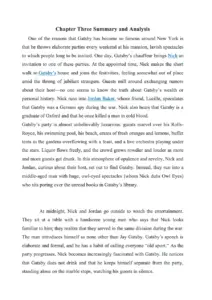
Chapter 3: Nick is invited to a party at Gatsbys mansion,
where he runs into Jordan Baker. At the party, few people
know Gatsby; even fewer are formally invited. During
the party, Nick finally meets Gatsby: he has a remarkable
smile, and uses ‘old sport’ as a term of endearment. Later,
Gatsby speaks to Jordan Baker alone, and afterwards she
tells Nick that she has learned something amazing. She
cannot yet share it with him, however. Nick and Jordan
become romantically involved.
F. Scott Fitzgerald
The Great Gatsby
c Pearson Education Limited 2008
The Great Gatsby - Teacher’s notes 2 of 5
Teacher’s notes LEVEL 5
PENGUIN READERS
Teacher Support Programme
Chapter 4: Gatsby takes Nick to lunch. On the way
Gatsby tells Nick that his parents died and left him a
lot of money and that he went to war and later attended
Oxford University. Nick is sceptical of the story. At lunch,
Gatsby introduces Nick to his business associate, Meyer
Wolfsheim. Later, Jordan Baker tells Nick the story of
Gatsby: he had been in love with Daisy when they met
in Louisville before the war. Gatsbys extravagant lifestyle
and wild parties are simply an attempt to impress Daisy.
Gatsby bought the house to be close to Daisy. This
is where Nick fits in. Gatsby wants Nick to arrange a
meeting between himself and Daisy.
Chapter 5: Nick invites Daisy to tea and tells her not to
bring Tom. Gatsby comes over to inspect everything to
make sure that the tea goes perfectly. After an initially
awkward reunion, Gatsby and Daisy re-establish their
connection. Gatsby has meticulously planned their
meeting: he gives Daisy a carefully rehearsed tour of
his mansion, and is desperate to exhibit his wealth and
possessions. The love between Gatsby and Daisy is revived.
Chapter 6: Nick learns the true story of Gatsbys past.
He was born James Gatz in North Dakota, but changed
his name at the age of seventeen. The gold baron, Dan
Cody, served as Gatsbys mentor until his death. Although
Gatsby inherited nothing of Codys fortune, Gatsby had
created a persona and found something that he wanted to
achieve at all costs. Gatsby has become wealthy through
illegal activities with the sole intention of winning back
Daisy. He believes that she is the key to perfect happiness.
While out horseback riding, Tom Buchanan happens
upon Gatsbys mansion. There he meets both Nick and
Gatsby. Tom looks down on the new rich like Gatsby
as he is from an established upper class family. Despite
this, Tom and Daisy come to the next party at Gatsbys.
There, he is extremely rude and condescending towards
Gatsby. Daisy also seems to be unhappy at the party which
frightens Gatsby. He tells Nick that he will make things
right with her and they will be able to go back to how they
once were.
Chapter 7: Gatsby stops throwing his lavish parties. The
only reason he threw such parties was the chance that
Daisy (or someone who knew her) might attend. On a
hot summer’s day Daisy invites Gatsby, Nick and Jordan
to lunch at her house. Tom figures out what is going
on between Gatsby and Daisy and becomes very upset.
They decided to drive into the city: there, at the Plaza
Hotel, Tom and Gatsby have a bitter confrontation. Tom
denounces Gatsby for his low birth, and reveals to Daisy
that Gatsbys fortune has been made through being a
bootlegger (illegally selling alcohol during Prohibition).
When Gatsby asks her to say that she never loved Tom,
she cant say it. Tom scornfully sends her back to East Egg
with Gatsby.
Chapter 8: When Nick, Jordan, and Tom drive through
the valley of ashes, however, they discover that Gatsbys car
has hit and killed Myrtle, Toms lover. They rush back to
Toms house in East Egg, where Nick learns from Gatsby
that Daisy was driving the car when it struck Myrtle, but
that Gatsby intends to take the blame. Nick asks Gatsby
to go back with him but Gatsby wants to wait outside the
house to make sure that nothing happens to Daisy.
Chapter 9: Early the next morning Nick goes over to
check up on Gatsby. He has been at Daisys all night
just watching to see if she was safe. He and Nick stay up
talking about Gatsbys past. Nick has to leave Gatsby to
get to work. After Nick leaves, Gatsby decides to go use
his pool and relax. George Wilson was looking for Gatsby.
Someone had told him that Gatsby was involved. George
has leapt to the conclusion that the driver of the car that
killed Myrtle must have been her lover. George, believing
Gatsby to be at fault, decides to avenge her death. He
finds Gatsby in the pool and shoots him dead. He then
kills himself as well.
Chapter 10: After the murder, Daisy and Tom leave town
without leaving any means of being contacted. Nick is
left to organise Gatsbys funeral, but few people attend
the funeral. Nick ends his relationship with Jordan and
decides to move back to the Midwest. He has figured out
that Tom was the one who told Wilson that it was Gatsby
who ran over Myrtle. Nick thinks of Gatsby, and the role
of the past in dreams of the future.
Background and themes
The Jazz Age (the Roaring Twenties): The Jazz Age
began soon after World War I and ended with the stock
market crash of 1929. Prohibition, the ban on the sale
and consumption of alcohol, made millionaires out of
bootleggers. The period saw the beginning of a new
style of music which combined ragtime and blues. It
was an exciting time, but its basis was money and the
extravagances that money could buy. This emptiness was
in sharp contrast to the purity of the American Dream

The Great Gatsby
c Pearson Education Limited 2008
The Great Gatsby - Teacher’s notes 3 of 5
Teacher’s notes LEVEL 5
PENGUIN READERS
Teacher Support Programme
which held that anyone could succeed if they strove to
improve themselves and anyone could get wealthy through
hard work and perseverance.
The American Dream: The American Dream was
originally about discovery and the pursuit of happiness.
The 1920s, however, was an era of decayed social and
moral values, when prosperity and material excess have
corrupted this dream, especially on the East Coast. The
unrestrained desire for money and pleasure surpassed more
noble goals. In the novel, Nick thinks of the disintegration
of the American Dream as Gatsbys dream crumbles.
Class: During the Roaring Twenties anyone from any
social background could make a fortune, but there was a
class structure. Fitzgerald uses a geographical motif. West
Egg represents the newly self-made millionaires, East Egg
the American aristocracy, i.e. families with old wealth. The
East Egg crowd scorned the new rich in West Egg. Toms
attitude towards Gatsby is typical of this class. Ultimately
this wide class gulf is the reason why Daisy chooses to stay
with her husband, who is from the same class as she is.
Irresponsibility: Fitzgerald portrays how people could use
their position to look down on others and live their lives
not caring about other people. Tom and Daisy exemplify
this stereotype. Tom cheats on Daisy, Daisy often goes
over to Gatsbys, and they run away from the scene of
Myrtle’s death. Despite their respectable social status,
their actions are, selfish and inconsiderate. They live their
irresponsible lives thinking only of themselves because
they think they are in a class above other people. They
can use their wealth and position to escape whatever they
choose.
Discussion activities
Chapter 1
Before reading
1 Discuss: Talk about the title.
Start a whole-class discussion by asking the following
questions: Why do you think the novel is called The
Great Gatsby? In what ways can a person be great?
2 Guess:
Have students look through the book at the
titles of the chapters. Put students into pairs to guess
and discuss what kind of story they think this will be.
After reading
3 Role play: Ask students to work in pairs. They role
play the telephone conversation between Tom and
Myrtle while Nick is having dinner at the Buchananss
house.
4 Discuss:
Have students re-read page 8 where Daisy
tells Nick what she said when her daughter was born.
Ask them the following question: Daisy says, ‘Im glad
it’s a girl. And I hope she’ll be a fool – that’s the best
thing a girl can be in this world, a beautiful little fool.
Why do you think she says that? Students could discuss
in pairs or small groups. Ask them to share their
opinions with the class later on.
Chapter 2
Before reading
5 Discuss: Talk about the characters.
Put students into small groups. Ask them to list the
names of the characters from Chapter 1. Have them
remind each other what each character is like. Later,
ask some students to report to the class.
After reading
6 Discuss: Put students into small groups to discuss
why Fitzgerald brings in the following points:
the piles of ash
the eyes of Dr Eckleburg
Chapter 3
Before reading
7 Discuss: Talk about Gatsby.
Have a whole class discussion on Gatsby:
In this
chapter, Nick finally meets Mr. Gatsby. What kind of
information on him have you got so far?
After reading
8 Discuss: Talk about Gatsby.
Ask students to work in pairs. They make two lists:
facts they know about Gatsby
rumours about Gatsby
Then ask students to work in bigger groups to
compare their lists. Tell students to complete their
final lists of facts and rumours because the will need
them later (activity 20).
9 Discuss:
Put students into pairs or small groups.
Elicit the answers to the following question: Gatsby
finally appears in a speaking role in this chapter. Why do
you think Fitzgerald delays Gatsbys appearance?
10 Discuss:
Talk about Nick and Jordan.
Remind students of a conversation between Nick and
Jordan about driving a car. Have students work in
pairs or small groups to discuss the following
questions:
Why did they start this conversation?
Do you think Jordan is safe as long as she doesnt
meet another bad driver?
What changed their relationship?
What is Nick going to do?
/ 5
End of Document
376

FAQs

What is the significance of the green light in The Great Gatsby?
The green light symbolizes Gatsby's hopes and dreams for the future, particularly his desire to reunite with Daisy Buchanan. In Chapter 1, Gatsby is seen reaching out towards this mysterious light across the bay, representing his longing for a life he has idealized. As the story progresses, it becomes clear that this light represents not only his love for Daisy but also the elusive nature of the American Dream, highlighting the gap between aspiration and reality.
How does Tom Buchanan's character influence the plot of The Great Gatsby?
Tom Buchanan is a pivotal character whose actions drive much of the conflict in the novel. He is portrayed as arrogant and racist, obsessed with maintaining class boundaries. His affair with Myrtle Wilson and his confrontational nature lead to significant events, including the confrontation at the Plaza Hotel in Chapter 7, where he exposes Gatsby's past and wealth. Tom's disdain for Gatsby and the new rich ultimately contributes to the tragic outcomes of the story, showcasing the theme of class struggle.
What are the main themes explored in The Great Gatsby?
The Great Gatsby explores several key themes, including the American Dream, class disparity, and irresponsibility. The American Dream is depicted as corrupted by materialism and the pursuit of wealth, particularly during the Jazz Age. Class differences are illustrated through the geographical divide between East Egg and West Egg, representing old money versus new money. Irresponsibility is exemplified by characters like Tom and Daisy Buchanan, who act selfishly without regard for the consequences of their actions, leading to tragic results.
How does Nick Carraway serve as a narrator in The Great Gatsby?
Nick Carraway serves as the novel's narrator and provides a unique perspective on the events and characters. Coming from a prominent Midwestern family and educated at an Ivy League school, he moves to West Egg and becomes entangled in the lives of Gatsby and the Buchanans. Nick's reflective and observant nature allows readers to see the complexities of the other characters, particularly Gatsby, while also revealing his own moral judgments. His role as both participant and observer highlights the themes of disillusionment and the quest for identity.
What events lead to Myrtle Wilson's death in The Great Gatsby?
Myrtle Wilson's death occurs in Chapter 8 after she is struck by Gatsby's car, which Daisy is driving. The events leading up to this tragic incident involve a series of confrontations and tensions between Tom Buchanan, Gatsby, and Daisy. Tom discovers the affair between Gatsby and Daisy and becomes increasingly aggressive. During a drive, Myrtle, believing Gatsby is in the car, rushes into the road, resulting in her being hit. This incident underscores the recklessness of the characters and the consequences of their actions.
What is the outcome of Jay Gatsby's pursuit of Daisy Buchanan?
Jay Gatsby's pursuit of Daisy Buchanan ultimately ends in tragedy. Despite his lavish parties and wealth, which he amassed in hopes of rekindling their past romance, Gatsby's dream is unattainable. In Chapter 7, during a confrontation with Tom, Daisy is unable to fully commit to Gatsby, revealing the complexities of her feelings. After Myrtle's death, Gatsby takes the blame for the accident, showcasing his devotion to Daisy. However, his life ends abruptly when George Wilson, seeking revenge for Myrtle's death, kills him, highlighting the futility of his dreams.