Overview
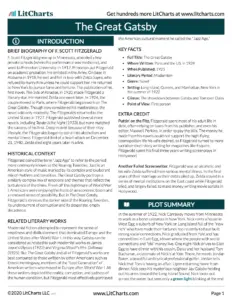
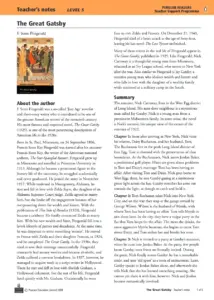
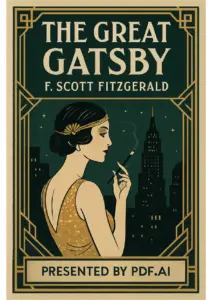
Written by the American writer F. Scott Fitzgerald in
1925, The Great Gatsby is one of the greatest
American novels of the twentieth century and arguably Fitzgerald’s seminal text. It is set in the
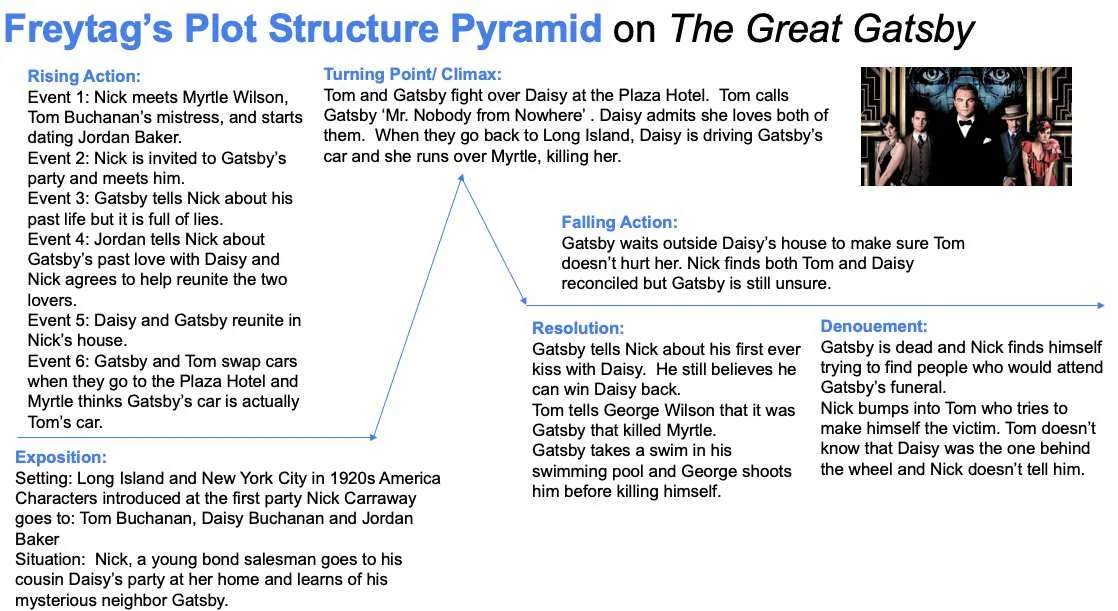
summer of 1922 in New York. It has 9 chapters and is framed by Nick Carraway, an unreliable
narrator. The story follows Nick’s memories of Jay Gatsby, a man who still loves Daisy
Buchanan, now a married woman. Gatsby tries to impress Daisy, who lives across the bay from
him, with his extravagant and lavish parties. But Gatsby’s hopes and dreams of winning Daisy
are crumbled when he faces her husband, the cruel Tom Buchanan. The Great Gatsby explores
the Roaring Twenties, The American Dream, class and grapples with the past and future. In
doing so, it captures the spirit, excitement, and violence of the era Fitzgerald named ‘The Jazz
Age’. Indeed, through the symbols of the green light, the eyes of Doctor T. J. Eckleburg, the
valley of ashes, the friction between the east and west and Gatsby’s mansion, The Great
Gatsby is a classic story of hope and disillusion.
Genre and Structure
Fitzgerald was writing in the
Modernist period where technological change was rapid and this
meant society was moving towards modernity. But throughout, Fitzgerald’s poetic language
suggests his inspiration from the Romantic age.
Some critics argue that Fitzgerald was influenced by the English Romantic poet, John Keats. In
his ‘Ode to a Nightingale’, Keats’s speaker is torn between the enchanting nature of death and
the uncertainty of life. Perhaps Fitzgerald alludes to this through Daisy. When Daisy sees a
nightingale in The Great Gatsby, she says “It’s romantic, isn’t it, Tom?”. Perhaps Daisy is
enchanted by its poetic symbol. This moment ends with the “shrill” of the telephone. This shows
how modernity kills the beauty of nature, it cuts it off and thus, the conflict between science and
nature arises. Fitzgerald was also influenced by the great Modernist poet, T. S. Eliot (he called
himself a “worshipper” of Eliot’s poetry. We see the influence of Eliot’s seminal poem ‘The Waste
Land’ in the novel. The Valley of Ashes alludes to this wasteland and both writers criticise
modernity and its ruin of nature.
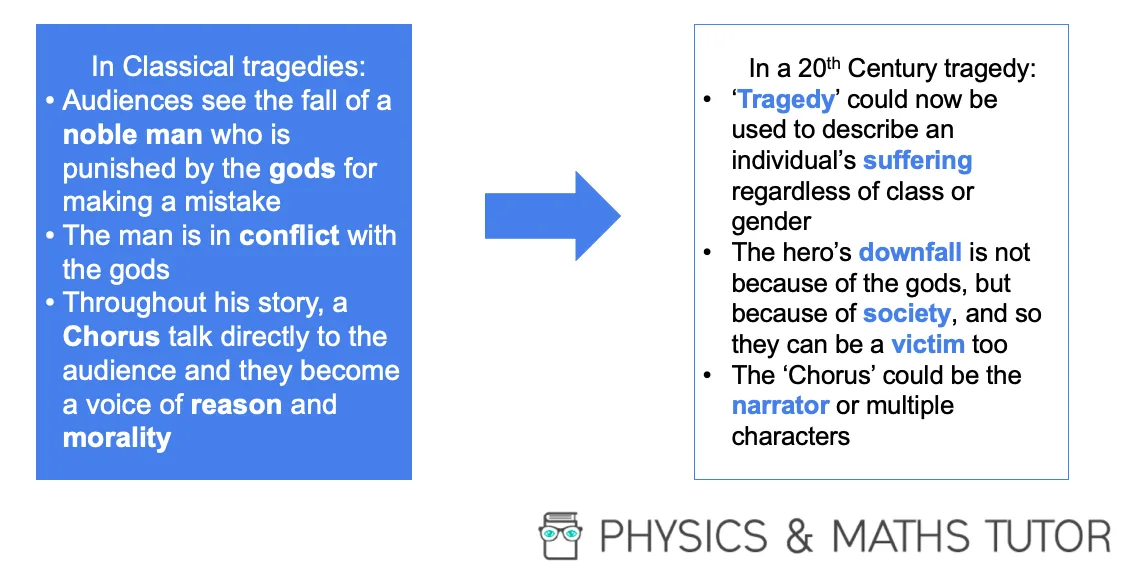
The Great Gatsby is a novel about America in the 1920s. Many readers consider The Great
Gatsby as a 20th-century tragedy. If we can understand what a classical tragedy entails, then we
can extrapolate this into its modern equivalent.