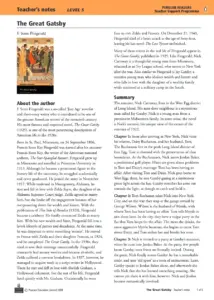
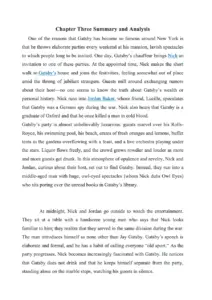
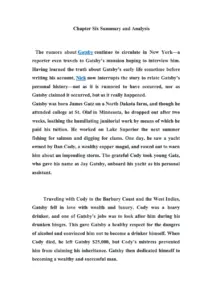
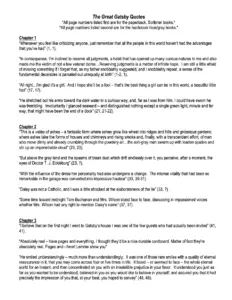
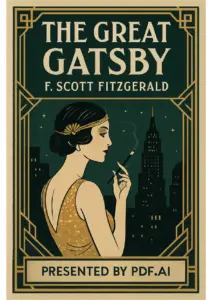
The Great Gatsby by F. Scott Fitzgerald introduces readers to Nick Carraway, the narrator, who recounts his experiences in 1922 New York. This chapter establishes the social divide between West Egg and East Egg, highlighting the differences between 'new money' and 'old money.' Key characters such as Tom and Daisy Buchanan are introduced, revealing their complex relationship and societal tensions. Themes of disillusionment, class struggles, and moral decay are explored through Nick's observations and interactions. This summary is ideal for students and readers seeking to understand the foundational elements of this classic American novel.

Key Points

  • Introduces Nick Carraway, the narrator of The Great Gatsby.
  • Establishes the social divide between West Egg and East Egg.
  • Highlights the characters Tom and Daisy Buchanan and their troubled marriage.
  • Explores themes of disillusionment and moral decay in the 1920s.
  • Sets the stage for Gatsby's mysterious character and his aspirations.
newtopiccyclegrowin
Author:F. Scott Fitzgerald
6 pages
Language:English
Type:Book Summary
newtopiccyclegrowin
Author:F. Scott Fitzgerald
6 pages
Language:English
Type:Book Summary
373
/ 6
THE GREAT GATSBY
Detailed Analysis: Chapter I
"In my younger and more vulnerable years my father gave me some advice
that I've been turning over in my mind ever since. 'Whenever you feel like
criticizing any one,' he told me, 'just remember that all the people in this world
haven't had the advantages that you've had.'"
I. Introduction to Nick Carraway
Chapter 1 introduces us to our narrator, Nick Carraway, a young man from the
Midwest who has moved to New York in the spring of 1922 to enter the bond
business. Nick begins by establishing his credibility as a narrator—or perhaps his bias.
He claims to be "inclined to reserve all judgments," a trait inherited from his father.
This quality has made him a confidant to many "abnormal minds" and tiresome
people.
Nick provides a brief history of his family, the Carraways, who have been prominent
in their Midwestern city for three generations. After participating in the Great War
(WWI), Nick felt restless in his hometown and decided to move East. He settles in
West Egg, a coastal village on Long Island, which he describes as less fashionable
than its neighbor, East Egg.
Page 1
II. The Two Eggs
Fitzgerald immediately establishes the central geographical and social divide of the
novel:
West Egg: Nick's residence. It is "new money," home to the "nouveau riche" who
lack social connections and aristocratic pedigree. Nick lives in a small bungalow
("an eyesore") squeezed between two massive mansions.
East Egg: Across the bay, home to the "old money" aristocracy. These are the
established wealthy families who look down upon the flashy displays of West Egg
residents.
"I lived at West Egg, the—well, the less fashionable of the two,
though this is a most superficial tag to express the bizarre
and not a little sinister contrast between them."
Page 2
III. The Dinner at the Buchanans
The core of the chapter involves Nick driving to East Egg to have dinner with his
second cousin once removed, Daisy Buchanan, and her husband, Tom, whom Nick
knew slightly at Yale. The Buchanans’ house is described in grandiose terms—a
cheerful red-and-white Georgian Colonial mansion overlooking the bay.
Tom Buchanan
A former football star at Yale, Tom is described as a "sturdy straw-haired man of
thirty" with a "hard mouth and a supercilious manner." He is aggressive,
physically imposing, and intensely arrogant. He represents the brutal side of old
money—restless, bored, and slightly threatening.
Daisy Buchanan
Daisy is ethereal and magnetic. Her most striking feature is her voice, which Nick
describes as having a "singing compulsion" and sounding like "money." She
exudes a charmed, superficial innocence that masks a deeper melancholy or
cynicism.
Jordan Baker
A professional golfer and friend of Daisy’s. She is cool, aloof, and "slender, small-
breasted," with an erect carriage. She seems perpetually bored by the world
around her, adding to the atmosphere of upper-class ennui.
Page 3
/ 6
End of Document
373

FAQs

Who is the narrator of The Great Gatsby and what is his background?
The narrator of The Great Gatsby is Nick Carraway, a young man from the Midwest. He moves to New York in the spring of 1922 to enter the bond business. Nick comes from a prominent family in his Midwestern city and has participated in World War I, which left him feeling restless. He settles in West Egg, a coastal village on Long Island, which he describes as less fashionable than its neighbor, East Egg.
What are the main differences between West Egg and East Egg?
West Egg is where Nick lives and is characterized as 'new money,' home to the 'nouveau riche' who lack social connections and aristocratic pedigree. In contrast, East Egg is home to the 'old money' aristocracy, established wealthy families who look down upon the flashy displays of West Egg residents. Nick describes West Egg as the less fashionable of the two, highlighting a significant social divide between them.
What is revealed about Tom Buchanan during the dinner at the Buchanans?
During the dinner at the Buchanans, Tom Buchanan is portrayed as an aggressive and arrogant individual, described as a 'sturdy straw-haired man of thirty' with a 'hard mouth.' He represents the brutal side of old money, revealing his racism by discussing a book that argues the 'white race' is in danger. This conversation exposes Tom's insecurities and desire to maintain his status through exclusivity and dominance.
How does Daisy Buchanan express her views on gender roles?
Daisy Buchanan expresses her views on gender roles during dinner when she states that she hopes her daughter will be a 'beautiful little fool.' This remark highlights her cynicism about the limited agency women possessed in the 1920s aristocratic circles. Daisy's wish reflects the societal expectations placed on women and suggests that ignorance may be preferable in a world that marginalizes them.
What significant symbol is introduced in Chapter 1 and what does it represent?
In Chapter 1, the significant symbol introduced is the green light that Gatsby is seen reaching toward. This green light, described as 'minute and far away,' represents Gatsby's hopes and dreams, particularly his yearning for the unattainable past, specifically his desire for Daisy. The moment captures Gatsby's longing and sets the stage for the themes of aspiration and disillusionment that permeate the novel.
What does Nick Carraway think of the Buchanans' lifestyle?
Nick Carraway feels 'confused and a little disgusted' by the Buchanans' lifestyle. He observes that despite their wealth, they have no intention of changing their lives, which are marked by unhappiness. He describes them as 'careless people' who use their wealth as a shield, suggesting a critique of the moral decay and superficiality of the upper class.
How is Jordan Baker characterized in Chapter 1?
Jordan Baker is characterized as a professional golfer and a friend of Daisy's. She is described as cool and aloof, with a 'slender, small-breasted' figure and an erect carriage. Her demeanor conveys a sense of perpetual boredom with the world around her, which contributes to the atmosphere of upper-class ennui present during the dinner at the Buchanans.