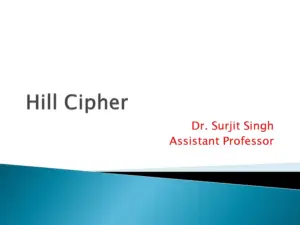
Polyalphabetic Cipher Vigenère by Dr. Surjit Singh
The Polyalphabetic Cipher Vigenère, authored by Dr. Surjit Singh, explores the intricacies of polyalphabetic substitution ciphers. It delves into the historical significance of the Vigenère cipher, its operational mechanics, and the algebraic descriptions that underpin its functionality. This resource is ideal for students and enthusiasts of cryptography seeking to understand advanced encryption techniques. Key topics include the Tabula Recta, encryption and decryption processes, and practical examples of cipher application. The document serves as a comprehensive guide for those studying cryptography at an academic level.
Key Points
Explains the historical context and significance of the Vigenère cipher in cryptography.
Describes the operational mechanics of polyalphabetic substitution ciphers.
Includes detailed examples of encryption and decryption using the Vigenère method.
Covers the algebraic representation of the Vigenère cipher for advanced understanding.
Presents the Tabula Recta as a critical tool in the encryption process.
This link leads to an external site. We do not know or endorse its content, and are not responsible for its safety. Click the link to proceed only if you trust this site.
Acceleration of a Trolley on an Inclined Plane ExperimentStudy Guide
PDFStudy Guide
AIIMS Exam Preparation Guide for NEET AspirantsStudy Guide
FAQs
What is the Vigenère cipher and how does it work?
The Vigenère cipher is a method of encrypting alphabetic text by using a series of interwoven Caesar ciphers based on the letters of a keyword. It employs a Tabula Recta, a table of alphabets arranged in a specific order, to facilitate encryption and decryption. Each letter of the plaintext is transformed based on the corresponding letter of the keyword, making it more secure than simple monoalphabetic ciphers. The cipher's complexity comes from its use of multiple substitution alphabets, which significantly increases the difficulty of cryptanalysis.
How is the Tabula Recta used in the Vigenère cipher?
The Tabula Recta is a crucial component of the Vigenère cipher, serving as a table that displays the alphabet in a shifted manner across multiple rows. Each row corresponds to a letter of the keyword, allowing for different substitution rules to be applied at each position of the plaintext. When encrypting, the letter from the plaintext is matched with the appropriate row from the Tabula Recta based on the keyword letter, facilitating the transformation into ciphertext. This method enhances the security of the cipher by utilizing multiple alphabets.
What are the advantages of using polyalphabetic ciphers like Vigenère?
Polyalphabetic ciphers, such as the Vigenère cipher, offer significant advantages over monoalphabetic ciphers by utilizing multiple substitution alphabets. This complexity makes it much harder for cryptanalysts to decipher the text without knowledge of the keyword. The use of a repeating keyword allows for a more secure encryption process, as the same letter can be encrypted differently depending on its position in the text. This method effectively mitigates frequency analysis attacks that are common against simpler ciphers.
What is the algebraic description of the Vigenère cipher?
The algebraic description of the Vigenère cipher involves representing letters as numbers, where A=0, B=1, and so forth up to Z=25. The encryption process can be expressed mathematically as Ci = (Mi + Ki) mod 26, where Ci is the ciphertext letter, Mi is the plaintext letter, and Ki is the key letter. For decryption, the formula is Mi = (Ci - Ki) mod 26. This algebraic framework provides a clear understanding of how the cipher operates and allows for easier implementation in programming and cryptographic applications.
Related
PDFStudy Guide
NEET Chemistry Study Guide for Aspiring Medical StudentsStudy Guide
PDFStudy Guide
9th Grade Literature Vocabulary Units 1 and 2Study Guide
PDFStudy Guide
Cornell Notes System for Effective Note TakingStudy Guide
PDFStudy Guide
Corporate Analysis and Valuation Unit 2 Study NotesStudy Guide
PDFStudy Guide
Corporate Analysis and Valuation Study Notes Semester 4Study Guide
PDFStudy Guide
Business Management Paper 1 Case Study Spanish 2024Study Guide