Language education in Nigeria explores the complexities of multilingualism and the impact of language policies on literacy and instruction. It discusses the challenges of using mother tongues in education, including teacher competency and resource availability. The document examines the role of English and indigenous languages in the educational system, highlighting the need for effective communication across diverse linguistic backgrounds. It also presents research findings on the benefits of mother tongue education and the implications for national integration and development. This resource is essential for educators, policymakers, and researchers interested in language education in Nigeria.

Key Points

  • Analyzes the impact of Nigeria’s National Policy on Education regarding language use in schools.
  • Explores the benefits of mother tongue education in enhancing student performance and understanding.
  • Discusses the challenges of implementing multilingual education in a diverse linguistic landscape.
  • Presents research findings on language proficiency and its effects on learning outcomes.
Cryptedmike
11 pages
Language:English
Type:Report
Cryptedmike
11 pages
Language:English
Type:Report
256
/ 11
Reason for Renewed Interest in Language in Relation to Education in Nigeria.
i. The introduction of the universal primary education in September 1976 has led to
children from different linguistic backgrounds finding their wy into the formal school system.
These had meant that languages which have previously not been considered to be vital for initial
literacy mainly on account of paucity of speakers are now candidates for such use. Besides the
question of which language was to be used as medium of instruction at which level which
generally has been left to local initiative to resolve in an ad-hoc manner now had to be tackled in
all seriousness and preferably as matter of policy at the national level.
ii. The publication of the federal republic of Nigeria National Policy on Education 1977
which for the first time; set in clear terms Government policy on language in education
immediately raises important questions on how the policy is to be implemented.
iii. Some of the projects in language in education which had been on-going in the country
notably the Ife Six Year Primary Project the Primary Education Improvement Project and the
Rivers Readers Project are now becoming known to a wider public interested in education.
iv. With the impending return to civilian rule in Nigeria questions were being raised again
mainly in the newspapers about a lingua franca for the country and the future role of English vis-
à
-vis the Nigerian language (Bamgbose 1977).
Issues in the Mother Tongues in Nigeria.
Obviosly Nigeria is a thoroughly multilingual country and the attendant problems of;
i. Not having competent teachers
ii. Unavailable learning facilities i.e. books and instructional materials
iii. The financial implications and coping with the demands of science and technology
Actually from inception of the mother tongue controversy three major objections have been
raised:
i. That the educational and psychological basis of the use of the mother-tongue in early
education has not been substantiated by experimentation.
ii. As an idea it is impracticable because of the large number of minority languages in
which literacy work is bound to be uneconomical.
iii. The need for a language of wider communication will necessarily restrict the scope of
education in the mother tongue.
However a pertinent question to as is:
i. Do the prospective students know the language well enough to learn effectively through
it?
ii. Would the proposed choice be consistent with overall national aim?
iii. Are the materials written in the language(s) adequate for use at the proposed level?
Consideration for Language Choice
Kelman (1971:40) suggested two functional considerations to guide the authorities to arrive at
language policies.
i. Patterns of communication that would enable the socio-economic institutions to
function most effectively and equitably in meeting the needs and interests of the population.
ii. Ensuring that different groups within the society varying in their linguistic repertoires
have equal access to the public system and to participate in it.
From the above it is suggested that language policy for Nigeria should serve the following
objectives:
i. Increased inter-ethnic communication leading to national integration through (a)
common indigenous language(s)
ii. Increased communication efficiency in our public institutions.
iii. Increased and easy access to knowledge of varying degree of technicality.
iv. Equal access to information in the public system leading to equal opportunities to
participate in the system.
v. Increased access to our indigenous literary arts and opportunities to participate in
contribute to and propagate them.
The benefits of mother tongue education
Despite all the problems of adopting the mother tongue as medium of instruction its benefits
are enumerated below:
i. It helps to obviate certain kinds of psychological dissonance on transition from home to
school.
ii. It facilitates and maximises the effectiveness of instructional and learning efforts.
iii. It generates respects and appreciation for indigenous institution.
There is the need to examine scholarly views on Mother Tongue Education from the results of
previous researches.
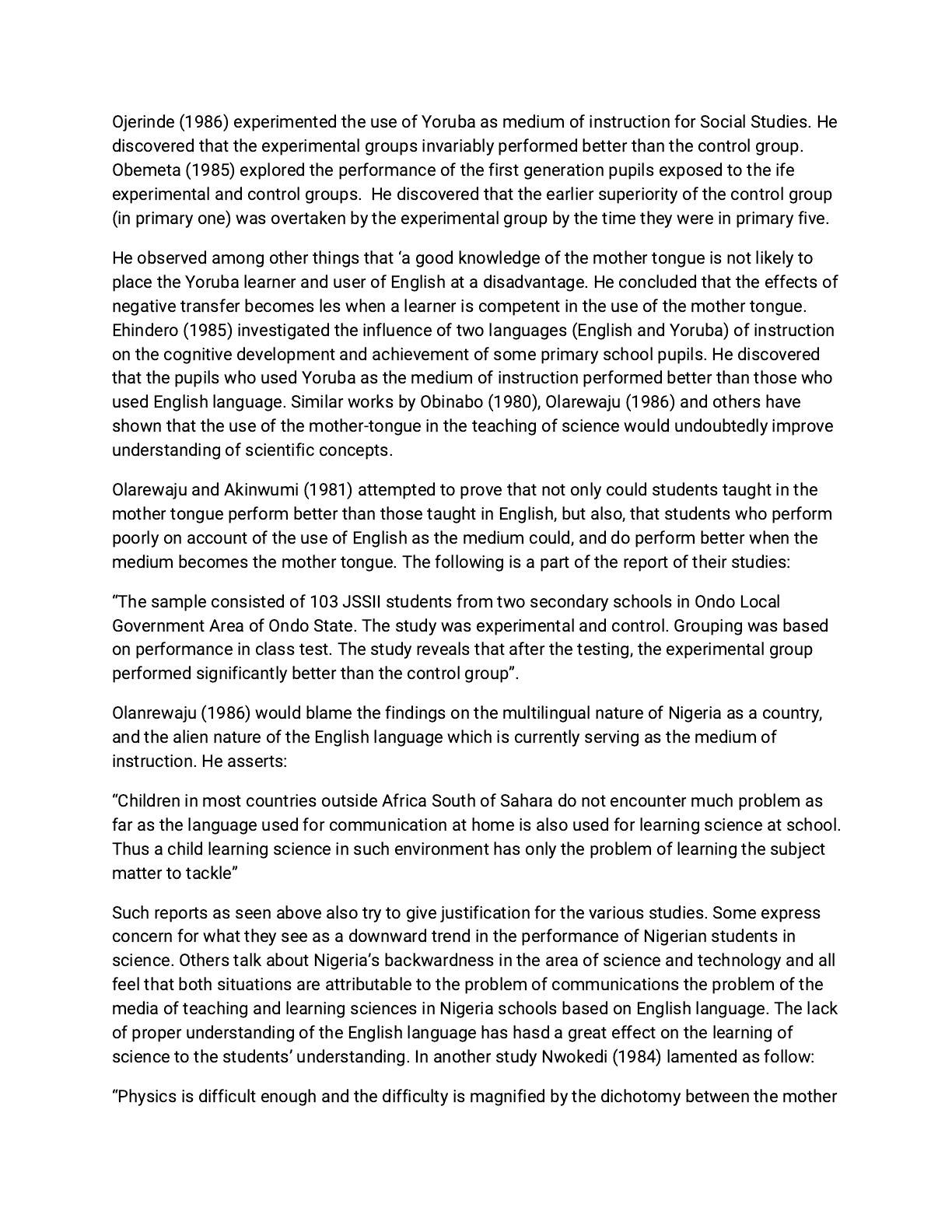
Ojerinde (1986) experimented the use of Yoruba as medium of instruction for Social Studies. He
discovered that the experimental groups invariably performed better than the control group.
Obemeta (1985) explored the performance of the first generation pupils exposed to the ife
experimental and control groups. He discovered that the earlier superiority of the control group
(in primary one) was overtaken by the experimental group by the time they were in primary five.
He observed among other things that
a good knowledge of the mother tongue is not likely to
place the Yoruba learner and user of English at a disadvantage. He concluded that the effects of
negative transfer becomes les when a learner is competent in the use of the mother tongue.
Ehindero (1985) investigated the influence of two languages (English and Yoruba) of instruction
on the cognitive development and achievement of some primary school pupils. He discovered
that the pupils who used Yoruba as the medium of instruction performed better than those who
used English language. Similar works by Obinabo (1980), Olarewaju (1986) and others have
shown that the use of the mother-tongue in the teaching of science would undoubtedly improve
understanding of scientific concepts.
Olarewaju and Akinwumi (1981) attempted to prove that not only could students taught in the
mother tongue perform better than those taught in English, but also, that students who perform
poorly on account of the use of English as the medium could, and do perform better when the
medium becomes the mother tongue. The following is a part of the report of their studies:
The sample consisted of 103 JSSII students from two secondary schools in Ondo Local
Government Area of Ondo State. The study was experimental and control. Grouping was based
on performance in class test. The study reveals that after the testing, the experimental group
performed significantly better than the control group
.
Olanrewaju (1986) would blame the findings on the multilingual nature of Nigeria as a country,
and the alien nature of the English language which is currently serving as the medium of
instruction. He asserts:
Children in most countries outside Africa South of Sahara do not encounter much problem as
far as the language used for communication at home is also used for learning science at school.
Thus a child learning science in such environment has only the problem of learning the subject
matter to tackle
Such reports as seen above also try to give justification for the various studies. Some express
concern for what they see as a downward trend in the performance of Nigerian students in
science. Others talk about Nigeria
s backwardness in the area of science and technology and all
feel that both situations are attributable to the problem of communications the problem of the
media of teaching and learning sciences in Nigeria schools based on English language. The lack
of proper understanding of the English language has hasd a great effect on the learning of
science to the students
understanding. In another study Nwokedi (1984) lamented as follow:
Physics is difficult enough and the difficulty is magnified by the dichotomy between the mother

/ 11
End of Document
256

FAQs

What are the main objectives of language policy in Nigeria?
The suggested language policy for Nigeria aims to achieve several key objectives. These include increased inter-ethnic communication leading to national integration through common indigenous languages, improved communication efficiency in public institutions, and enhanced access to knowledge across various technical fields. Additionally, the policy seeks to ensure equal access to information within the public system, thereby providing equal opportunities for participation. It also emphasizes the importance of fostering indigenous literary arts and encouraging participation in their propagation.
What are the benefits of mother tongue education in Nigeria?
Mother tongue education offers several significant benefits. It helps reduce psychological dissonance for children transitioning from home to school, thereby facilitating a smoother educational experience. Instruction in the mother tongue maximizes the effectiveness of learning efforts, leading to better academic performance. Furthermore, it fosters respect and appreciation for indigenous institutions, contributing to cultural preservation and identity.

What challenges does Nigeria face in implementing mother tongue education?
Nigeria encounters multiple challenges in implementing mother tongue education. Key issues include the lack of competent teachers who are proficient in various indigenous languages, insufficient learning materials such as books and instructional resources, and financial constraints related to the demands of science and technology education. Additionally, the multilingual nature of Nigeria complicates the establishment of a standardized approach to language use in education.
How does the National Policy on Education address language in schools?
The National Policy on Education (NPE) outlines specific language requirements for different educational levels. In primary school, children must study two languages: their mother tongue (if available) and English. In Junior Secondary School, students are required to learn three languages, including their mother tongue, English, and one of the major indigenous languages (Hausa, Igbo, or Yoruba). By Senior Secondary School, the requirement shifts to studying an indigenous language and English, promoting bilingualism and cultural awareness.
What are the three major dimensions of the National Language Question?
The National Language Question in Nigeria focuses on three major dimensions: national integration, education, and national development. These dimensions highlight the importance of language in fostering unity among diverse ethnic groups, enhancing educational outcomes through effective communication, and contributing to the overall development of the nation. Each aspect underscores the critical role that language plays in shaping Nigeria's socio-political landscape.
What are the constraints of mother tongue education identified in the report?
The report identifies several constraints affecting mother tongue education in Nigeria. These include historical constraints, which stem from colonial legacies; sociolinguistic constraints related to the diverse linguistic landscape; and socio-cultural constraints that impact acceptance and implementation. Economic constraints also play a role, as do theoretical and pedagogical challenges that hinder effective teaching practices. Lastly, political constraints affect the policy enforcement and prioritization of mother tongue education.
What findings were reported regarding the effectiveness of mother tongue instruction?
Research findings reported in the document indicate that students instructed in their mother tongue tend to perform better academically. For instance, Ojerinde's study showed that students using Yoruba as a medium of instruction for Social Studies outperformed those taught in English. Similar studies highlighted that students who struggled with English often excelled when taught in their mother tongue, suggesting that mother tongue instruction significantly enhances understanding and retention of subject matter.