Systems of Equations Answer Key for section 5.2.1 provides solutions to various problems related to systems of equations. It includes unit rate calculations, bike race progress analysis, and equation translations. This resource is ideal for students studying algebra and preparing for exams. The answer key covers multiple problems, including graphical interpretations and equation solving techniques, making it a valuable tool for understanding systems of equations.

Key Points

  • Provides solutions for systems of equations problems in section 5.2.1
  • Includes calculations for unit rates and time estimates
  • Analyzes bike race progress with graphical interpretations
  • Translates mathematical symbols into words for better understanding
newtopiccyclegrowin
2 pages
Language:English
Type:Worksheet
newtopiccyclegrowin
2 pages
Language:English
Type:Worksheet
315
/ 2
5.2.1 Introduction to Systems of Equations
Homework
Name ____________________________________________________ Period __________
Work through each of the problems below to practice the concepts from today’s lesson and review concepts
from previous lessons. Be sure to always show all work!
5-27. To ride to school, Elaine takes 7 minutes to ride 18 blocks. What is her unit rate (blocks per minute)?
Assuming she rides at a constant speed, how long should it take her to go 50 blocks? Justify your answer.
19.44 mins
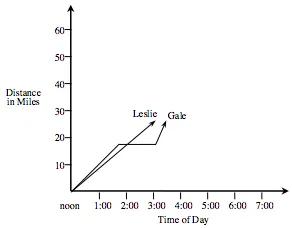
5-28. Gale and Leslie are riding in a friendly 60-mile
bike race that started at noon. The graph at right
represents their progress so far.
a. What does the intersection of the two lines
represent?
At 2:00 they had traveled the same
distance
b. At approximately what time did Leslie pass
Gale?
2:00 pm
c. About how far had Leslie traveled when she passed Gale?
≈ 18 miles
d. What do you think happened to Gale between 1:30 and 3:00?
Gale stopped to rest, got a flat tire, etc.
e. If Leslie continues at a steady pace, when will she complete the race?
At approximately 7:12 p.m.
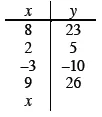
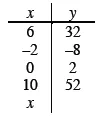
5-29. Write an equation (rule) for each of the
x
y
tables below.
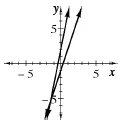
Then, on one set of axes, use each rule to graph.
y = 3x 1 y = 5x + 2
5-30. Translate each part below from symbols into words or from words into symbols.
a.
y
+ 8 the opposite of
y
increased by 8
b. 2
x
48 48 less than two times
x
c. (
x
+ 3)
2
the square of the sum of
x
and 3
d. The opposite of six times the square of a number. −6
x
2
e. A number multiplied by itself, then added to five.
x
·
x
+ 5
5-31. Solve each of the following equations for the indicated variable. Show all of your steps.
a.
y
= 2
x
5 for
x
b.
p
= −3
w
+ 9 for
w
x = w =
c. 2
m
6 = 4
n
+ 4 for
m
d. 3
x
y
= −2
y
for
y
m = 2n + 5 y = −3x
a.
b.
/ 2
End of Document
315

FAQs

What is Elaine's unit rate of riding blocks per minute?
Elaine takes 7 minutes to ride 18 blocks, which gives her a unit rate of approximately 2.57 blocks per minute. This is calculated by dividing the number of blocks (18) by the time taken in minutes (7). Assuming she maintains this constant speed, we can use this rate to determine how long it would take her to ride 50 blocks.
At what time did Leslie pass Gale during the bike race?
Leslie passed Gale at approximately 2:00 PM during their 60-mile bike race. This is indicated by the intersection of the two lines on the graph representing their progress. At this point, both riders had traveled the same distance, which is a key moment in the race.
How far had Leslie traveled when she passed Gale?
When Leslie passed Gale at 2:00 PM, she had traveled approximately 18 miles. This distance is inferred from the graph included in the document, which shows the progress of both riders up to that point.
What might have happened to Gale between 1:30 and 3:00 PM?
Between 1:30 and 3:00 PM, it is suggested that Gale may have stopped to rest or encountered an issue such as a flat tire. This inference is based on the graph, which shows a slowdown in Gale's progress compared to Leslie's steady pace during that time.
What is the equation for the relationship in the first x→y table?
The equation for the first x→y table is y = 3x - 1. This equation represents the linear relationship between x and y, where y is dependent on the value of x.
How do you express 'the opposite of y increased by 8' in symbols?
In symbols, 'the opposite of y increased by 8' is expressed as -y + 8. This phrase translates directly into mathematical notation, capturing the operation of negating y and then adding 8 to the result.
What is the solution for x in the equation y = 2x - 5?
To solve for x in the equation y = 2x - 5, you would rearrange the equation to isolate x. This involves adding 5 to both sides and then dividing by 2, resulting in x = (y + 5) / 2.